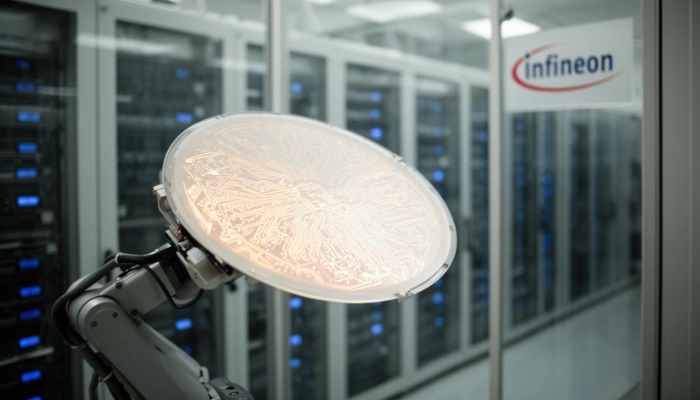
*Image from the internet; all rights belong to the original author, for reference only.
Infineon’s AI Power Growth Puts Capacity in Focus
Quick Take
- Infineon reported record fiscal Q3 revenue of €4.172 billion, with AI data center power solutions remaining its most important growth driver.
- The company has concluded or is negotiating multi-year AI customer capacity reservations with a cumulative value in the high single-digit billions of euros.
- The update supports stronger demand for power semiconductors but does not, by itself, confirm an industry-wide shortage or price increase.
Background
On August 5, 2026, Infineon reported record revenue for its fiscal third quarter and said power solutions for AI data centers remained its leading growth driver. The company also disclosed substantial multi-year capacity reservations and projected another sequential revenue increase for the fourth quarter. For engineers and component buyers, the update highlights how AI infrastructure growth is reaching beyond processors and memory into the power-conversion semiconductor supply chain.
Q1. What did Infineon announce this week?
Infineon reported fiscal Q3 2026 revenue of €4.172 billion for the quarter ended June 30, with a Segment Result of €797 million and a Segment Result Margin of 19.1%. The company characterized the revenue figure as a quarterly record.
For fiscal Q4, Infineon expects revenue to increase by slightly more than 13% sequentially to approximately €4.7 billion, based on an assumed exchange rate of US$1.15 per euro. It also expects a Segment Result Margin of about 23%.
The company now projects full-year revenue of approximately €16.3 billion. These outlook figures are management forecasts, not completed results, and remain subject to demand, production, currency and execution conditions.
Q2. What is new about its AI data center business?
The most important new disclosure is the scale of customer capacity planning. Infineon said it has concluded or is negotiating multi-year capacity reservation agreements with leading AI customers representing a cumulative revenue volume in the high single-digit billions of euros.
That wording requires care. Some agreements have been concluded, while others remain under negotiation; the total should therefore not be treated as a fully secured order backlog. Infineon also did not identify the customers, individual products, contract periods or guaranteed purchase volumes.
Nevertheless, capacity reservations are a stronger demand signal than a general statement about market interest. They indicate that customers and the supplier are planning power-semiconductor availability over multiple years.
Q3. Why do AI data centers need more power semiconductors?
AI accelerators increase rack-level power density, making efficient power conversion and thermal control increasingly important. Electricity must be converted and regulated through several stages—from grid and facility infrastructure to server power supplies, rack distribution and the low-voltage rails used by processors and accelerator cards.
Infineon addresses these stages with silicon power devices, SiC MOSFETs, GaN power devices, power-management ICs and gate-driver technologies. Silicon remains useful where cost, maturity and switching requirements favor it. SiC supports high-voltage, high-power conversion with lower losses, while GaN can enable high switching frequencies and compact power stages.
The quarterly announcement does not specify how much AI revenue comes from each technology, so no single device category should be presented as the sole beneficiary.
Q4. Which applications and components could be affected?
The most direct applications are AI server power supplies, rack-level power distribution, battery backup units, uninterruptible power supplies and data center grid infrastructure. Relevant component categories include power MOSFETs, SiC MOSFETs, GaN transistors, gate drivers, voltage regulators, current sensors and power-control ICs.
Demand can also extend to supporting hardware such as magnetics, high-current connectors, capacitors, busbars and thermal-management components. However, Infineon’s announcement primarily addresses its own semiconductor portfolio and does not confirm corresponding demand levels for every supporting component.
For engineering teams, the practical issue is architectural: higher rack power requires decisions about voltage level, conversion topology, efficiency, cooling, qualification and the balance between silicon and wide-bandgap devices.
Q5. Does this mean power semiconductors will become scarce or more expensive?
Not necessarily. Infineon confirmed strong AI-related demand and disclosed long-term capacity planning, but it did not announce a general allocation program, industry-wide shortage, price increase or broad lead-time extension.
Capacity reservations may help suppliers justify manufacturing investment and give customers greater supply visibility. They may also tighten availability for particular qualified products if demand grows faster than planned capacity. That remains a potential scenario rather than a confirmed current condition.
Buyers should therefore monitor lead times and authorized supply information at the manufacturer, package and part-number level. Demand growth in AI power cannot automatically be applied to automotive, industrial or consumer power components, even when products share a technology platform.
Q6. What should engineers and procurement teams watch next?
The first signal is execution: whether Infineon reaches its approximately approximately €4.7 billion fiscal Q4 revenue forecast and provides a higher AI power revenue outlook for fiscal 2027. Updates on manufacturing ramp-up and the conversion of negotiated capacity reservations into concluded agreements will also be important.
At the component level, teams should watch qualification status, package availability, lead times and the release of higher-power reference designs. Changes in server architecture—particularly higher-voltage rack distribution—could affect the mix of silicon, SiC and GaN devices.
There is no current basis for an emergency second-source exercise across all power components. For designs with concentrated exposure, however, maintaining approved alternatives and avoiding dependence on a single package can improve BOM resilience.
Conclusion
Infineon’s record quarter shows that AI infrastructure demand is increasingly visible in the power-semiconductor supply chain, not only in processors and memory. Its multi-year capacity discussions suggest that customers are planning beyond near-term server deployments, although they do not prove a market-wide shortage. The next meaningful signals will be manufacturing execution, completed capacity agreements and part-level lead-time trends—especially for high-efficiency SiC and GaN devices used in dense AI power systems.
© 2026 Win Source Electronics. All rights reserved. This content is protected by copyright and may not be reproduced, distributed, transmitted, cached or otherwise used, except with the prior written permission of Win Source Electronics.