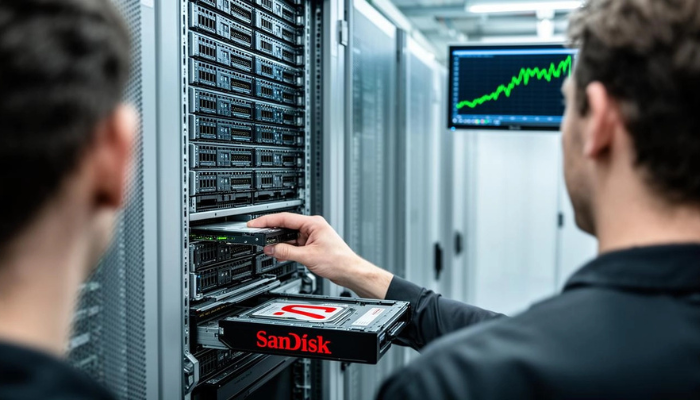
*Image from the internet; all rights belong to the original author, for reference only.
Sandisk Maps Out Denser QLC NAND for AI Data Centers
Quick Take
- Sandisk unveiled BiCS9 and BiCS10 QLC technologies as part of a new scaling strategy for increasingly storage-intensive AI workloads.
- The company says BiCS10 QLC can increase bit density by 60% compared with BiCS8, but commercial ramp details remain limited.
- Multiyear customer agreements may improve Sandisk’s capacity visibility, although they do not establish a market-wide NAND shortage or price trend.
Background
At its 2026 Investor Day in New York on August 13, Sandisk outlined a NAND flash roadmap built around BiCS9 and BiCS10 QLC, AI-focused storage products and longer-term customer agreements. The announcement matters because AI inference is increasing demand for high-capacity, power-efficient data-center storage, while NAND suppliers still have to balance new capacity against a historically cyclical market. Here are the main technical and supply-chain questions raised by the update.
Q1. What did Sandisk announce this week?
Sandisk introduced a two-dimensional scaling strategy based on its CMOS directly Bonded to Array, or CBA, architecture. The first new implementation is BiCS9 QLC, which combines what Sandisk describes as a proven BiCS8 memory array with CMOS technology derived from BiCS10. The company also presented BiCS10 QLC, saying it can provide 60% higher bit density than BiCS8.
The update was broader than a single NAND generation. Sandisk also discussed its HBF high-bandwidth flash technology, enterprise storage opportunities created by AI inference, and multiyear customer agreements intended to align demand more closely with future capacity planning. These are roadmap and business-model announcements; Sandisk did not say that all of the technologies are already shipping at high volume.
Q2. What is technically important about BiCS9 and BiCS10 QLC?
The key idea is that the NAND memory array and its CMOS control circuitry can be developed and combined with greater flexibility. In BiCS9 QLC, Sandisk is pairing a BiCS8-based array with newer CMOS circuitry. That approach could allow the company to improve performance or create workload-specific variants without changing every part of the NAND structure at the same time.
QLC NAND stores four bits per memory cell, supporting high capacity and a lower cost per bit than lower-density NAND types. The trade-offs can include endurance, latency and write-performance considerations, depending on the drive architecture and workload. The announced 60% density improvement for BiCS10 QLC is a company claim relative to BiCS8; it should not be treated as an independently verified 60% improvement in complete SSD performance.
Q3. Why does this matter for AI infrastructure?
AI inference can create large storage requirements beyond the HBM and DRAM located close to an accelerator. Models, vector databases, training data, inference results and key-value—or KV—cache data all need appropriate positions in the memory and storage hierarchy.
High-capacity QLC NAND can support data that must remain accessible but does not require the bandwidth or latency of HBM. Enterprise SSDs built with denser NAND may therefore help data-center operators store more data within a given physical and power envelope. Sandisk also expects the enterprise data-center flash market to reach 1.2 zettabytes by 2030, but that figure is the company’s forward-looking market estimate, not a confirmed shipment result.
HBF addresses a different part of the problem by seeking substantially higher flash bandwidth. It should not be described as a direct replacement for HBM or server DRAM.
Q4. Which components and applications could be affected?
The most direct applications are AI inference servers, enterprise storage arrays and data-center systems that need high-capacity flash close to compute resources. Relevant component categories include QLC NAND flash, enterprise SSDs, memory controllers, server memory and high-speed PCIe interfaces.
Denser NAND may also affect drive-level requirements. Controllers must manage error correction, wear leveling, firmware, data placement and thermal behavior, while server designers must evaluate sustained rather than peak performance. Power management ICs, connectors and supporting passive components remain part of the SSD and server design, but Sandisk’s announcement did not identify changes in their supply.
For procurement teams, the relevant comparison is not density alone. Qualification should consider endurance ratings, latency, power consumption, form factor, interface generation, firmware support and workload behavior.
Q5. Will the announcement affect NAND supply, prices or inventory?
No immediate market-wide supply or price change has been confirmed. BiCS10’s higher bit density could eventually increase the number of sellable bits produced from a given manufacturing base, but the effect depends on yield, manufacturing ramp, product mix and customer qualification. Sandisk did not disclose enough information to calculate an immediate capacity increase.
The company also said that new multiyear business-model agreements cover approximately 50% of its expected FY2027 bit volume and about two-thirds of FY2028 bit volume. These agreements include committed volumes, contractual frameworks, minimum financial guarantees and structured pricing mechanisms, according to Sandisk.
That may give Sandisk better demand visibility and reduce some exposure to short-term volatility. It does not prove that NAND prices will rise, remain stable or become less cyclical across the wider market.
Q6. What should engineers and buyers watch next?
The first signals should be product qualification, controller support and commercial shipment timing for BiCS9 and BiCS10-based enterprise SSDs. Buyers should also watch whether Sandisk publishes detailed endurance, performance, power and form-factor specifications for specific products rather than relying on array-level density claims.
For HBF, ecosystem development will be especially important. Controller availability, interface definitions, system demonstrations and named platform support will show whether the technology is progressing toward deployable infrastructure.
On the supply side, quarterly bit shipments, capital spending, manufacturing yields and the share of volume covered by longer-term agreements will provide better evidence than a single roadmap announcement. Changes in NAND contract pricing, distributor inventory and enterprise SSD lead times should be evaluated separately rather than assumed from AI demand alone.
Conclusion
Sandisk’s update connects denser QLC NAND, emerging high-bandwidth flash and longer-term customer agreements to the storage demands of AI inference. The roadmap could improve storage density and give the supplier greater visibility when planning NAND capacity, but it does not yet demonstrate a volume ramp or an industry-wide pricing change. The next meaningful signals will be qualified BiCS9 and BiCS10 products, detailed SSD specifications and evidence that HBF is gaining controller and system-level support.
© 2026 Win Source Electronics. All rights reserved. This content is protected by copyright and may not be reproduced, distributed, transmitted, cached or otherwise used, except with the prior written permission of Win Source Electronics.