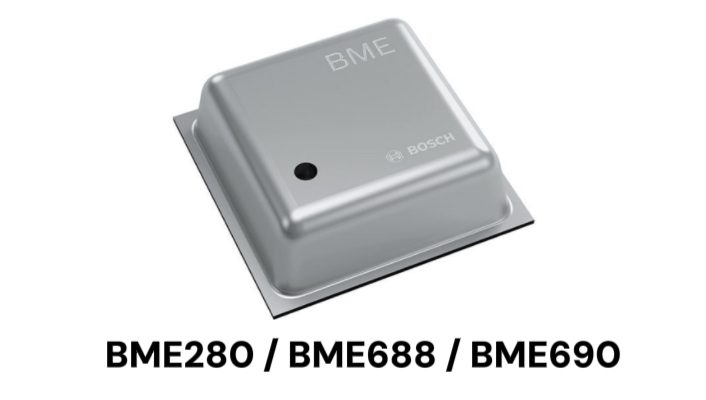
Temperature, relative humidity, and barometric pressure are fundamental environmental parameters in smart home products, wearables, environmental data loggers, air-quality monitors, and battery-powered IoT nodes. Applications that also need to assess air quality, odors, or specific gas mixtures require a gas-sensing element and suitable signal-processing algorithms.
The Bosch Sensortec BME280 integrates temperature, humidity, and pressure sensing. The BME688 and BME690 add a metal-oxide gas sensor. When used with BSEC and BME AI-Studio, they can provide air quality indices and application-specific gas classification.
This guide uses the compact, low-power, and widely adopted BME280 as a baseline for comparison with the BME688 and BME690.
Parameter Comparison
| Parameter | BME280 | BME688 | BME690 |
| Sensing capabilities | Temperature, relative humidity, and pressure | Temperature, relative humidity, pressure, and gas | Temperature, relative humidity, pressure, and gas |
| Package size | 2.5 × 2.5 × 0.93 mm | 3.0 × 3.0 × 0.93 mm | 3.0 × 3.0 × 0.93 mm |
| Supply voltage and interfaces | VDD: 1.71–3.6 V; I²C and SPI | VDD: 1.71–3.6 V; I²C and SPI | VDD: 1.71–3.6 V; I²C and SPI |
| Measurement ranges | −40 to 85°C; 0–100% RH; 300–1,100 hPa | −40 to 85°C; 0–100% RH; 300–1,100 hPa | −40 to 85°C; 0–100% RH; 300–1,100 hPa |
| Key measurement accuracy | Humidity: ±3% RH; pressure: ±1.0 hPa; temperature: ±0.5°C | Humidity: ±3% RH; pressure: ±0.6 hPa; temperature: ±0.5°C | Humidity: ±3% RH; pressure: ±0.5 hPa; temperature: ±0.5°C |
| Humidity response time | 1 s | 8 s | 1 s |
| Typical current consumption for temperature, humidity, and pressure measurement | 3.6 µA at 1 Hz; typical sleep current: 0.1 µA | 3.7 µA at 1 Hz; typical sleep current: 0.15 µA | 4.2 µA at 1 Hz; typical sleep current: 0.11 µA |
| Gas and air-quality capabilities | Not supported | Responds to VOCs, VSCs, and other gases; supports IAQ output and trainable gas-classification models | Similar capabilities to the BME688, with improved tolerance in condensation-prone environments |
| Gas-mode power consumption and positioning | No gas heater; ideal for basic, ultra-low-power environmental sensing | Approximately 90 µA in ULP mode, 0.9 mA in LP mode, and 3.9 mA for standard gas scanning; suited to established air-quality and odor-recognition solutions | Approximately 50 µA in ULP mode, 0.5 mA in LP mode, and 3.1 mA for standard gas scanning; suited to new designs that prioritize battery life and operation in high-humidity environments |
Application Fit
- BME280
Best for: Products that only need temperature, humidity, and pressure measurements, especially where low power consumption, compact size, and fast humidity response are important. Typical applications include temperature and humidity data loggers, weather stations, HVAC controllers, wearables, asset trackers, and battery-powered IoT nodes.
Key takeaway: The BME280 has a smaller 2.5 × 2.5 mm package than the two gas-sensing models. Its typical average current for humidity, pressure, and temperature measurements is only 3.6 µA at 1 Hz, while typical sleep current is 0.1 µA. It does not require a gas heater or BSEC software, which simplifies both hardware and software integration. If air-quality or odor detection is not required, the BME280 is usually the simplest and most energy-efficient choice.
- BME688
Best for: Products that need an air quality index, VOC or VSC response, or trained recognition of odors and gas mixtures. Typical applications include air-quality monitors, smart appliances, odor-detection systems, food-condition research, and environmental sensing terminals. It is also a strong choice for designs that benefit from the established BME688 hardware and software ecosystem.
Key takeaway: The BME688 provides raw gas-resistance measurements. With BSEC, it can also generate IAQ, bVOC, and CO₂-equivalent outputs. BME AI-Studio allows developers to train application-specific gas-classification models. When gas sensing is enabled, average current ranges from approximately 0.09 to 12 mA, depending on the operating mode. Battery-powered products must therefore calculate average power consumption using the actual measurement and update intervals.
- BME690
Best for: New designs that require the gas-sensing and AI capabilities of the BME688 but place greater emphasis on battery life, pressure accuracy, humidity response, or tolerance of humid and condensation-prone environments. Typical applications include wearable air-quality monitors, bathroom and kitchen sensors, home appliances, food-freshness research, and portable environmental monitoring nodes.
Key takeaway: The BME690 is a newer evolution of the BME688 platform. Typical current consumption in IAQ ULP mode is reduced from 90 µA to 50 µA. In LP mode, it decreases from 0.9 mA to 0.5 mA, while standard gas-scanning current falls from 3.9 mA to 3.1 mA. Absolute pressure accuracy improves to ±0.5 hPa, and humidity response time is reduced from 8 seconds to 1 second. AI training data and configurations must be collected specifically for the BME690. Models trained with BME688 data cannot be reused directly.
Design Considerations
- Confirm Whether Gas Sensing Is Really Required
Choose the BME280 when the application only needs temperature, humidity, pressure, altitude-change detection, or indoor climate control.
The main advantage of the BME688 and BME690 is their gas response and algorithm-based output. If these functions are not required, their larger package, additional software dependencies, and gas-heater power consumption usually offer little benefit.
- Distinguish Raw Gas Response, IAQ, and Actual Gas Concentration
The BME688 and BME690 are not selective analyzers designed to measure the concentration of a single gas directly. They first measure the resistance of a metal-oxide sensing layer. BSEC or a trained model then converts this response into outputs such as IAQ, gas classes, bVOC, or CO₂ equivalent.
CO₂-equivalent values are not direct CO₂ measurements. Applications requiring regulatory-grade measurements, reliable demand-controlled ventilation, or quantitative CO₂ data should use a dedicated NDIR or photoacoustic CO₂ sensor.
- Calculate Power Consumption and Self-Heating for the Actual Operating Mode
All three devices consume only microampere-level current when measuring temperature, humidity, and pressure. Once the gas heater is enabled on the BME688 or BME690, however, average current can rise to approximately 0.05–12 mA. Peak current may be higher.
The gas heater also raises the sensor temperature above ambient. As a result, the temperature reading is primarily intended for internal compensation. Applications that require accurate ambient-temperature measurements should optimize PCB thermal isolation, sampling timing, and enclosure ventilation. The finished product should be validated under representative thermal and airflow conditions; apply a temperature offset only if required.
- Account for Condensation, Enclosure Design, and Response Time
The humidity operating ranges in all three datasheets are specified for non-condensing conditions. The BME690 offers increased robustness for condensation-prone applications. This does not make it waterproof, nor does it guarantee full measurement accuracy during condensation or while the sensor is covered by liquid water.
Humidity response times are measured under specified airflow and step-change conditions. Protective membranes, filters, narrow ventilation openings, and stagnant air pockets inside an enclosure can significantly increase the response time of the finished product.
- Check the PCB, Driver, and Algorithm When Migrating
The BME280 uses a 2.5 × 2.5 mm package and is not footprint-compatible with the 3.0 × 3.0 mm BME688 or BME690. The BME688 and BME690 share the same package and pinout.
All three devices support I²C addresses 0x76 and 0x77, as well as I²C and SPI interfaces. However, the BME280 and the two gas-sensing models use different register maps, compensation formulas, and drivers. The BME688 and BME690 also use different variant IDs, and the BME690 has a dedicated Sensor API. When migrating, verify the Sensor API, BSEC version, configuration files, and production-test procedures.
Product Summary
| Part | Manufacturer | Recommended Use | Buy |
| BME280 | Bosch Sensortec | Ideal for products that only need temperature, humidity, and pressure measurements while prioritizing compact size, low power consumption, and straightforward software integration | Buy Now |
| BME688 | Bosch Sensortec | Ideal for designs that require an air quality index, VOC or VSC response, or application-specific odor recognition, while benefiting from a mature hardware and software ecosystem | Buy Now |
| BME690 | Bosch Sensortec | Ideal for new designs that require gas-sensing and AI capabilities while placing greater emphasis on battery life, pressure accuracy, humidity response, and tolerance of condensation-prone environments | Buy Now |
WIN SOURCE supplies Bosch Sensortec environmental sensors, including the BME280, BME688, and BME690. The final decision should consider sensing requirements, package size, operating-mode power consumption, software compatibility, enclosure airflow, and condensation conditions. Visit WIN SOURCE for real-time inventory and pricing.
©2026 Win Source Electronics. All rights reserved. This content is protected by copyright and may not be reproduced, distributed, transmitted, cached or otherwise used, except with the prior written permission of Win Source Electronics.