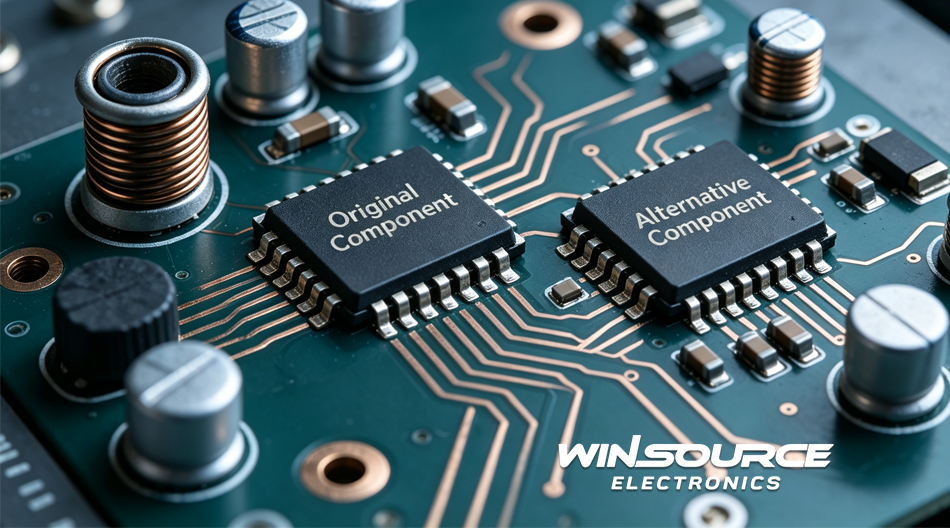
In industrial equipment, instrumentation, and other electronic systems with long product lifecycles, TPS62050DGSR may remain part of an established power design for many years. The device is an adjustable synchronous step-down converter in Texas Instruments’ TPS6205x family, supporting an input range of 2.7 V to 10 V, an adjustable output range of 0.7 V to 6 V, and up to 800 mA of output current. It also supports Power-Save Mode, fixed-frequency PWM operation, and external clock synchronization. For systems that have already been validated and maintained in production, continuing to use the original device can reduce redesign effort. However, sourcing or replacement decisions still require verification of electrical conditions, control configuration, external circuitry, and actual operating requirements.
1. What Should Be Verified When Continuing to Source TPS62050DGSR?
The complete ordering code should be identified accurately. In TPS62050DGSR, DGS refers to the 10-pin VSSOP package, while the R suffix indicates Large Tape & Reel packaging, with a standard quantity of 2,500 pieces per reel. For long-term BOM procurement, the manufacturer, complete part number, packaging format, labeling, and lot information should all be verified to avoid treating packaging-related suffix differences as functional device differences.
The original electrical conditions should also be reconfirmed. TPS62050 has a typical internal switching frequency of 850 kHz and supports external synchronization from 600 kHz to 1.2 MHz. It operates in fixed-frequency PWM mode at medium to high loads and can enter Power-Save Mode under light-load conditions. These operating modes can affect light-load efficiency, output ripple, and noise performance. When servicing or restarting production, the original SYNC and EN configurations, feedback network, and external component selection should therefore be reviewed.
For inventory that has been stored for an extended period, quality assessment should also consider the Date Code, packaging integrity, storage conditions, and traceability. Manufacturing date alone does not determine whether a device remains usable. Long-term storage may affect terminal condition, solderability, and package integrity, so acceptance should be based on the actual lot condition and relevant inspection or test results.
2. Replacing TPS62050DGSR Requires More Than Matching Rated Parameters
In replacement selection, input voltage, output voltage, and output current are only initial screening criteria. Further verification should cover pin definitions, feedback reference, switching frequency, enable logic, startup behavior, Power Good functionality, synchronization method, protection features, package dimensions, and operating temperature range. For TPS62050DGSR, the candidate device’s control behavior under both light-load and heavy-load conditions should also be checked against the original design. Similar headline ratings alone do not establish Pin-to-Pin or Drop-in compatibility.
The surrounding circuit is also an important part of the replacement assessment. The inductor, input and output capacitors, feedback resistors, and PCB layout all influence converter stability, transient response, output ripple, EMI, and thermal performance. If the candidate device uses a different control architecture, switching frequency, or compensation approach, the original external component values or PCB implementation may require adjustment. Replacement decisions should therefore be based on the schematic, BOM, PCB design, load range, and actual operating conditions rather than on a comparison of datasheet headline specifications alone.
3. System-Level Verification Is Important When Restarting Legacy Production
Even when the original part number is retained, a system that has not been manufactured for several years should undergo appropriate engineering verification based on changes in materials, manufacturing processes, and application conditions. Device lots, external components, PCB manufacturing conditions, and load environments may differ from those used during the original production phase. Verification can include startup and steady-state output, light-load and heavy-load performance, output ripple, temperature rise, and system behavior under abnormal operating conditions.
TPS62050 has a maximum rated output current of 800 mA and supports up to 100% duty-cycle operation to reduce the input-to-output voltage differential when the input voltage approaches the output voltage. Actual operating capability still depends on the input-to-output voltage relationship, load current, inductor characteristics, switch conduction losses, and thermal environment. Designs operating close to the rated output current or under constrained thermal conditions should therefore be validated at board level to confirm regulation performance and operating margin.
From a long-term BOM management perspective, both sourcing the original device and evaluating a replacement are part of component risk control. This includes confirming the complete part number, supply status, and lot information, followed by verification of electrical, package, and system-level compatibility. For projects that continue to use mature components such as TPS62050DGSR, WIN SOURCE can support component sourcing, lot information verification, and preliminary alternative-part screening. Any final replacement decision, however, should be based on the specific circuit conditions and complete engineering validation.
© 2026 Win Source Electronics. All rights reserved. This content is protected by copyright and may not be reproduced, distributed, transmitted, cached or otherwise used, except with the prior written permission of Win Source Electronics.