* Question
What Charging Stages Does the bqTINY-II Support?
* Answer
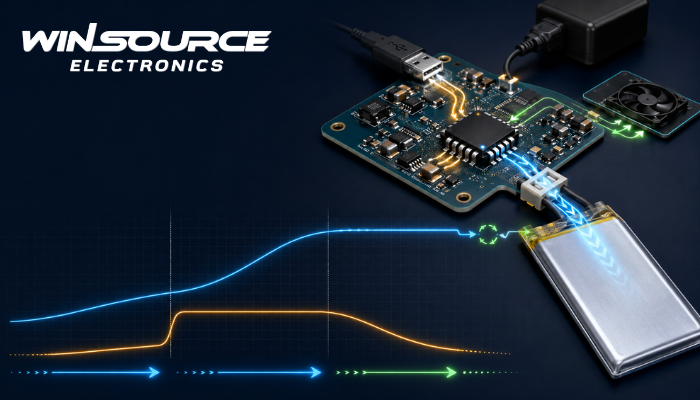
The Texas Instruments bqTINY-II series supports a three-phase charging process for single-cell lithium-ion and lithium-polymer batteries:
- Battery conditioning or precharge
- Constant-current fast charge
- Constant-voltage charge
The name is written bqTINY-II, using the Roman numeral “II,” rather than “BQTINY-11.”
Battery Conditioning or Precharge
If the battery voltage is below the low-voltage threshold, the charger supplies a reduced current to safely recover a deeply discharged cell. This phase limits stress on the battery and verifies that its voltage can rise normally before full charging begins.
For the bqTINY-II family, the typical transition threshold from precharge to fast charge is approximately 3.0 V, although the exact limits and programmed current should be confirmed for the specific device and circuit.
Constant-Current Fast Charge
Once the battery voltage rises above the low-voltage threshold, the charger enters the constant-current phase. It supplies the programmed charging current while the battery voltage gradually increases.
When powered from an AC adapter, the charge current is configured using an external resistor. In USB mode, supported devices can select nominal 100 mA or 500 mA operation through the ISET2 input. The actual available battery-charging current may be affected by the system load and thermal conditions.
Constant-Voltage Charge
When the battery approaches the regulation voltage—typically 4.2 V for this family—the charger changes to constant-voltage regulation. It maintains the battery at the regulated voltage while the charging current gradually decreases.
The charger terminates charging when the current falls below the applicable termination threshold. Depending on the bqTINY-II variant, taper detection, charge termination, and timer-control behavior may differ.
Charge Completion and Automatic Recharge
Charge completion and automatic recharge are control states rather than additional charging phases. After termination, the charger monitors the battery voltage. If it falls below the internal recharge threshold, charging starts again automatically.
The device also includes a safety timer to prevent charging from continuing indefinitely. Selected family members provide battery-temperature monitoring and can suspend charging when the battery is outside the permitted temperature range.
Texas Instruments specifies the three charging phases as conditioning, constant current, and constant voltage.
When selecting a bqTINY-II device, engineers should verify the exact part number, input source, charge-current configuration, regulation voltage, timer duration, temperature-sensing function, termination control, package, and thermal design because features vary across the bq24020–bq24027 family.