* Question
What Are the Types of Photoelectric Sensors?
* Answer
Photoelectric sensors detect objects or changes in surface conditions by transmitting light and monitoring how that light is interrupted or reflected. Most industrial photoelectric sensors use visible red light, infrared light, or a laser source.
Based on their optical arrangement, they are primarily classified as through-beam, retro-reflective, and diffuse-reflective sensors.
Through-Beam Sensors
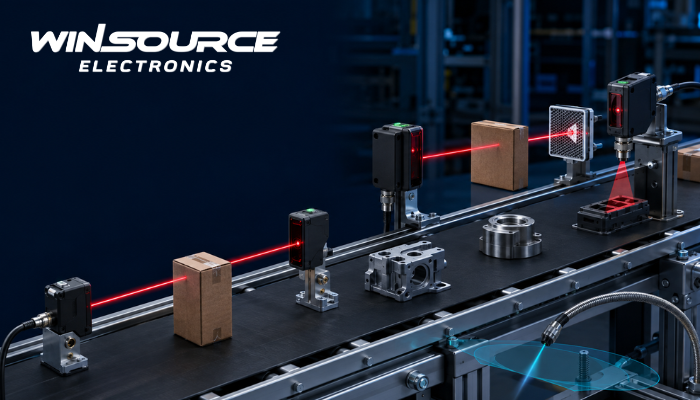
A through-beam system uses separate emitter and receiver units installed opposite each other. Under normal conditions, the receiver continuously detects the emitted light. An object is detected when it passes between the two units and interrupts the beam.
Through-beam sensors generally provide:
- The longest sensing distance
- High detection reliability
- Good resistance to object color and surface variations
- Reliable detection in dusty or demanding environments
Their main disadvantage is that the emitter and receiver must be installed, aligned, powered, and wired on opposite sides of the detection area.
A slot or fork sensor is a compact through-beam variation in which the emitter and receiver are built into opposite sides of one housing.
Retro-Reflective Sensors
A retro-reflective sensor contains the emitter and receiver in the same housing. A reflector installed opposite the sensor returns the emitted light. An object is detected when it interrupts the path between the sensor and reflector.
This arrangement provides simpler installation than a through-beam system because electrical wiring is required on only one side. It is commonly used for conveyor detection and packaging applications.
Polarized retro-reflective sensors help distinguish the reflector from shiny objects. Specialized models are available for detecting transparent materials such as glass bottles, clear films, and plastic containers.
Diffuse-Reflective Sensors
A diffuse-reflective sensor also places the emitter and receiver in one housing, but it does not require a separate reflector. Light strikes the target, and part of it is reflected directly back to the receiver.
These sensors are easy to install, but their sensing distance and stability can be affected by the target’s:
- Color
- Reflectivity
- Surface texture
- Angle
- Size
Dark, matte, transparent, or highly glossy objects may require a specialized optical arrangement or sensitivity adjustment.
OMRON identifies through-beam, retro-reflective, and diffuse-reflective designs as the principal photoelectric sensing methods.
Background-Suppression Sensors
A background-suppression sensor is a reflective sensor that evaluates the target’s distance rather than relying only on the amount of returned light. It can detect an object while ignoring a reflective surface located beyond a preset distance.
This makes it useful for detecting differently colored objects on a conveyor or in front of a nearby machine surface.
Distance-Settable Sensors
Distance-settable sensors commonly use optical triangulation or time-of-flight measurement. They determine whether an object is within a specified range and are less sensitive to variations in reflected intensity than conventional diffuse sensors.
Depending on the model, they may provide a switching output or a continuous analog or digital distance measurement.
Fiber-Optic Photoelectric Sensors
Fiber-optic sensors guide light between a remote amplifier and a compact sensing head. They are suitable for confined spaces, small targets, high-temperature areas, vacuum environments, or locations exposed to strong electrical noise.
The sensing principle may still be through-beam or reflective; the optical fibers primarily change how light is delivered and collected.
Other Specialized Types
Photoelectric sensors are also available as:
- Laser sensorsfor small spots and precise positioning
- Color and contrast sensorsfor identifying marks or surface differences
- Area sensorswith multiple beams for detecting objects across a wider zone
- Light curtainsfor safety or dimensional monitoring
- Luminescence sensorsfor detecting fluorescent marks
- Time-of-flight sensorsfor longer-range distance measurement
When selecting a photoelectric sensor, engineers should consider the sensing distance, target size and speed, material transparency, surface color and gloss, required response time, ambient light, contamination, mounting space, output type, supply voltage, connector, and environmental protection rating.