* Question
What Are the Three Practical Techniques for Dry Etching?
* Answer
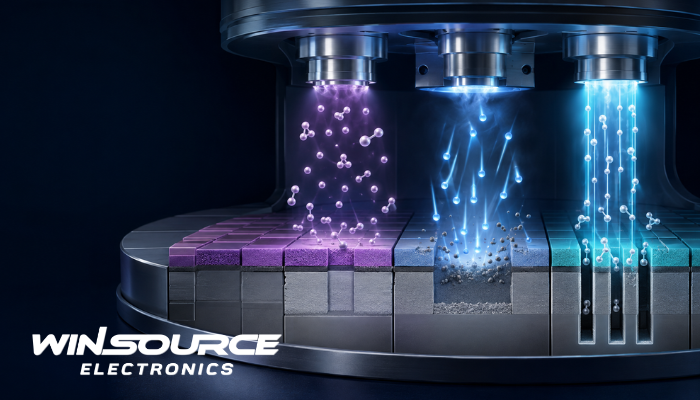
Dry etching removes material from a substrate using reactive gases, plasma-generated species, energetic ions, or a combination of these mechanisms. The three commonly used techniques are plasma etching, sputter etching, and reactive ion etching (RIE).
1. Plasma Etching
Plasma etching is primarily a chemical process. Reactive radicals generated in a plasma interact with the exposed substrate and form volatile by-products, which are removed by the vacuum system.
Because neutral reactive species reach the surface from different directions, plasma etching is often relatively isotropic, meaning it can also remove material laterally beneath the mask. It typically provides good material selectivity and causes less ion-bombardment damage than strongly physical methods.
2. Sputter Etching
Sputter etching, also called ion milling in some implementations, is primarily a physical process. Energetic ions—often argon ions—strike the substrate and transfer enough momentum to eject surface atoms.
The directional ion bombardment can produce anisotropic profiles and remove materials that do not form volatile chemical products. However, sputter etching generally has lower selectivity and may cause surface damage, redeposition, mask erosion, or substrate heating.
3. Reactive Ion Etching (RIE)
Reactive ion etching combines chemical reactions with directional ion bombardment. Plasma-generated radicals react with the substrate, while accelerated ions activate the surface and assist in removing reaction products.
This combination gives RIE a practical balance of etch rate, selectivity, and anisotropy. It is widely used to create narrow features and nearly vertical sidewalls in semiconductor devices, integrated circuits, and MEMS structures. Stanford’s nanofabrication facility identifies RIE as a general-purpose dry-etch process for metals, oxides, nitrides, silicon, and certain organic films.
Technique | Dominant mechanism | Typical profile | Main advantage |
Plasma etching | Chemical reaction | More isotropic | High selectivity |
Sputter etching | Physical ion bombardment | Directional | Broad material compatibility |
Reactive ion etching | Chemical and physical | Highly anisotropic | Precise pattern transfer |
The appropriate technique depends on the substrate material, required sidewall profile, etch rate, selectivity, feature size, and acceptable level of surface damage. In modern fabrication, variations such as ICP-RIE, deep reactive ion etching, and atomic layer etching provide greater control for advanced structures.