* Question
What Is the Analytical Redundancy Method?
* Answer
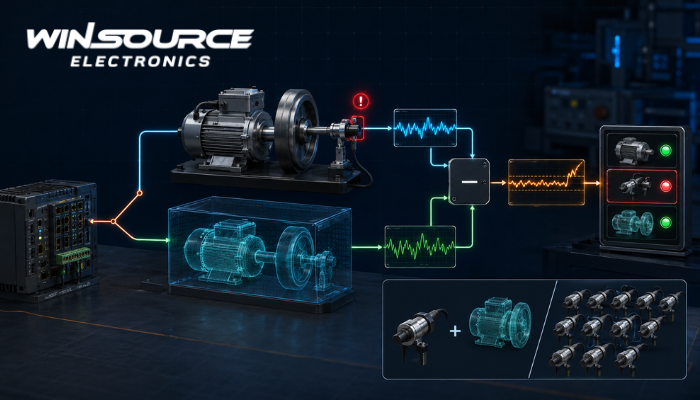
The analytical redundancy method is a model-based technique for detecting, isolating, and sometimes estimating faults in sensors, actuators, and system components. Instead of installing duplicate physical hardware, it uses mathematical relationships among system inputs, outputs, and internal states to generate an independent estimate of expected behavior.
The estimated value is compared with the actual measurement. A significant difference, known as a residual, may indicate a fault.
How Does Analytical Redundancy Work?
A typical analytical redundancy system performs the following steps:
- Sensors collect actual operating data from the system.
- A mathematical model predicts the expected outputs or internal states.
- The diagnostic algorithm compares measured and predicted values.
- The difference is calculated as a residual.
- The residual is evaluated against thresholds or statistical criteria.
- If the residual exceeds the acceptable range, the system identifies a possible fault.
- Multiple residuals may be analyzed to isolate the faulty sensor, actuator, or process component.
For example, an electronic control unit can estimate vehicle speed from motor speed, transmission ratio, and wheel diameter. If the measured wheel-speed value differs substantially from the estimate, the corresponding sensor or signal path may be faulty.
Common Analytical Techniques
Analytical redundancy can be implemented using:
- State observers, such as Luenberger observers
- Kalman filtersand extended Kalman filters
- Parity equations
- Parameter-estimation methods
- System-identification models
- Physical or data-driven models
- Machine-learning fault classifiers
Observers and filters are especially useful when the required internal state cannot be measured directly or when sensor data contains noise.
Analytical vs. Physical Redundancy
Physical redundancy uses multiple sensors or components to measure or perform the same function. It can provide direct backup capability but increases cost, weight, wiring, power consumption, and component count.
Analytical redundancy uses existing measurements and software models, reducing additional hardware requirements. However, its reliability depends on model accuracy, input quality, computing resources, and the ability to distinguish real faults from normal disturbances.
Applications
The method is widely used in:
- Automotive electronic control systems
- Aircraft flight-control and navigation systems
- Industrial process monitoring
- Robotics and autonomous equipment
- Power converters and motor drives
- Battery-management systems
- Chemical plants and energy systems
- Predictive maintenance platforms
Design Considerations
Engineers must account for measurement noise, model uncertainty, operating-point changes, environmental conditions, and component aging. A threshold that is too low may generate false alarms, while one that is too high may allow smaller faults to remain undetected.
The diagnostic model should be validated across the complete operating range. Fault-detection time, computational load, observability, residual sensitivity, and resistance to disturbances must also be evaluated. In safety-critical systems, analytical redundancy is often combined with physical redundancy and fail-safe control rather than used as the only protection mechanism.