* Question
What Are the Pin Functions of the TPS6205x?
* Answer
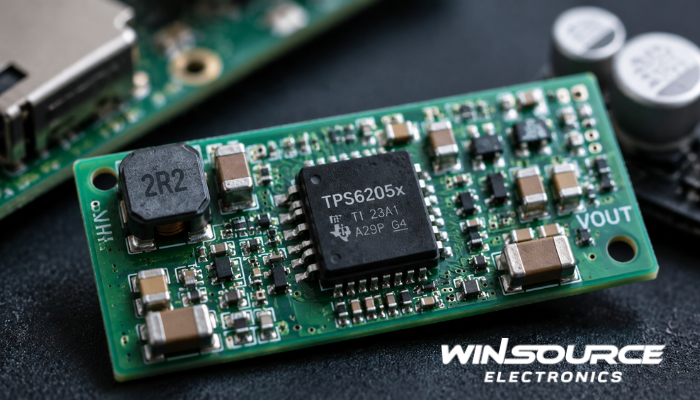
The TPS6205x series is a family of high-frequency synchronous step-down (buck) converters designed for efficient power management in compact electronic systems. Understanding the function of each pin is important for proper circuit design, PCB layout, and reliable device operation.
The exact pin configuration may vary slightly depending on the specific TPS6205x device version and package type. Engineers should always refer to the corresponding datasheet for the latest pin assignment and electrical specifications.
What Are the Main Pin Functions of the TPS6205x?
The TPS6205x typically includes pins for power input, output regulation, control, synchronization, and feedback functions.
VIN (Input Voltage Pin)
The VIN pin provides the input supply voltage for the converter.
Key considerations:
- Connects to the input power source.
- Requires proper input bypass capacitors to reduce voltage ripple and noise.
- The input voltage range should remain within the device’s specified operating limits.
SW (Switching Node Pin)
The SW pin is the switching node connected to the internal power MOSFETs.
Its functions include:
- Delivering switching energy to the external inductor.
- Generating the voltage waveform required for power conversion.
- Connecting to the inductor and output stage.
Because this pin carries high-frequency switching signals, PCB layout around the SW node should be carefully designed to minimize electromagnetic interference (EMI).
VOS (Output Voltage Sense Pin)
The VOS pin monitors the output voltage and provides feedback information to the internal control loop.
This pin helps the converter:
- Maintain a stable output voltage.
- Improve regulation accuracy.
- Respond to changes in load conditions.
Proper routing of the VOS connection is important to avoid noise coupling and inaccurate voltage sensing.
EN (Enable Pin)
The EN pin controls whether the device is enabled or disabled.
Typical functions include:
- Turning the converter on or off.
- Supporting power sequencing.
- Reducing system power consumption during standby operation.
Depending on the application, the EN pin can be controlled by a microcontroller, system power-management IC, or external logic signal.
MODE / SYNC Pin
Some TPS6205x devices include a MODE or SYNC pin for controlling operating behavior.
This pin may be used for:
- Selecting power-saving or forced PWM operation modes.
- Synchronizing the switching frequency with an external clock.
- Optimizing efficiency under different load conditions.
The exact function depends on the specific device variant.
PG (Power Good Pin)
The PG pin provides an indication of whether the output voltage is within the expected regulation range.
It can be used for:
- System power sequencing.
- Monitoring power supply status.
- Triggering other circuits after the output stabilizes.
GND (Ground Pin)
The GND pins provide the electrical return path for the converter.
Good PCB grounding practices are essential because switching regulators are sensitive to:
- Ground noise
- Voltage spikes
- Poor current return paths
A properly designed ground layout improves efficiency and overall system stability.
Why Is Understanding TPS6205x Pin Functions Important?
Correct understanding of TPS6205x pin functions helps engineers:
- Design stable power supply circuits.
- Select appropriate external components.
- Reduce EMI and switching noise.
- Improve power conversion efficiency.
- Avoid common PCB layout issues.
For switching regulators, proper connection of pins such as VIN, SW, VOS, and GND is especially important because incorrect routing can affect output regulation and device reliability.
What Should Engineers Consider When Designing with TPS6205x?
When using the TPS6205x in a design, engineers should pay attention to:
- Recommended input and output capacitor values.
- Inductor selection and current rating.
- Feedback signal routing.
- Switching node area and EMI control.
- Thermal management.
- Datasheet-specific pin configuration.
Since different TPS6205x variants may have different package options and pin assignments, always verify the exact device datasheet before final PCB design.
Summary
The TPS6205x pin functions include power input, switching control, voltage feedback, enable control, synchronization, power status indication, and grounding. Each pin plays an important role in achieving stable and efficient DC/DC conversion.
Understanding the purpose and proper connection of each pin helps engineers optimize circuit performance and ensure reliable operation in applications such as portable devices, embedded systems, and battery-powered electronics.