* Question
What Is NVRAM?
* Answer
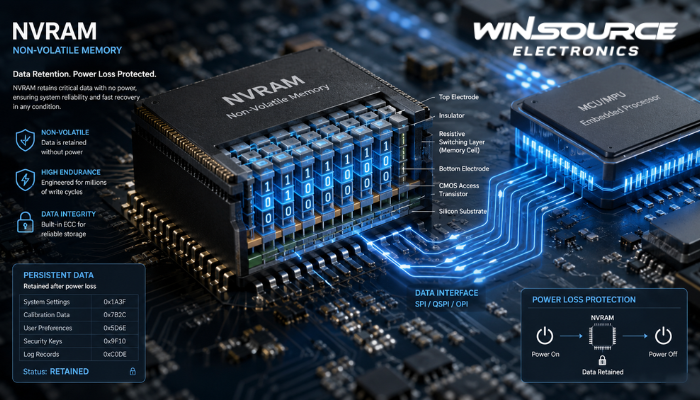
NVRAM (Non-Volatile Random Access Memory) is a type of memory that can retain stored data even when power is removed. It combines the fast read/write characteristics of RAM with the data retention capability of non-volatile memory.
Unlike traditional volatile RAM, which loses data after power is turned off, NVRAM preserves important information without continuous power supply. It is widely used in embedded systems, industrial equipment, networking devices, automotive electronics, and computing platforms where reliable data storage and fast access are required.
How Does NVRAM Work?
NVRAM uses different technologies to maintain stored information without power. Depending on the implementation, it may use:
- Battery-backed SRAM
- EEPROM-based memory
- Flash memory
- FRAM (Ferroelectric RAM)
- MRAM (Magnetoresistive RAM)
- ReRAM (Resistive RAM)
These technologies store data through different physical mechanisms, but they share the same purpose: maintaining information after power loss.
For example:
- A battery-backed SRAMkeeps normal RAM data alive using a small backup battery.
- EEPROM or Flash-based NVRAMstores data by changing the electrical state of memory cells.
- MRAM and FRAMuse advanced materials to provide fast and durable non-volatile storage.
What Are the Main Features of NVRAM?
1. Data Retention Without Power
The most important feature of NVRAM is its ability to preserve information after shutdown.
Typical stored data includes:
- System configuration settings
- Calibration parameters
- User preferences
- Device status information
- Critical operating data
This makes NVRAM suitable for systems that must recover quickly after power interruption.
2. Fast Read and Write Performance
Compared with traditional non-volatile storage devices, many NVRAM technologies provide faster access speeds.
Advantages include:
- Low access latency
- Direct memory access capability
- Efficient real-time data processing
This is especially useful in embedded systems and industrial applications.
3. High Reliability
NVRAM is designed for applications requiring stable long-term operation.
Depending on the technology, it can provide:
- High endurance for frequent write operations
- Resistance to power interruptions
- Long data retention periods
4. Low Power Consumption
Many NVRAM technologies require very little energy to maintain stored data.
This makes them suitable for:
- Battery-powered devices
- Portable electronics
- Energy-efficient embedded systems
5. Flexible Integration
NVRAM devices are available in various interfaces and packages, including:
- SPI
- I²C
- Parallel interfaces
This allows easy integration with microcontrollers, processors, and industrial control systems.
What Are the Common Applications of NVRAM?
Embedded Systems
NVRAM is commonly used to store:
- Firmware configuration data
- Device parameters
- System logs
It allows embedded devices to maintain important settings after reboot or power failure.
Industrial Automation
Industrial equipment often operates continuously and requires reliable data storage.
Applications include:
- PLC systems
- Industrial controllers
- Machine settings storage
- Calibration data storage
Automotive Electronics
Vehicles use NVRAM for storing critical information such as:
- ECU configuration parameters
- Sensor calibration values
- Diagnostic information
Reliable data retention is essential because automotive systems must operate under harsh conditions.
Networking Equipment
Routers, switches, and communication devices use NVRAM to store:
- Startup configuration files
- Network parameters
- Device settings
This allows systems to restore their operating state after restart.
Computing Systems
In computers and servers, NVRAM can be used for:
- BIOS/UEFI settings
- Persistent system data
- High-speed storage applications
Emerging memory technologies are also being explored as alternatives to traditional DRAM and storage architectures.
What Is the Difference Between NVRAM and Traditional RAM?
Feature | RAM | NVRAM |
Data retention | Lost when power is removed | Maintained without power |
Speed | Very fast | Fast, depending on technology |
Main purpose | Temporary data processing | Persistent data storage |
Power requirement | Requires continuous power | Retains data without power |
Typical use | CPU working memory | Configuration and critical data storage |
Why Is NVRAM Important for Modern Electronics?
As electronic systems become more intelligent and connected, they need memory solutions that combine speed, reliability, and data persistence.
NVRAM helps address these requirements by providing:
- Faster system recovery after power loss
- Reliable storage for critical information
- Improved performance in real-time applications
- Reduced dependence on slower storage devices
With the growth of IoT, edge computing, industrial automation, and automotive electronics, NVRAM continues to play an important role in next-generation memory architectures.