* Question
What are the basic transmission components of PWE3?
* Answer
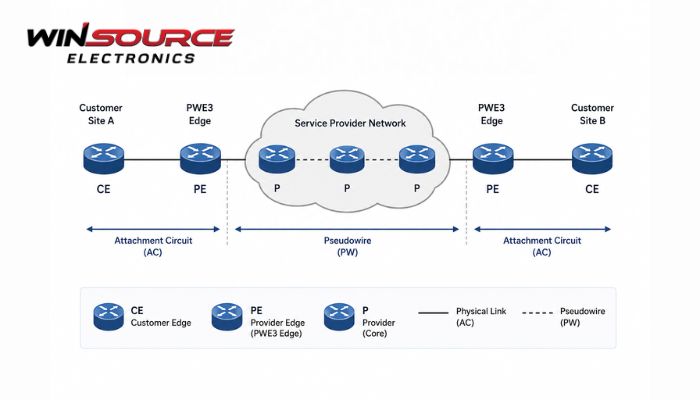
PWE3 (Pseudowire Emulation Edge-to-Edge) defines a way to transport packet-based services (like Ethernet) over existing transport networks such as SDH/SONET, ATM, or MPLS. Its basic transmission components are designed to emulate a point-to-point service across a packet-switched network. The key components include:
- Ingress and Egress Attachment Circuits (ACs):
- The attachment circuits connect the customer service interface (like Ethernet) to the PWE3 network.
- Ingress ACmaps the incoming service into the pseudowire.
- Egress ACmaps the pseudowire back to the customer-facing interface.
- Pseudowire (PW):
- The core element that emulates the native service over the packet-switched network.
- Carries the encapsulated payload (e.g., Ethernet frames, ATM cells) across the network.
- Includes PW headersthat maintain sequence, timing, and control information.
- PW Labeling / MPLS or L2TPv3 Tunnels:
- Labels or tunnel identifiers are used to route the pseudowire through the transport network.
- For MPLS networks, MPLS labelsidentify the specific PW.
- For IP-based transport, L2TPv3 or GRE tunnelsmay be used.
- Transport Network (T-NET):
- The underlying network that carries the encapsulated pseudowire, which could be MPLS, IP, or ATM networks.
- Provides connectivity between PWE3 edge devices.
- Control and Management Components:
- Mechanisms to establish, maintain, and monitor the pseudowire.
- Include LDP (Label Distribution Protocol)for MPLS-based PWs or other signaling protocols.
- Encapsulation and Sequencing:
- Encapsulation methods wrap customer frames with headers needed for transport.
- Sequence numbers ensure in-order delivery and detect lost packets.
In summary, the basic transmission components of PWE3 are Attachment Circuits (ACs), Pseudowires (PWs), label/tunnel identifiers, the transport network, control signaling, and encapsulation/sequencing mechanisms. These components together provide a transparent, reliable emulation of native services over packet-switched networks.