* Question
What are the key advantages of the DS18B20 digital temperature sensor?
* Answer
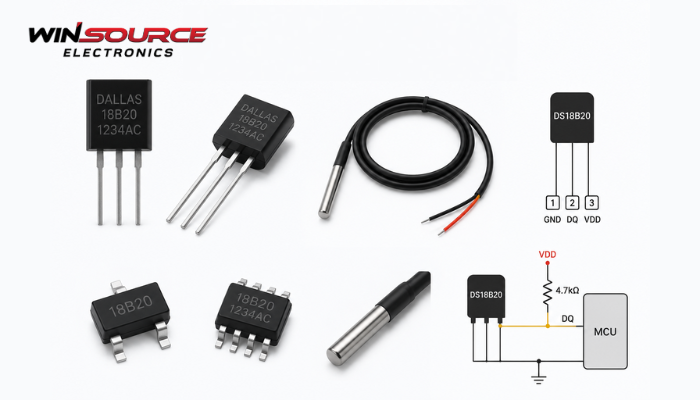
The DS18B20 is a widely used digital temperature sensor known for its reliability, accuracy, and ease of integration. Its main advantages include:
- Digital Output (1-Wire Interface):
- Provides temperature readings directly in digital form, eliminating the need for analog-to-digital conversion.
- Uses a simple 1-Wire communication protocol, allowing multiple sensors to share a single data line.
- Wide Temperature Range:
- Can measure temperatures from −55°C to +125°C, suitable for many industrial, environmental, and consumer applications.
- High Accuracy:
- Offers ±0.5°C accuracy over a wide operating range, making it reliable for precision applications.
- Unique 64-Bit Serial Code:
- Each sensor has a unique identifier, allowing multiple sensors to be connected on the same bus without conflict.
- Low Power Consumption:
- Can operate in “parasite power” mode, drawing power directly from the data line, which simplifies wiring and reduces external power requirements.
- Compact and Durable:
- Available in small TO-92 and waterproof stainless steel packages, suitable for embedded systems, industrial processes, or harsh environments.
- Ease of Integration:
- Supported by many microcontrollers and development platforms (e.g., Arduino, Raspberry Pi), with extensive libraries and documentation available.
- Cost-Effective:
- Affordable and widely available, making it a popular choice for both hobbyist projects and professional industrial applications.
In short, the DS18B20 combines digital simplicity, accuracy, wide temperature range, and easy multi-sensor deployment, making it highly versatile for temperature monitoring tasks in various applications.