* Question
What is conductivity?
* Answer
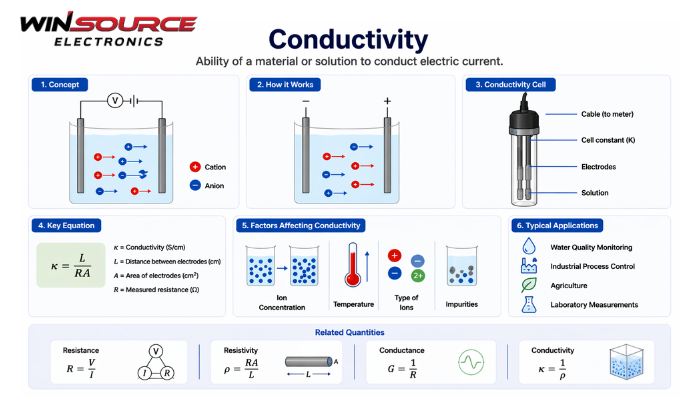
Conductivity is a measure of a material’s ability to conduct an electric current. It is the reciprocal of resistivity, which means that the higher the conductivity, the lower the resistance to the flow of electric charge. Conductivity is influenced by factors such as temperature, the material’s composition, and the presence of impurities or additives.
In more detail:
- Electrical Conductivity
Electrical conductivity refers to the capacity of a material to allow the movement of charged particles (such as electrons or ions) through it. Materials with high conductivity, like metals (e.g., copper, aluminum), allow electrons to flow freely, while materials with low conductivity, like insulators (e.g., rubber, wood), restrict the flow of electrons. - Units of Conductivity
The SI unit of electrical conductivity is siemens per meter (S/m). In the case of water or electrolytic solutions, conductivity is often measured in microsiemens per centimeter (µS/cm) because these materials tend to have lower conductivities. - Factors Affecting Conductivity
- Material Type:Metals have high conductivity, while non-metals like rubber or plastic are poor conductors.
- Temperature:Conductivity usually increases with temperature in metals (due to increased atomic vibrations that allow more electron flow) and decreases in electrolytes or semiconductors (due to decreased ion mobility at higher temperatures).
- Impurities:In the case of water, dissolved salts or minerals increase the solution’s conductivity because they provide more ions to carry the electrical charge.
- Applications of Conductivity
Conductivity is used in various industries and fields:
- Applications of Conductivity
- Water Quality Testing:Conductivity is a key indicator of the amount of dissolved salts, minerals, and other substances in water, helping to assess its quality.
- Materials Science and Engineering:Understanding a material’s conductivity is critical for designing electrical circuits, semiconductors, and other devices.
- Electrochemical Processes:Conductivity plays a role in processes like electroplating and electrolysis, where the flow of current through solutions is essential.
In short, conductivity is a key physical property that determines how easily electrical current can pass through a material, and it plays a crucial role in a variety of technological, industrial, and environmental applications.