* Question
What is the relationship between signals and variables?
* Answer
In the context of control systems, automation, and programming, signals and variables are closely related but serve different purposes. Here’s how they are connected:
- Signals
A signal is typically a physical quantity or an electrical representation of a system’s state or condition. Signals are transmitted between devices or systems and are often analog or digital in nature. In industrial systems, signals could represent things like sensor outputs, control system inputs, or communication between devices. For example, a temperature sensor might output an analog signal representing the temperature in a system.
- Analog Signals:Continuous signals that vary in magnitude, such as a voltage or current (e.g., 0-10V, 4-20mA).
- Digital Signals:Discrete signals that can have only two states, typically “on” or “off” (e.g., 0V or 24V).
- Pulse Signals:A type of digital signal, often used for timing or counting (e.g., pulse-width modulation signals).
- Variables
In programming and control systems, a variable is a symbolic representation of a value that can change or be manipulated. Variables hold data that represent the state of a process or system, and their values are updated based on input signals, calculations, or external factors. Variables are used in software (e.g., PLC programs) to store information about the system’s status and control parameters. - Relationship Between Signals and Variables
- Variables
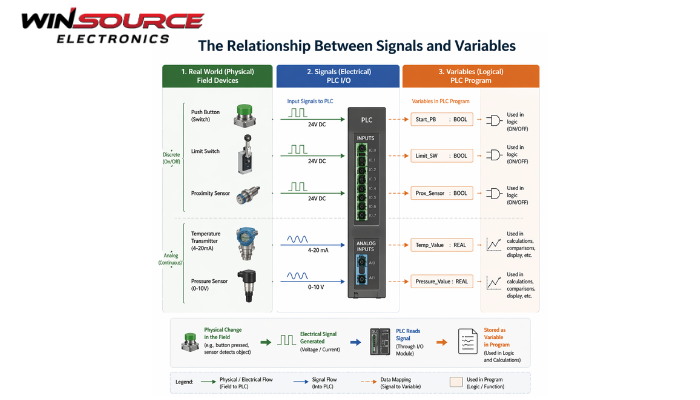
- Signal as Input to Variables:Signals from sensors or devices are often read by a control system (such as a PLC), and their values are stored in variables. For example, an analog temperature signal might be read by the PLC, and the temperature value is then assigned to a variable (e.g., “Temp_Value”).
- Variables Control Signals:Conversely, variables in the system (such as setpoints or calculated control values) can influence signals sent to output devices. For instance, a variable that stores the desired speed of a motor could control the signal sent to a motor driver, affecting the motor’s operation.
- Signal Processing to Variables:Signals, especially analog signals, may need to be converted (e.g., through an ADC) or processed (e.g., filtered or scaled) before they can be assigned to variables. This conversion allows the system to make use of the physical data in a meaningful way, allowing control actions to be based on the processed signal.
- Updating and Monitoring:Signals provide real-time data to the system, which updates variables accordingly. These variables, in turn, can be monitored by operators or used in decision-making processes for control actions.
In summary, signals serve as the real-world data or inputs/outputs, while variables represent that data in a system, allowing it to be processed, stored, and manipulated within control logic. They work together to bridge the gap between the physical system and the control logic, ensuring smooth operation and automation.