* Question
What types of PLC input circuits are usually divided into?
* Answer
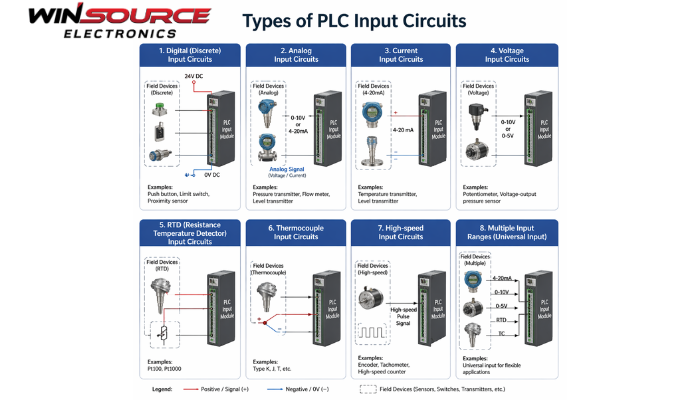
PLC (Programmable Logic Controller) input circuits can be generally classified into several types based on the nature of the signals they handle. These circuits serve as the interface between the field devices (such as sensors, switches, and other input devices) and the PLC. The main types include:
- Digital (Discrete) Input Circuits
These circuits are used to process binary signals (ON or OFF). A digital input can either be a contact-type input (such as a switch or relay) or a signal from a sensor that outputs a discrete voltage level (e.g., 24V or 0V). These are commonly used for devices like limit switches, push buttons, or proximity sensors. - Analog Input Circuits
Analog input circuits handle continuous signals, such as voltage or current that varies within a specified range. Analog signals are often used to measure parameters like temperature, pressure, or flow rate. The PLC uses an Analog-to-Digital Converter (ADC) to convert the analog signal into a digital form that the controller can process. - Current Input Circuits
Current input circuits typically handle 4-20 mA signals, which are standard for many industrial sensors, especially in situations where noise immunity is important. This type of circuit is often used in applications like temperature sensors or level transmitters. These circuits are typically interfaced with an ADC to convert the current signal into a usable value. - Voltage Input Circuits
These circuits accept voltage signals, such as 0-10V or 0-5V, commonly from sensors measuring physical quantities. The voltage is then converted by the PLC to a digital value using ADCs for further processing. Voltage inputs are typically used for analog sensors like potentiometers or voltage-output pressure sensors. - RTD (Resistance Temperature Detector) Input Circuits
RTD input circuits are designed to interface with temperature sensors that operate based on changes in electrical resistance. The PLC uses these circuits to measure temperature by interpreting the resistance value of the RTD sensor. - Thermocouple Input Circuits
These circuits are used to interface with thermocouples, which are temperature sensors that generate a voltage proportional to temperature. The PLC processes this voltage to determine the temperature in the system. - High-speed Input Circuits
High-speed input circuits are used for applications where fast signal processing is required, such as in counting or pulse-width modulation (PWM) applications. These inputs handle rapid changes in state, such as those from encoders, tachometers, or high-speed sensors.
Each of these PLC input circuits is designed to handle specific types of input signals, ensuring that the PLC can effectively monitor and control industrial processes in real-time.