* Question
What Is the Difference Between the Thumb Instruction Set and the ARM Instruction Set?
* Answer
The Thumb instruction set and the ARM instruction set are two different instruction sets used in ARM-based processors. Each set is designed for different purposes, and understanding their differences is crucial for optimizing performance and energy efficiency in embedded systems and mobile devices.
1. Instruction Length
The primary difference between the Thumb and ARM instruction sets lies in the length of the instructions:
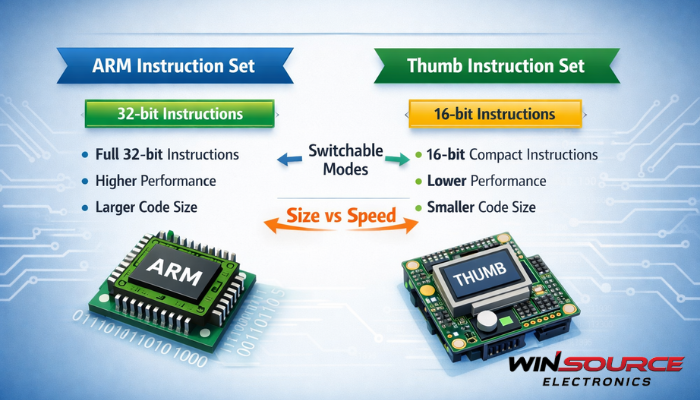
- ARM Instruction Set: ARM instructions are 32 bits long, providing a wide range of addressing and operational capabilities. They are typically used for tasks requiring high performance.
- Thumb Instruction Set: Thumb instructions are 16 bits long, which results in smaller code size compared to the ARM instruction set. This compactness allows for more efficient use of memory, making it ideal for low-memory environments.
2. Performance vs. Code Density
- ARM Instruction Set: The 32-bit ARM instruction set offers more functionality per instruction. It can perform more complex operations in a single instruction, which makes it suitable for high-performance tasks where speed is critical.
- Thumb Instruction Set: While Thumb instructions are smaller, they can be less powerful than ARM instructions. Multiple Thumb instructions may be required to perform a single task that would only take one ARM instruction. As a result, Thumb can offer better code density, meaning more instructions fit into a given amount of memory, but at a potential cost of slower execution for certain operations.
3. Execution Efficiency
- ARM Instruction Set: The ARM instruction set is optimized for higher performance. It executes most instructions in a single cycle on processors that support it, which makes it highly efficient for complex tasks.
- Thumb Instruction Set: The Thumb instruction set sacrifices some performance for smaller instruction size. It generally requires more cycles to execute a task compared to ARM, but in return, it uses less memory, which can be beneficial in resource-constrained environments.
4. Use Cases
- ARM Instruction Set: The ARM instruction set is commonly used in high-performance applications such as running operating systems, complex algorithms, or gaming engines, where performance is critical, and memory resources are not as limited.
- Thumb Instruction Set: The Thumb instruction set is often used in low-power or embedded applications, where memory and energy efficiency are more important than raw performance. It is ideal for applications with limited space, such as embedded systems or mobile devices, where conserving battery life and maximizing memory usage is crucial.
5. Hybrid Mode (ARM/Thumb Switching)
Many ARM processors support a mixed ARM/Thumb mode, allowing developers to use both instruction sets within the same program:
- ARM code can be executed for tasks requiring performance.
- Thumb code can be used for parts of the program that are memory-bound, balancing both code size and performance.
6. Impact on Compiler Optimization
- ARM Instruction Set: Compilers can generate ARM instructions to exploit the full capabilities of the processor, often optimizing for speed and performance.
- Thumb Instruction Set: Compilers can optimize code to use Thumb instructions when memory usage is a concern, but this may require more sophisticated management of instruction flow.
Conclusion
In summary, the ARM instruction set is suited for high-performance applications requiring more complex operations, while the Thumb instruction set offers reduced code size at the expense of some performance. The ability to switch between ARM and Thumb modes provides a flexible approach to optimize for both speed and memory efficiency, making it a powerful tool for various embedded and mobile applications.