* Question
What Are the Main Operating Frequencies of RFID Systems?
* Answer
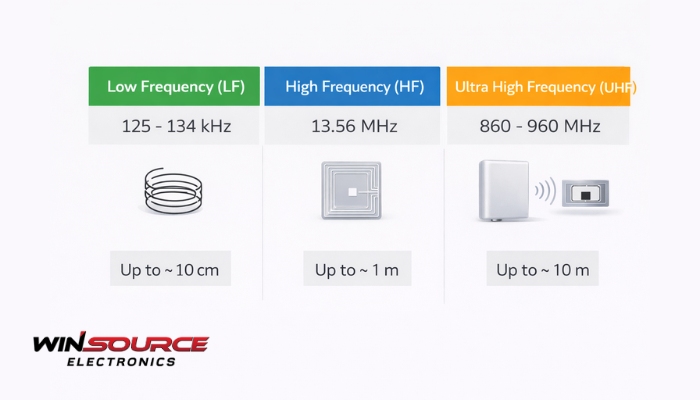
Radio Frequency Identification (RFID) systems are used for a wide variety of applications, ranging from inventory management to access control and asset tracking. RFID systems operate at different frequencies, which significantly impact their range, speed, and performance. Understanding these frequencies is essential for choosing the right RFID system for specific use cases. The main operating frequencies for RFID systems are:
1. Low Frequency (LF) – 125 kHz to 134.2 kHz
- Range: Typically up to 10 cm (4 inches)
- Applications: LF RFID systems are commonly used for animal tracking, access control, and asset management. Due to their relatively short range, they are ideal for close-range applications where security and precision are critical.
- Advantages: LF RFID systems are less susceptible to interference from water or metals, making them suitable for applications in environments with such materials.
- Limitations: The main disadvantage is the short read range and slower data transfer speed compared to higher frequency RFID systems.
2. High Frequency (HF) – 13.56 MHz
- Range: Typically up to 1 meter (3 feet)
- Applications: HF RFID is commonly used in contactless payment systems, smart cards, library book tracking, and access control. This frequency is widely used due to its balance of range and data transfer speed.
- Advantages: HF RFID systems have moderate read ranges and are more versatile, suitable for a wide range of applications. They also offer relatively fast data transmission speeds.
- Limitations: While they can offer moderate ranges, they are still limited compared to Ultra High Frequency (UHF) systems, especially in environments with interference.
3. Ultra High Frequency (UHF) – 860 MHz to 960 MHz
- Range: Typically up to 12 meters (39 feet), with the potential for longer ranges in optimal conditions
- Applications: UHF RFID systems are widely used in inventory management, supply chain logistics, asset tracking, and warehouse automation. UHF provides a long read range, making it ideal for tracking items over large distances.
- Advantages: UHF RFID offers high-speed data transfer, long-range capabilities, and is efficient for bulk reading of tags, making it ideal for large-scale tracking and logistics operations.
- Limitations: UHF systems are more sensitive to interference from water and metals, which can affect their performance. Additionally, they are subject to stricter regulatory restrictions in certain regions regarding transmission power and frequency usage.
4. Microwave Frequency – 2.45 GHz to 5.8 GHz
- Range: Typically up to 100 meters (328 feet), depending on the system and environmental conditions
- Applications: Microwave RFID is used in high-security access control, toll collection systems, and vehicle tracking. It offers extremely long-range capabilities and is often used in specialized applications.
- Advantages: This frequency provides the longest range of all RFID systems, with the ability to track moving objects over considerable distances.
- Limitations: Microwave RFID systems are highly susceptible to interference from environmental factors such as water, metal objects, and weather conditions. They also tend to consume more power.
Conclusion
The main operating frequencies of RFID systems—Low Frequency (LF), High Frequency (HF), Ultra High Frequency (UHF), and Microwave—are chosen based on the specific application requirements such as range, speed, and environment. LF and HF are suitable for short-range applications with security or precision needs, while UHF and microwave frequencies offer longer ranges and are ideal for large-scale or moving object tracking.
By selecting the appropriate frequency, businesses can optimize the efficiency and effectiveness of their RFID-based systems.