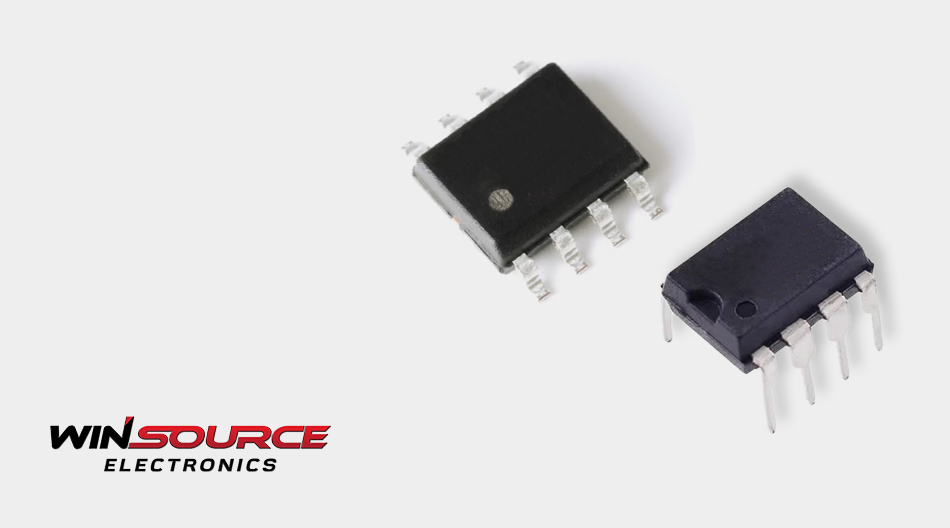
In precision analog circuits, a voltage reference does more than provide a fixed voltage. It often defines the measurement reference for ADCs, DACs, sensor conditioning circuits, test instruments, and industrial control modules. If the reference source has drift, excessive noise, or insufficient load capability, the system may still operate, but measurement accuracy and long-term stability can be affected.
ADR02BRZ is a 5.0 V precision bandgap voltage reference from the Analog Devices ADR02 series. It is available in an SOIC-8 package and is suitable for analog signal chain designs that require a stable 5 V reference. Although the SOIC version of ADR02 is pin-compatible with the industry-standard 8-pin SOIC version of REF02, pin compatibility does not necessarily mean full system-level compatibility. Replacement decisions should still be based on key parameters and application conditions.
1. Replacement Decisions Should Not Be Based Only on Output Voltage and Package
When replacing ADR02BRZ or REF02-class devices, output voltage, package type, and pin configuration are only the basic conditions. Even if two devices both provide a 5.0 V output and use an SOIC-8 package, they may still differ in initial accuracy, temperature drift, noise, input voltage range, output current capability, and adjustment method. For this reason, replacement decisions should not rely only on similar part numbers or pin compatibility.
From a parameter perspective, the ADR02 series emphasizes low drift, low noise, and a relatively wide input voltage range. ADR02 provides a 5.0 V output and operates with an input voltage range of 7.0 V to 36.0 V. Its 8-pin SOIC version has a typical temperature coefficient of 3 ppm/°C and includes a TRIM pin for output voltage adjustment. TI’s REF02 is also a 5 V precision voltage reference. Its input range is 8 V to 40 V, its temperature drift is 10 ppm/°C max, and it supports an external adjustment range of approximately ±6%. In actual replacement work, the evaluation should start from the system error budget. Temperature drift, noise, supply margin, load conditions, and long-term supply stability all need to be considered.
2. Key Parameters to Check When Replacing a Precision Reference
When evaluating a replacement for a precision voltage reference, the following parameters should be checked at minimum:
- Output voltage and initial accuracy
- Temperature coefficient and operating temperature range
- Output noise, especially low-frequency noise
- Input voltage range and minimum headroom requirement
- Output current capability and load regulation
- Line regulation, long-term stability, and startup behavior
- Whether functional pins such as TRIM or TEMP are used in the original circuit
- Package dimensions, pin compatibility, and PCB pad compatibility
Among these parameters, temperature coefficient is often one of the most important factors in replacement evaluation. If the system operates across a wide temperature range, such as in industrial sites, outdoor equipment, or vehicle-related modules, reference voltage drift enters directly into the error chain. Two devices that perform similarly at room temperature may produce different output drift under high- or low-temperature conditions.
Noise should also not be ignored. According to ADR02 specifications, the low-frequency noise of ADR02 is 10 μV p-p over the 0.1 Hz to 10 Hz range. For high-resolution ADCs or weak-signal acquisition systems, reference noise may limit the effective number of bits. If the original design already includes filtering and layout decisions based on the noise performance of a specific reference source, noise, decoupling, and output stability should be rechecked during replacement.
Functional pins also need attention. REF02-class devices may include voltage adjustment or temperature output functions. The ADR02 series provides TEMP and TRIM pins. The TEMP pin can be used for temperature sensing with an external buffer and a simple resistor network. The TRIM pin can be used for output voltage adjustment. If these pins are not used in the original circuit, replacement is usually simpler. If they are involved in calibration, temperature compensation, or system monitoring, their functional range and external connections must be checked one by one.
3. Selection Boundaries Between ADR02BRZ and REF02-Class Devices from a System Perspective
ADR02BRZ is better evaluated within precision analog signal chains, such as data acquisition, industrial measurement, DAC/ADC references, sensor conditioning, and calibration-related circuits. Its value is not only in providing a 5 V output. It also helps maintain a stable reference point under temperature variation and process variation. For systems with a tight error budget, initial accuracy, temperature drift, and noise should be confirmed first.
REF02-class devices cover a broad range of products. Specifications may differ across manufacturers, suffixes, and accuracy grades. Some REF02 versions emphasize a wider input voltage range and external adjustment capability. They may be suitable for maintenance, replacement, or cost optimization in existing REF02-based designs. However, if the replacement target is ADR02BRZ, the original design requirements for temperature drift, noise, supply range, pin functions, and load conditions still need to be confirmed.
Production and validation conditions should also be considered during replacement. If the device is used in general power monitoring or a low-accuracy control loop, parameter differences may not significantly affect system performance. If it is used in 16-bit or higher-resolution acquisition, precision calibration, process control, or equipment with high long-term stability requirements, prototype-level validation is recommended. This may include output accuracy, temperature drift, noise behavior, startup stability, and load variation testing.
The choice between ADR02BRZ and REF02-class devices should not be based only on 5 V output, SOIC-8 package, or pin compatibility. As a key component in the system error chain, a precision voltage reference must be evaluated by reviewing initial accuracy, temperature drift, noise, input range, output capability, functional pins, and application environment together. For engineering selection, a more reliable approach is to confirm key parameters based on the schematic and error budget, then verify replaceability through datasheet comparison and prototype testing. When supporting the sourcing of ADR02BRZ and related precision reference devices, WIN SOURCE also recommends confirming the exact suffix, package, grade, and application conditions to avoid replacement decisions based only on part number similarity.
© 2026 Win Source Electronics. All rights reserved. This content is protected by copyright and may not be reproduced, distributed, transmitted, cached or otherwise used, except with the prior written permission of Win Source Electronics.