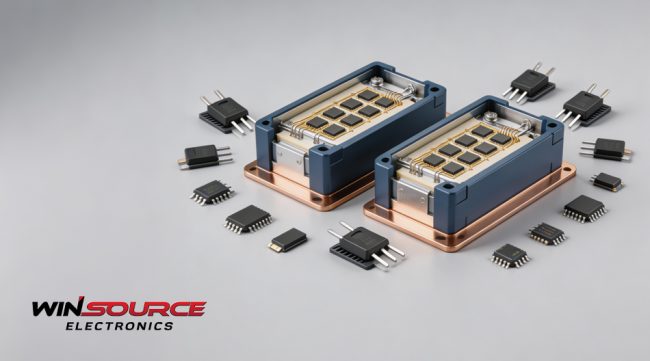
A familiar scene is playing out on many procurement desks these days. A power-device BOM that used to be straightforward suddenly shows lead times stretching from a few weeks to six months—or even a full year—while prices climb in parallel. MOSFETs, IGBTs, and the growing presence of silicon carbide (SiC) and gallium nitride (GaN) devices have shifted from readily available commodities to items that demand early locking and repeated confirmation.
This is not an isolated move by one supplier. According to supplier price notices and industry reports, STMicroelectronics has raised prices multiple times this year, with automotive-grade power devices up roughly 15–20% and lead times extending to 30–52 weeks. Texas Instruments implemented another adjustment in September, following a 10–20% increase in July on AI power-management chips and automotive IGBTs. Infineon has likewise lifted prices 10–20% on AI server power supplies and automotive power devices. Second-tier and regional manufacturers have followed, with increases in the 15–25% range.
When both price and lead time tighten at the same time, it usually signals simultaneous pressure on the demand and supply sides.
Why Power Semiconductors Are Tightening Now
Start with demand. On one side sits AI infrastructure: as compute pushes up the power budget of entire racks, data-center power shelves and PDUs consume far more power semiconductors than before. On the other side is electrification—electric vehicles and energy-storage systems that rely heavily on IGBTs, SiC MOSFETs, and power modules.
Both waves land on mature-node wafer capacity. Power semiconductors do not run on leading-edge processes, yet AI and automotive orders are large and high-priority. Capacity is simply being reallocated toward them. Supply has not “broken”; it is being redirected.
Which Part Numbers Feel the Pressure First
For procurement teams the more practical question is which devices tighten first—and how the shift toward SiC and GaN changes the selection process.
Silicon IGBTs and MOSFETs. Pressure appears earliest on automotive-grade and high-current industrial devices. Lead times of 30–52 weeks are no longer unusual, and high-volume designs are again facing allocation.
SiC and GaN devices. Moving from silicon to wide-bandgap is a selection change, not merely a supply issue. Automotive-grade SiC power modules are entering volume production (covering 750 V–1700 V with efficiencies around 98% and above), while GaN continues to expand in power conversion and data-center supplies. These devices cost more per unit, yet they deliver higher system efficiency and can lower total cost of ownership over time—a trade-off that is reshaping purchasing decisions.
Supporting discretes. Passives, gate drivers, and protection devices surrounding the power stage are experiencing similar allocation pressure. They are often overlooked, yet equally critical.
Once the pressure points are clear, the actions procurement can take in advance become clearer as well.
Practical Steps Procurement Can Take Now
- Track lead times by part number, not by category.Power-device lead times are the earliest warning signal. Establish part-level tracking for IGBTs, MOSFETs, and SiC/GaN devices. As soon as lead times begin to stretch, open dual-source evaluations—do not wait for formal allocation notices.
- Start alternative validation early. When silicon IGBTs or MOSFETs face allocation, SiC or GaN can be viable directions—provided the validation work is already underway. Better to begin sample testing now than to switch under shortage pressure.
- Build in longer qualification windows for automotive parts.Automotive power devices require AEC-Q qualification and longer validation cycles. Any change should allow 6–12 months for the process.
- Make traceability a formal requirement.Allocation periods are peak seasons for counterfeit and substandard power devices. Require batch information and corresponding test records from suppliers, especially when purchasing outside authorized channels.
- Design dual sourcing in, rather than treating it as a rescue plan. Power-stage packages and pinouts are often standardized, making dual sourcing practical. Validating a second source for high-volume devices in advance costs far less than firefighting later.
For procurement teams, the real difficulty is not the price increase itself. It is the need to keep supply steady when lead times are uncertain and alternative options have not yet been fully validated. Finding one more supplier rarely solves the problem; both available inventory and pre-validated alternatives are usually required at the same time.Through a global supplier network, WIN SOURCE provides multi-brand inventory of IGBTs, MOSFETs, SiC, and GaN devices, and can support alternative recommendations based on electrical, thermal, and package requirements. If you are currently evaluating lead times, dual-sourcing options, or SiC/GaN alternatives for specific power-device part numbers, we would be happy to discuss your requirements based on your BOM. We can also work with you to assess feasible supply and alternative solutions based on your specific needs.
©2026 Win Source Electronics. All rights reserved. This content is protected by copyright and may not be reproduced, distributed, transmitted, cached or otherwise used, except with the prior written permission of Win Source Electronics.