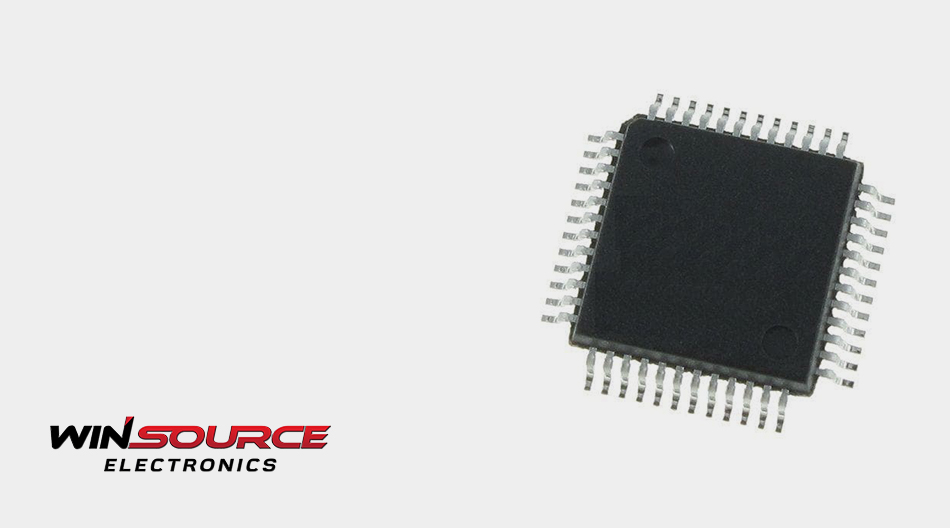
In embedded system selection, a higher-performance MCU is not always the best choice. For many low-cost control products, the main design priority is not complex computing capability. Instead, the system needs to execute basic control logic reliably, provide sufficient interface resources, and maintain a practical balance among cost, power consumption, and production controllability. Based on the Arm Cortex-M0 core, STM32F030C8T6TR is suitable for embedded applications with clearly defined functions, such as status acquisition, switch control, simple communication, timing output, and basic human-machine interaction.
1. The Core Requirement of Low-Cost Control Systems Is Not Pure Performance
In real projects, many low-cost control boards do not require a high clock frequency, large memory capacity, or complex computing units. Small industrial control modules, relay control boards, sensor acquisition nodes, auxiliary power control boards, and simple panel devices usually focus more on stable execution of fixed logic and basic data exchange with external components. STM32F030C8T6TR integrates a 48 MHz Cortex-M0 core and 64 KB Flash, making it suitable for small to medium-scale control programs. It can support tasks such as state machine control, periodic sampling, PWM output, button detection, LED indication, simple fault judgment, and serial communication.
From an engineering selection perspective, a suitable MCU should match the actual system task rather than simply provide excessive specifications. If the project does not involve complex algorithms, high-speed data processing, large protocol stacks, or graphical interfaces, using a higher-end MCU may not significantly improve system value. It may instead increase hardware cost and software maintenance effort. For low-cost control systems, sufficient resources, interface compatibility, controlled development cycles, and long-term supply stability are often more important than a single performance metric.
2. Suitable Application Scenarios and System Boundaries
STM32F030C8T6TR is better suited as a basic control node rather than a complex computing node. It can be used in sensor interface boards, small controllers, simple motor or relay control, auxiliary power management modules, low-cost instrument panels, and consumer electronics control units. In these systems, the MCU is typically responsible for input acquisition, logic judgment, output control, and basic communication.
The device integrates common MCU peripheral resources, including GPIO, ADC, timers, and interfaces such as I2C, SPI, and USART. These resources help connect analog sensors, digital sensors, drivers, communication modules, display modules, or external memory devices. For low-cost boards that require multiple basic peripherals to work together, it can complete control, acquisition, and communication functions within a relatively small system scale.
However, engineering teams also need to define its limitations clearly. The Cortex-M0 core is suitable for basic control, but it is not intended for complex digital signal processing, high-frequency closed-loop control, large data buffering, or complex operating system tasks. If an application requires stronger computing capability, larger RAM, more advanced communication functions, or a higher level of security, a higher-level MCU platform should be evaluated.
3. Selection Details to Consider During the Design Stage
In hardware design, whether MCU resources are sufficient should not be judged only by the product series. It should be verified against the specific application. For a low-cost control MCU such as STM32F030C8T6TR, the following aspects are especially important during the design stage:
Memory and interface resources
Flash capacity, I/O count, peripheral multiplexing, ADC channels, timer resources, and communication interface quantity can all affect schematic planning and PCB layout. If the project may later add communication protocols, parameter storage, a bootloader, or more diagnostic functions, sufficient firmware space should be reserved in advance.
Power supply and system protection design
STM32F030C8T6TR is commonly used in 3.3 V systems. During design, engineers should pay attention to the supply range, decoupling capacitors, reset circuit, clock source, debugging interface, and I/O level compatibility. For industrial environments, long cable connections, or external load driving, additional surge protection, reverse-polarity protection, ESD protection, isolation, or filtering may also be required. System-level risk should not be placed solely on the MCU itself.
Package, production, and BOM consistency
Package type can affect PCB layout, mounting process, prototype debugging, and repair convenience. LQFP packages are generally more convenient for debugging and maintenance than higher-density packages, but designers still need to balance pin multiplexing, routing space, and manufacturing requirements. For production projects, the complete part number, package, packing format, and manufacturing process requirements in the BOM should remain consistent. This helps avoid procurement or production issues caused by misunderstanding suffixes or package information.
4. Comprehensive Evaluation from Engineering Selection to Production Procurement
STM32F030C8T6TR is suitable for embedded products with clear functional boundaries, cost sensitivity, and relatively stable control logic. It is not intended for every application, but it can still provide practical engineering value in basic control, simple data acquisition, regular communication, and small board designs. For these projects, the key selection factor should be system requirement matching rather than a simple comparison of MCU performance parameters.
When evaluating this device, procurement and engineering teams should also consider supply status, batch consistency, alternative options, and long-term maintenance cost. If an alternative part needs to be assessed, factors such as Flash/RAM capacity, package size, pin compatibility, peripheral configuration, voltage range, software migration cost, and validation workload should be checked one by one. It is not advisable to judge interchangeability only by core type or product series name.
Overall, the value of STM32F030C8T6TR lies in providing a mature, simple, and resource-appropriate MCU option for low-cost embedded control systems. It is suitable for applications that do not require high computing power but still need stable control capability and common peripheral interfaces. In actual design and procurement processes, WIN SOURCE can provide reference support for MCU supply status, part number verification, and component selection, helping engineering and procurement teams move more steadily from design validation to production implementation.
© 2026 Win Source Electronics. All rights reserved. This content is protected by copyright and may not be reproduced, distributed, transmitted, cached or otherwise used, except with the prior written permission of Win Source Electronics.