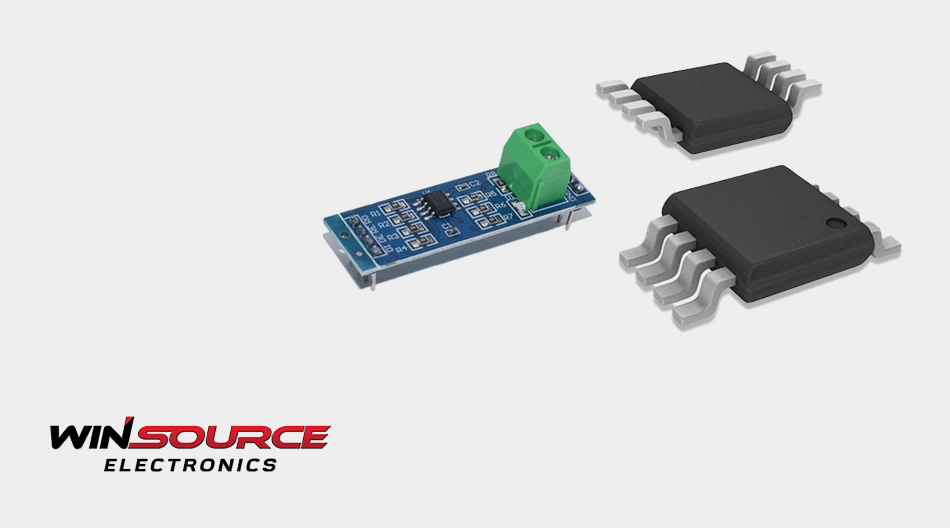
RS-485 interfaces are commonly used for long-distance, multi-node communication in industrial control, instrumentation, building automation, and communication equipment. ISL3179EIUZ-T is a 3.3V transceiver designed for RS-485/RS-422 balanced communication. Its full fail-safe receiver feature helps reduce output uncertainty when the bus is open, shorted, or terminated but not actively driven. For system design, understanding this feature can support a more accurate evaluation of RS-485 interface stability and component suitability under boundary conditions.
1. The Role of Full Fail-Safe Protection in RS-485 Buses
RS-485 uses differential signal transmission. The receiver determines the logic state by detecting the differential voltage between the A and B lines. Under ideal conditions, the bus is controlled by an active driver, and the receiver receives a clearly defined differential input. In real systems, however, the bus may become idle, disconnected, partially unstable due to poor contact, or terminated without any active node driving it. In these cases, if the receiver lacks fail-safe design, the output state may not remain stable.
The full fail-safe receiver design of ISL3179EIUZ-T is intended to improve output determinacy under these non-ideal bus conditions. It helps the receiver maintain a more predictable logic state when the input condition is not clearly defined. From a system perspective, this can reduce the possibility of false triggering. It should be noted that full fail-safe protection is not a complete system-level protection solution. It does not replace proper termination, bus biasing, isolation, surge protection, or PCB layout control.
2. System-Level Selection Considerations for ISL3179EIUZ-T
During component selection, ISL3179EIUZ-T should not be treated only as a general-purpose interface device. Its 3.3V supply characteristic makes it suitable for use with low-voltage MCUs, controllers, or digital logic systems. Its 40Mbps data rate also makes it applicable to RS-485/RS-422 links that require a certain level of communication response speed. However, the achievable communication distance and data rate in an actual system will still be affected by cable quality, node count, termination impedance, bus topology, and the electromagnetic environment.
The device also features a 1/5 unit load, which can support RS-485 network designs with higher node density. For multi-node systems, this parameter can serve as an important reference when evaluating network scale. Engineering teams still need to verify the design based on bus length, node distribution, driver capability, and actual loading conditions. System capacity should not be determined by a single parameter alone.
From a reliability perspective, high ESD protection is also an important factor in RS-485 interface selection. Field interfaces are often exposed to plugging and unplugging, cable connection events, electrostatic discharge, and external interference. A transceiver with stronger ESD protection can improve interface tolerance under abnormal electrical stress. In industrial field applications or long-cable systems, external protection components and system-level validation are still recommended based on application risk.
3. From Interface Features to System Reliability
The engineering value of full fail-safe protection lies in reducing uncertainty under RS-485 bus boundary conditions. Communication issues do not always occur during stable data transmission. They may also appear when the bus is idle, when nodes switch states, when line abnormalities occur, or when external interference is present. Under these conditions, the receiver output state can affect how the system interprets communication status and may further influence control logic, data parsing, and fault handling.
When evaluating the suitability of ISL3179EIUZ-T, engineering teams should not focus on a single parameter in isolation. The supply voltage needs to match the host control platform. The data rate should meet communication response requirements. The unit load characteristic should align with the node count and overall bus scale. The ESD rating should also be assessed against the electrical environment of the application. On this basis, the full fail-safe feature can serve as an important reference for reducing the risk of misjudgment under abnormal bus conditions.
Understanding full fail-safe protection in ISL3179EIUZ-T is not simply about interpreting one device function. It is also a way to evaluate the design boundaries of RS-485 interfaces from the perspective of interface reliability. For applications that require long-term operation, multi-node connections, or operation in high-interference environments, transceiver selection should be considered together with bus topology, protection circuitry, layout rules, and field validation.
In electronic component selection and supply evaluation, WIN SOURCE can provide reference support from the perspectives of product parameters, application boundaries, and supply availability. This helps customers better understand the selection value of interface devices such as ISL3179EIUZ-T. For engineering and procurement teams, connecting device characteristics with real application scenarios can support more robust system design and material decision-making.
© 2026 Win Source Electronics. All rights reserved. This content is protected by copyright and may not be reproduced, distributed, transmitted, cached or otherwise used, except with the prior written permission of Win Source Electronics.