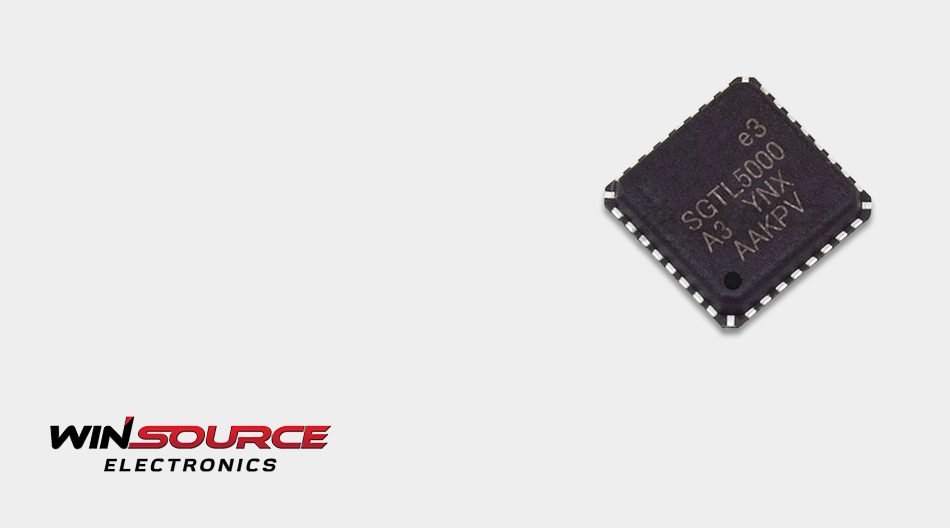
In the development of audio products, a common yet often overlooked phenomenon is that prototypes perform reliably, while issues emerge once the design enters mass production. This is particularly evident in audio systems built around SGTL5000XNAA3. From an engineering perspective, such issues rarely originate from a single component limitation, but are more often the result of decision bias during system design and component selection.
1. Component Lifecycle Overlooked: Long-Term Risks Introduced by Design Lock-In
SGTL5000XNAA3, as a mature audio codec, has been widely used in portable audio devices and industrial terminals. However, the device has entered its End of Life (EOL) phase. Once a design is locked in, this introduces a high level of supply uncertainty and replacement risk.
During the prototype phase, engineering efforts typically focus on functional validation and performance metrics, such as signal-to-noise ratio (SNR), total harmonic distortion (THD), and interface compatibility. In contrast, limited attention is given to component lifecycle considerations. A selection strategy driven by short-term availability tends to be amplified in the mass production stage. When projects move into volume delivery cycles, any supply fluctuation can directly impact production continuity and delivery schedules.
Compared to general-purpose components, audio codecs present significantly higher replacement complexity. This involves not only analog performance characteristics, but also register configuration, driver compatibility, and system-level debugging. Simple pin-to-pin substitution is rarely feasible. Without predefined alternative paths during the selection phase, redesign efforts at a later stage often require substantial time and engineering resources.
2. Power Integrity Issues: An Underestimated Variable in Audio Performance
In audio system design, the power module is often treated as a supporting function rather than part of the performance-critical path. In practice, power integrity directly determines the stability of audio output quality.
DC/DC converters represented by TPS56637RPAR serve as core power supply components in the system. When output ripple is not properly controlled or transient response performance is insufficient, noise can couple into the analog front end of SGTL5000XNAA3. This may result in elevated noise floor, increased distortion, or intermittent abnormalities.
Such issues are not easily observable during the prototype phase, as testing conditions are typically controlled and ideal. In mass production, however, variations in PCB batches, component tolerances, and operating temperature can significantly amplify the impact of power noise on the audio signal path.
Layout design introduces additional constraints. Inadequate isolation between analog ground and power ground, or improper routing clearance, increases the likelihood of noise coupling into the audio path. Once exposed in production environments, these issues are difficult to resolve through software tuning or localized design changes.
3. Single-Source BOM: Structural Imbalance in Supply Chains
In audio system design, the power module is often categorized as a basic support element and not included in performance-critical evaluation. However, power integrity has a direct impact on audio output quality. DC/DC converters such as TPS56637RPAR play a central role in system power delivery. When output ripple control is insufficient or load response is unstable, noise may couple into the analog front end of SGTL5000XNAA3, leading to increased noise floor, distortion, or intermittent anomalies.
These issues are typically not apparent during the prototype stage due to controlled testing environments. Once in mass production, variations in PCB manufacturing, component parameter dispersion, and operating temperature conditions can significantly amplify the impact of power noise. Layout design also serves as a critical constraint. Insufficient separation between analog and power grounds, or improper routing spacing, increases the likelihood of noise coupling into the audio path. Once these issues appear in production, they are difficult to correct through software adjustments or localized modifications.
4. From Prototype to Production: A Shift in Design Mindset
Many issues observed in audio systems during production can be traced back to differences in design objectives. The prototype phase prioritizes functional realization, while mass production requires stability, sustainability, and reproducibility.
This requires introducing additional evaluation dimensions at the early stage of component selection, including:
- Component lifecycle and vendor roadmap
- Feasibility and cost of alternative solutions
- Coupling between power and analog modules
- Supply chain stability and inventory support
Taking SGTL5000XNAA3 as an example, while it continues to meet functional requirements in many applications, it is no longer an optimal choice for new designs from a lifecycle perspective. Power components such as TPS56637RPAR also require careful matching based on system-level noise constraints.
From an engineering standpoint, early consideration of these constraints reduces downstream production risk. Delaying such decisions until the production phase typically results in increased time and cost.
Audio design failures rarely stem from a single technical limitation. More often, they originate from system-level decision bias. From component lifecycle to power integrity and BOM structure, each layer can amplify risks during mass production. In practice, more engineering teams are incorporating supply chain and component selection assessments earlier in the design phase. Distributors such as WIN SOURCE, with accumulated experience in component availability and alternative sourcing strategies, are increasingly referenced as part of engineering decision-making processes.
© 2026 Win Source Electronics. All rights reserved. This content is protected by copyright and may not be reproduced, distributed, transmitted, cached or otherwise used, except with the prior written permission of Win Source Electronics.