
* Question
How to Choose Between an Analog Oscilloscope and a Digital Storage Oscilloscope?
* Answer
Selecting the right oscilloscope is a crucial step in circuit analysis and signal debugging. Although analog oscilloscopes and digital storage oscilloscopes (DSOs) share the same fundamental purpose—visualizing electrical waveforms—their performance, functionality, and application suitability differ significantly. Understanding these differences helps engineers choose the right instrument for their testing requirements.
1. Signal Display and Measurement Principle
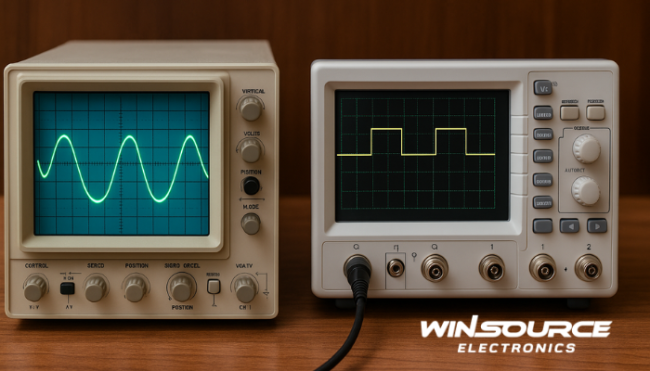
An analog oscilloscope displays signals in real time by directly modulating an electron beam across a cathode-ray tube (CRT). This continuous display offers smooth, instantaneous waveform response, ideal for observing fast transient changes or analog continuity.
By contrast, a digital storage oscilloscope converts analog signals into digital data through A/D conversion and then stores and reconstructs them on a screen. This allows for more stable, repeatable, and analyzable waveform observation, even after the signal event has passed.
2. Sampling, Storage, and Analysis Capabilities
The DSO’s key advantage lies in its data storage and analysis functions. Engineers can zoom, measure, or apply mathematical operations (FFT, RMS, frequency analysis, etc.) to recorded waveforms. The ability to capture single-shot or rare events makes digital scopes essential for modern debugging and research.
Analog oscilloscopes, however, lack storage; once a transient passes, it cannot be reviewed. This limits their usefulness in complex or high-speed systems but provides a true analog continuity that some professionals still prefer for visualizing pure waveforms.
3. Bandwidth, Resolution, and Cost
Analog oscilloscopes often offer high analog bandwidth with minimal latency, while DSOs trade off bandwidth for flexibility and precision. Today’s mid- to high-end digital scopes have surpassed analog bandwidth limits, offering gigahertz-level performance with deep memory and high-resolution ADCs.
From a cost perspective, analog models are simpler and less expensive, but digital oscilloscopes offer greater value due to their data recording, triggering precision, and integration with PCs or cloud systems.
4. Application Scenarios
- Choose an Analog Oscilloscopewhen you need real-time visual continuity, such as tuning analog audio circuits or observing continuous signal distortion.
- Choose a Digital Storage Oscilloscopewhen you require signal capture, analysis, and repeatability, such as debugging digital communication, embedded systems, or transient events.
Conclusion
In modern electronic testing, digital storage oscilloscopes dominate due to their accuracy, versatility, and analytical capability, though analog models still hold value in niche analog applications. The optimal choice depends on whether your priority is real-time analog behavior or comprehensive digital analysis.
For engineers seeking high-performance measurement solutions, selecting components and instruments from trusted distributors like Win Source ensures both technical reliability and long-term support.

COMMENTS