* Question
How to Reduce Noise Impact and Improve Detection Accuracy
* Answer
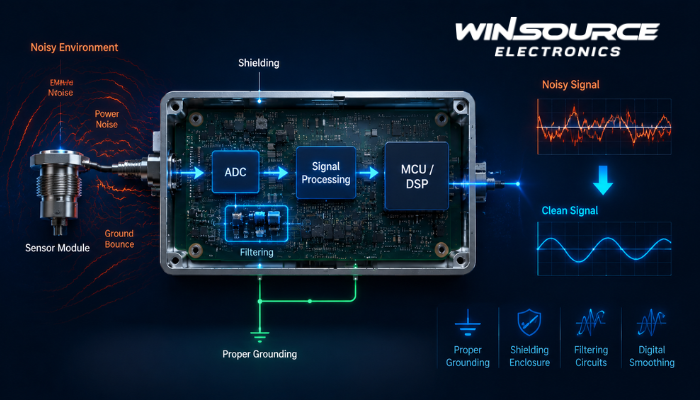
In electronic systems (such as sensors, RF modules, ADC-based measurement circuits, RFID readers, or industrial detection systems), noise is one of the main factors that reduces accuracy and stability.
To improve detection performance, the goal is to reduce noise at the source, prevent noise coupling, and enhance signal processing quality.
1. Hardware-Level Noise Reduction
1.1 Proper Grounding Design
A good grounding system is the foundation of noise control.
- Use single-point grounding(star ground) for sensitive analog circuits
- Separate analog ground (AGND)and digital ground (DGND)
- Avoid ground loops in PCB layouts
This reduces common-mode noise and return current interference.
1.2 PCB Layout Optimization
PCB design has a major impact on noise performance:
- Keep high-speed signals away from analog signals
- Minimize loop area in signal paths
- Use short and direct tracesfor sensitive inputs
- Place decoupling capacitors close to IC power pins
Good layout can reduce EMI before it is even generated.
1.3 Power Supply Filtering
Noise often enters through the power line.
- Use LDO regulators for low-noise analog sections
- Add LC filters or ferrite beads
- Use sufficient decoupling capacitors (100nF + bulk capacitor)
1.4 Shielding and Isolation
Physical isolation is highly effective:
- Metal shielding enclosures for sensitive modules
- Optical isolation for digital/industrial interfaces
- Transformer or capacitive isolation for signal separation
2. Signal Conditioning Techniques
2.1 Low-Pass Filtering
Removes high-frequency noise components:
- Analog RC filters before ADC input
- Digital low-pass filters after sampling
Essential for sensor and measurement systems.
2.2 Differential Signal Transmission
Using differential signals instead of single-ended:
- RS-485, CAN, LVDS
- Cancels common-mode noise effectively
2.3 Amplification Optimization
- Use low-noise amplifiers (LNA / precision op-amps)
- Keep gain stages properly distributed
- Avoid over-amplifying noise together with signal
3. Digital Processing Techniques
3.1 Oversampling and Averaging
- Take multiple samples and average them
- Reduces random noise significantly
Formula effect:
Noise ↓ proportional to √N (number of samples)
3.2 Digital Filtering Algorithms
Common methods:
- Moving average filter
- FIR / IIR filters
- Kalman filter (for dynamic systems)
3.3 Threshold Optimization
- Set adaptive detection thresholds
- Avoid fixed thresholds in noisy environments
- Use hysteresis to prevent false triggering
4. System-Level Design Optimization
4.1 Sensor Selection
- Choose sensors with higher SNR (Signal-to-Noise Ratio)
- Prefer digital output sensors when possible
- Use industrial-grade components for harsh environments
4.2 Timing and Sampling Strategy
- Sample during stable signal periods
- Avoid switching noise intervals
- Synchronize ADC sampling with system clock
4.3 EMI/EMC Design Compliance
- Follow EMC design rules (IEC standards)
- Reduce radiated and conducted emissions
- Use proper cable shielding and grounding
5. Environmental Noise Reduction
- Reduce electromagnetic interference sources nearby
- Use twisted-pair cables for signal lines
- Maintain physical distance from motors, relays, and power lines
- Use ferrite cores on external cables
Summary Table
Category | Method | Effect |
Grounding | Star ground, separate AGND/DGND | Reduces ground noise |
PCB design | Short traces, layout isolation | Prevents coupling |
Power | LDO, filters | Stabilizes supply |
Filtering | RC / digital filters | Removes high-frequency noise |
Signal type | Differential signaling | Cancels interference |
Processing | Averaging, Kalman filter | Improves accuracy |
Shielding | Metal enclosure | Blocks EMI |
Conclusion
To reduce noise impact and improve detection accuracy, a multi-layer strategy is required, combining:
- Hardware design optimization
- Proper grounding and shielding
- Signal conditioning
- Digital filtering and intelligent processing
The most effective systems do not rely on one method, but a combined noise-control architecture from PCB level to algorithm level.