
* Question
What are the two main positioning methods used in RFID systems?
* Answer
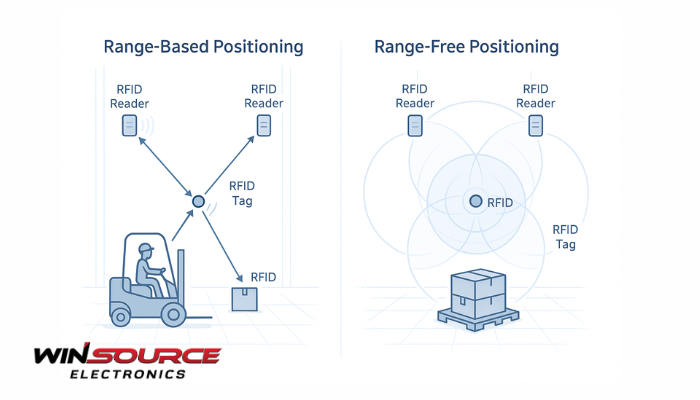
In RFID (Radio Frequency Identification) positioning, two main methods are commonly used to determine the location of tags: range-based positioning and range-free positioning.
These two approaches differ in how they process signal information and estimate spatial coordinates, each offering unique advantages depending on the application’s accuracy, cost, and environment.
1. Range-Based Positioning
Range-based RFID positioning relies on quantitative signal measurements to calculate the physical distance or angle between the RFID tag and one or more readers.
This approach uses the principles of geometry and signal propagation to estimate position precisely.
Key techniques include:
- TOA (Time of Arrival):Measures the signal propagation time from the reader to the tag.
- TDOA (Time Difference of Arrival):Determines position by comparing time delays between multiple readers.
- AOA (Angle of Arrival):Uses antenna arrays to detect the signal’s incident angle.
- RSSI (Received Signal Strength Indicator):Estimates distance based on the power level of received signals.
Advantages:
- High accuracy in controlled or line-of-sight environments.
- Suitable for industrial tracking, warehouse automation, and robot navigation.
Limitations:
- Requires precise synchronization or calibration.
- Performance may degrade due to multipath effects, interference, or signal attenuation.
2. Range-Free Positioning
Range-free methods do not depend on exact distance or angle measurements.
Instead, they use connectivity patterns or relative relationships between tags and readers to infer position qualitatively.
Common approaches include:
- Centroid algorithm:Estimates the tag position based on the geometric center of detected readers.
- DV-Hop and APIT algorithms:Use network topology and hop-count information for approximate localization.
- Fingerprinting method:Compares the current signal pattern to a pre-recorded database of signal “fingerprints” to identify position.
Advantages:
- Lower hardware and computational cost.
- More robust in non-line-of-sightor RF-interference-prone
Limitations:
- Generally less accurate than range-based methods.
- Requires large training datasets if fingerprinting is used.
Summary Insight
In essence, range-based methods focus on measuring precise physical parameters (time, angle, signal strength), while range-free methods emphasize spatial inference and pattern recognition.
Modern RFID systems often combine both—using hybrid algorithms that fuse signal metrics with statistical models—to achieve high accuracy, robustness, and scalability in complex environments such as smart warehouses, logistics hubs, and industrial IoT systems.

COMMENTS