* Question
Hall Sensors: Where They Excel—and Where They Don’t
* Answer
Hall sensors detect magnetic fields and convert them into electrical signals. Because they can sense position, movement, speed, or current without direct mechanical contact, they are widely used in automotive electronics, industrial equipment, consumer devices, and embedded systems.
Their non-contact operation offers clear benefits, but Hall sensors are not ideal for every design. Temperature drift, magnetic interference, air-gap variation, and power consumption can all affect performance. Understanding these tradeoffs helps engineers decide when a Hall sensor is the right choice.
How Does a Hall Sensor Work?
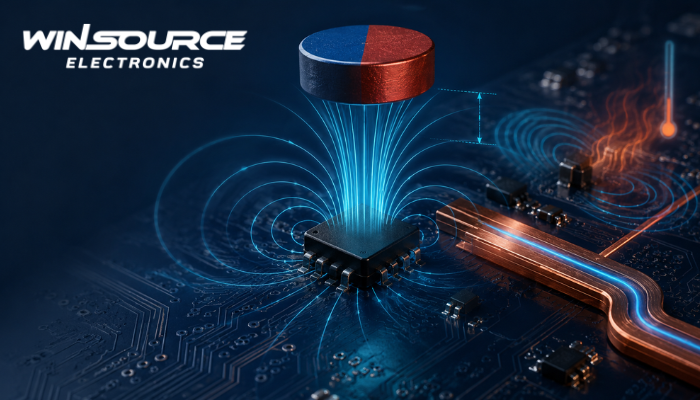
A Hall sensor operates through the Hall effect. Current flows through a semiconductor sensing element. When a magnetic field passes through the element perpendicular to the current, it creates a small voltage across the material. This Hall voltage is amplified and processed by the sensor electronics.
Depending on the device, the output may be a linear analog voltage, a digital switching signal, or a digital measurement delivered through an interface such as I²C or SPI. The complete system may also include a permanent magnet, magnetic target, or current-carrying conductor.
Where Hall Sensors Excel
1. Non-Contact Measurement
Hall sensors can detect motion or position without touching the moving target. Compared with contact-based switches or potentiometers, this reduces friction and mechanical wear.
The result can be longer service life, fewer mechanically induced failures, and reliable operation over frequent switching cycles. Hall sensors are therefore useful for motor commutation, pedal and throttle position sensing, door detection, and rotating-shaft monitoring.
2. Reliability in Demanding Environments
The semiconductor sensing element has no moving parts. With suitable packaging, a Hall sensor assembly can tolerate vibration, shock, dust, oil, and moisture better than many exposed mechanical contacts.
Environmental performance still depends on the package, sealing method, PCB design, and specified temperature range. The sensor should not be assumed to withstand harsh conditions unless the complete assembly is appropriately rated.
3. Fast Response
Hall sensors can respond quickly to changing magnetic fields. Suitable devices can measure rotational or linear speed, motor rotor position, proximity, and current in real time. Their bandwidth and propagation delay vary, so the selected part must match the application.
4. Compact Size and Easy Integration
Hall sensing elements, amplifiers, compensation circuits, and digital logic can be integrated into a small IC package. Some devices also include programmable thresholds, diagnostics, temperature compensation, or digital interfaces.
Low-power versions are available for battery-operated products, although low power is not a universal characteristic of Hall sensors.
5. Flexible Sensing Options
Hall devices are available as switches, latches, linear sensors, angle sensors, and current sensors. Designers can choose unipolar, bipolar, omnipolar, or three-dimensional sensing according to the field direction and required output.
6. Isolation in Certain Current Sensors
Some Hall-effect current sensors measure the magnetic field around a conductor while maintaining galvanic isolation between the high-current path and the low-voltage signal circuit.
Isolation is not an automatic property of every Hall sensor. It depends on the device construction, package, creepage and clearance distances, working-voltage rating, and safety certification.
Limitations Engineers Should Consider
1. Temperature Drift
Temperature can change sensor offset, sensitivity, switching thresholds, and magnet strength. Modern Hall ICs may include compensation, but precision designs can still require calibration or software correction. Engineers should evaluate performance across the full operating-temperature range, not only at room temperature.
2. Magnetic Interference
Motors, transformers, speakers, high-current conductors, and nearby magnets can create stray fields that affect measurements. Careful placement, differential sensing, magnetic shielding, field concentrators, or calibration may be needed.
3. Dependence on Magnetic and Mechanical Design
Position-sensing performance depends on magnet strength, polarity, orientation, air gap, target alignment, and production tolerances. A system that works at nominal spacing may fail at tolerance limits or under changing temperature.
Critical designs should include worst-case tolerance analysis and, when necessary, magnetic simulation.
4. Accuracy and Linearity Limits
Errors can arise from offset, nonlinearity, noise, hysteresis, and sensitivity variation. Weak magnetic fields may be difficult to distinguish from noise and offset drift.
Hall sensors can provide high accuracy, but other technologies may be more suitable for certain applications. These include shunt-based current sensing, magnetoresistive sensors, optical encoders, and resolvers.
5. Power Consumption
Active Hall sensors require electrical power. Continuous-operation devices may consume too much current for small batteries. Duty-cycled sensors reduce average consumption by sampling periodically, but this can increase response time.
6. Saturation, Bandwidth, and System Cost
A magnetic field beyond the specified range can saturate the output, while a rapidly changing signal may exceed the sensor’s bandwidth. Position sensing may also require a magnet or magnetic target, adding cost, assembly steps, and mechanical constraints.
The total sensing-system cost should therefore include more than the Hall IC itself.
Hall Sensors vs. Mechanical Switches
Feature | Hall sensor | Mechanical switch or contact sensor |
Target contact | Usually non-contact | Usually requires physical actuation |
Mechanical wear | Very low at the sensing element | Contacts or moving parts can wear |
Response | Typically fast | May be limited by movement and contact bounce |
Environmental resistance | Strong with suitable packaging | Exposed contacts may suffer contamination or corrosion |
Output options | Switching, linear, angle, speed, or current | Commonly on/off or mechanically variable |
Power requirement | Requires electrical power | A passive switch may use no standby power |
Additional requirements | May require a magnet and controlled air gap | Requires mechanical force or contact |
Neither technology is universally better. Hall sensors suit applications where long life, fast response, non-contact operation, or sealed construction is important. Mechanical switches may be preferable when simplicity, low cost, and zero standby power are the main priorities.
Common Hall Sensor Applications
- Automotive electronics:wheel speed, crankshaft and camshaft position, pedals, doors, and electric-motor control
- Industrial automation:motor feedback, cylinder position, limit detection, and machine-speed monitoring
- Consumer electronics:cover detection, appliance controls, and brushless DC motors
- Power systems:current sensing, overcurrent detection, power monitoring, and inverter control
- Embedded products:knobs, joysticks, proximity switches, and battery-powered position detectors
How to Decide Whether a Hall Sensor Is Suitable
Before choosing a Hall sensor, determine:
- Whether the application measures position, speed, angle, proximity, or current
- The required output type, accuracy, bandwidth, and response time
- The available field strength and direction
- Expected variation in air gap and alignment
- Operating temperature and environmental protection requirements
- Possible sources of stray magnetic fields
- Whether certified galvanic isolation is required
- The available power budget
These questions help identify the correct sensor type and reveal whether an alternative technology would perform better.
Frequently Asked Questions
Do all Hall sensors require a magnet?
No. Position and proximity systems commonly use a permanent magnet or magnetic target. Hall current sensors detect the field generated by current flowing through a conductor and may not require a separate magnet.
Are Hall sensors immune to dust and water?
No. Their non-contact principle avoids exposed sensing contacts, but environmental resistance depends on the package and enclosure. A Hall sensor is not waterproof unless the completed assembly has an appropriate protection rating.
Do all Hall current sensors provide electrical isolation?
No. Some provide reinforced, basic, or functional isolation, while others do not. Always verify the datasheet’s working voltage, isolation rating, creepage, clearance, and certification.
Conclusion
Hall sensors combine non-contact operation, long service life, fast response, and flexible measurement capabilities. They perform particularly well where mechanical wear or environmental exposure is a concern.
Their performance still depends on temperature, magnetic interference, geometry, bandwidth, and the complete magnetic design. Selecting the right device means evaluating these limitations alongside the advantages—not choosing a sensor based on the Hall effect alone.