
* Question
What Are the Advantages and Disadvantages of a Multi-Cell Series Multilevel Inverter Topology?
* Answer
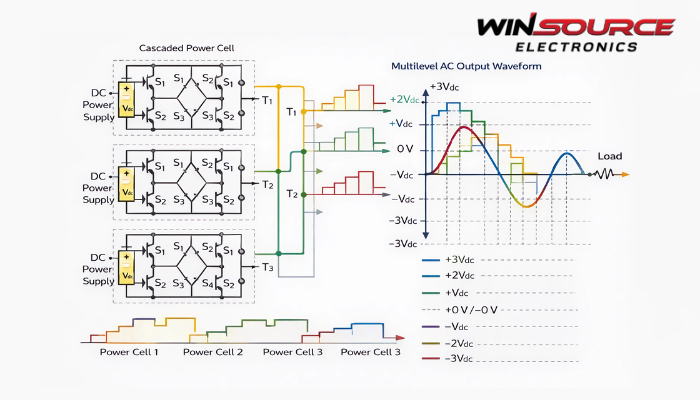
A multi-cell series multilevel inverter topology is widely used in medium- and high-voltage power conversion applications. By connecting multiple power cells in series, this topology can generate high-quality output waveforms while reducing voltage stress on individual power devices. However, it also introduces certain design and control challenges.
Advantages of Multi-Cell Series Multilevel Inverter Topology
1. Reduced Voltage Stress on Power Devices
Each power cell handles only a fraction of the total output voltage. This allows the use of lower-voltage semiconductor devices, improving reliability and reducing device stress.
2. Improved Output Voltage Quality
By increasing the number of voltage levels, the inverter output waveform more closely approximates a sinusoidal wave. This significantly reduces harmonic distortion and improves power quality.
3. Lower dv/dt and EMI
The stepwise voltage transitions result in lower voltage slew rates (dv/dt), which helps reduce electromagnetic interference (EMI) and stress on insulation systems.
4. Scalability and Modularity
The topology is modular by nature. Additional cells can be added to increase voltage levels or power capacity, making the system flexible and scalable for different applications.
5. Reduced Output Filter Requirements
Because of the improved waveform quality, the size and complexity of output filters can be reduced compared to two-level inverter topologies.
Disadvantages of Multi-Cell Series Multilevel Inverter Topology
1. Increased System Complexity
The use of multiple power cells increases system complexity in terms of hardware design, control algorithms, and fault management.
2. Voltage Balancing Challenges
Maintaining balanced voltage across each cell is critical. Imbalances can lead to uneven device stress and reduced system reliability, requiring sophisticated control strategies.
3. Higher Component Count
Compared to conventional inverters, this topology requires more power switches, gate drivers, and passive components, increasing system cost and size.
4. Complex Control and Modulation
Advanced modulation techniques are needed to ensure proper switching coordination and voltage balancing, increasing control implementation difficulty.
5. Fault Tolerance and Maintenance Issues
A failure in a single cell can affect the overall system operation. Fault detection, isolation, and maintenance are more challenging compared to simpler inverter structures.
Summary
The multi-cell series multilevel inverter topology offers significant advantages in terms of voltage scalability, output waveform quality, and reduced device stress, making it suitable for medium- and high-voltage applications. However, these benefits come at the cost of increased system complexity, higher component count, and more demanding control requirements.

COMMENTS