* Question
What are the characteristics of digital oscilloscopes and analog oscilloscopes?
* Answer
Characteristics of Digital Oscilloscopes
1. Digital Signal Processing:
– Digital oscilloscopes sample the analog input signal and convert it into a digital format using an analog-to-digital converter (ADC).
– These digital samples are then processed, stored, and displayed.
2. Memory and Storage:
– Digital oscilloscopes can store waveforms in memory for later analysis.
– They often have the ability to save data to external storage devices like USB drives.
3. Advanced Features:
– Offer various advanced features such as FFT analysis, automatic measurements, and waveform math functions.
– Capable of sophisticated triggering options (e.g., edge, pulse width, logic).
4. Display:
– Typically have high-resolution color displays.
– Can display multiple channels simultaneously with detailed and clear waveforms.
5. Bandwidth and Sampling Rate:
– The bandwidth and sampling rate are key specifications, with higher values allowing more detailed capture of fast signals.
– Sampling rates are generally high, often in the GHz range.
6. Connectivity:
– Often equipped with modern connectivity options like USB, Ethernet, and Wi-Fi.
– Can interface with PCs for extended analysis and data transfer.
7. Flexibility:
– Suitable for capturing and analyzing both repetitive and single-shot (transient) signals.
– Can handle a wide range of frequencies and signal types.
8. Software Integration:
– Many digital oscilloscopes come with software that allows for advanced data analysis and remote control.
– Some models offer cloud storage and remote viewing capabilities.
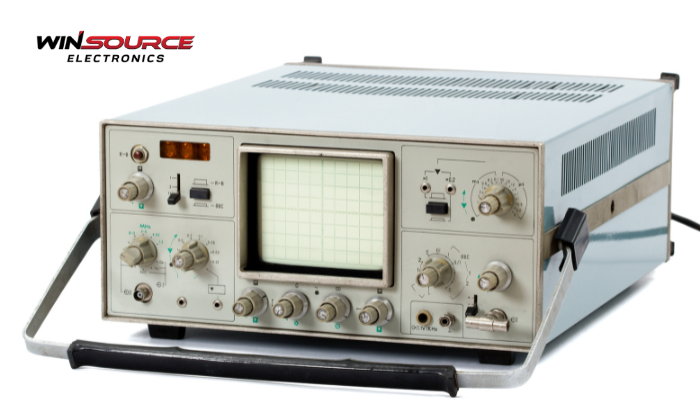
Characteristics of Analog Oscilloscopes
1. Real-Time Display:
– Analog oscilloscopes display signals in real-time without any lag, providing a continuous representation of the waveform.
– The signal is displayed directly on the screen using a cathode-ray tube (CRT).
2. Simplicity:
– Generally simpler in design and operation compared to digital oscilloscopes.
– Basic analog oscilloscopes have fewer advanced features but are easy to use.
3. Bandwidth:
– Typically, analog oscilloscopes have lower bandwidth compared to modern digital oscilloscopes.
– Suitable for measuring low to moderate frequency signals.
4. Resolution and Accuracy:
– Resolution is limited by the CRT display and the analog components.
– Precision can be affected by component drift and aging.
5. Triggering:
– Basic triggering capabilities such as edge triggering are available.
– Less flexible and sophisticated compared to digital oscilloscopes.
6. No Data Storage:
– Analog oscilloscopes cannot store waveforms for later analysis.
– They do not have memory to save data, making them unsuitable for capturing transient events.
7. Display Characteristics:
– The display is usually monochrome and less detailed than digital displays.
– Refresh rates and visibility can be affected by the phosphor persistence of the CRT.
8. Portability and Power Consumption:
– Analog oscilloscopes are often bulkier and heavier compared to their digital counterparts.
– They consume more power due to the CRT and analog circuitry.
Comparison
– Digital Oscilloscopes: Offer advanced features, high resolution, storage capabilities, and modern connectivity, making them versatile for a wide range of applications. They are suitable for both high-speed and complex signal analysis.
– Analog Oscilloscopes: Provide a real-time display of signals with simplicity and ease of use. They are generally more affordable and suitable for basic signal observation and low to moderate frequency analysis.
Choosing between a digital and an analog oscilloscope depends on the specific requirements of the task, the complexity of the signals being measured, and the need for advanced features and data storage.