
* Question
What are the key characteristics of self-oscillation in power and control circuits?
* Answer
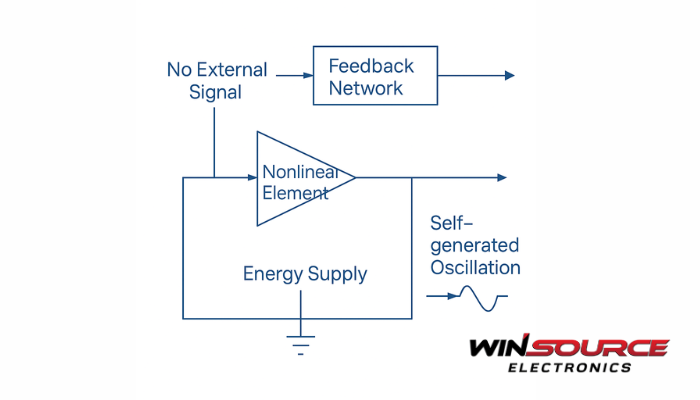
Self-oscillation refers to the phenomenon where a circuit or system generates a periodic oscillation without any external periodic input.
Unlike driven oscillators, which rely on an external signal or clock source, self-oscillating systems maintain their own oscillation through internal feedback mechanisms that sustain energy transfer over time.
1. Spontaneous Oscillation Without External Excitation
The most fundamental characteristic of self-oscillation is that the periodic signal arises spontaneously due to internal dynamics—typically through a feedback loop with sufficient gain and phase shift to satisfy the Barkhausen criterion.
This means the system can start oscillating from small noise or transient disturbances without an external trigger.
2. Energy Feedback and Nonlinear Control
In a self-oscillating system, energy is continuously supplied from a DC source and modulated through a nonlinear feedback element (such as a comparator, amplifier, or transistor).
The nonlinear behavior regulates amplitude, ensuring the oscillation remains stable and doesn’t grow indefinitely.
This property makes self-oscillation particularly useful in switch-mode power supplies (SMPS) and class-D amplifiers, where it enables efficient self-regulated switching.
3. Frequency Determined by Circuit Parameters
The oscillation frequency in self-oscillating circuits is defined by circuit parameters—such as inductance, capacitance, resistance, or propagation delay—rather than an external clock.
For instance, in self-oscillating flyback converters, the switching frequency depends on transformer characteristics and feedback response, automatically adjusting under varying load or input conditions.
4. Sensitivity to Feedback and Load Conditions
Self-oscillation is inherently sensitive to variations in feedback loop gain, propagation delay, and load impedance.
If the feedback phase or amplitude changes excessively, the oscillation may shift in frequency or become unstable, leading to jitter, distortion, or unwanted noise—particularly critical in power converters and control loops.
5. Applications in Power Electronics
Self-oscillating control is commonly used in:
- DC-DC converters(especially quasi-resonant or flyback topologies)
- Class-D amplifiersfor audio systems
- Electronic oscillatorsand sensor circuits that require automatic frequency adaptation
Its simplicity and ability to adapt to dynamic load conditions make it a robust choice in cost-sensitive and compact designs.
Summary Insight
In summary, self-oscillation is characterized by its autonomous generation of oscillatory behavior, governed by internal feedback, nonlinear dynamics, and circuit parameters.
It offers efficiency and adaptability advantages in modern power and signal circuits but requires careful loop stability design to prevent unwanted oscillation modes or instability.

COMMENTS