* Question
What Are the Components of an RFID System?
* Answer
An RFID (Radio Frequency Identification) system is an automatic identification technology that uses radio waves to exchange data between electronic tags and readers. It enables objects, products, or assets to be identified and tracked without direct physical contact.
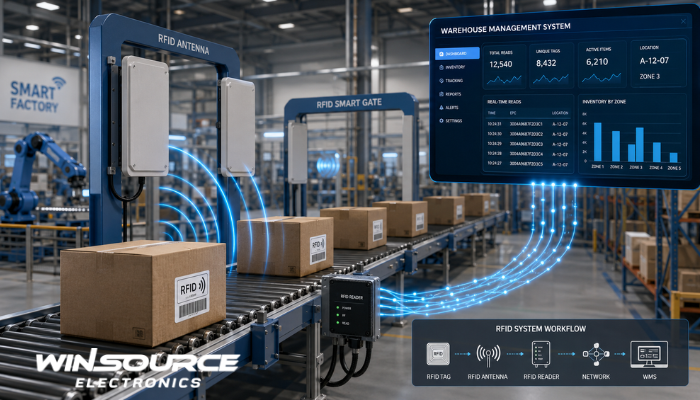
A typical RFID system consists of four main components: RFID tags, RFID readers, antennas, and data processing systems. Together, these components enable wireless identification, data collection, and information management.
1. RFID Tags
The RFID tag is the identification component attached to an object. It stores information about the item and communicates with RFID readers through radio frequency signals.
An RFID tag usually contains:
- Microchip– stores identification data and controls communication
- Antenna– receives and transmits radio signals
- Substrate or packaging material– provides physical support and protection
RFID tags are generally divided into three types:
Passive RFID Tags
Passive tags do not have their own power source. They obtain energy from the radio waves emitted by the reader.
Advantages:
- Low cost
- Small size
- Long service life
They are widely used in:
- Inventory management
- Retail tracking
- Logistics
- Access control
Active RFID Tags
Active tags contain an internal battery that powers signal transmission.
Advantages:
- Longer communication distance
- Higher data transmission capability
They are commonly used for:
- Asset tracking
- Vehicle monitoring
- Industrial equipment management
Semi-Passive RFID Tags
Semi-passive tags use a battery to power internal circuits but rely on the reader for communication.
They are often used when additional sensing capability is required, such as temperature or environmental monitoring.
2. RFID Readers
The RFID reader is responsible for communicating with tags and collecting their information.
Its main functions include:
- Sending radio frequency signals to activate tags
- Receiving data transmitted from tags
- Decoding and processing RFID information
- Communicating with backend systems
RFID readers can be categorized into:
- Fixed readers– installed at specific locations, such as warehouse entrances or production lines
- Handheld readers– portable devices used for mobile inventory checks and field operations
3. RFID Antennas
The antenna is a critical part of RFID communication. It allows the reader and tag to exchange radio frequency signals.
RFID antennas determine:
- Communication range
- Signal coverage
- Reading accuracy
- Operating frequency performance
Different applications require different antenna designs depending on:
- Reading distance
- Installation environment
- Tag orientation
- Required data throughput
4. RFID Middleware and Data Processing Systems
The RFID reader collects raw identification data, but additional software is needed to process and manage this information.
RFID middleware performs tasks such as:
- Filtering duplicate tag readings
- Managing communication between readers and databases
- Converting RFID data into usable information
The processed data can then be integrated into systems such as:
- Enterprise Resource Planning (ERP)
- Warehouse Management Systems (WMS)
- Manufacturing Execution Systems (MES)
- Supply chain management platforms
How Do RFID Components Work Together?
The basic workflow of an RFID system is:
- The RFID reader sends a radio signalthrough its antenna.
- The RFID tag receives the signaland responds with stored identification data.
- The reader captures the informationand sends it to the processing system.
- The software platform analyzes and manages the datafor tracking, monitoring, or automation purposes.
This process allows organizations to identify and track objects automatically without manual scanning.
What Are the Common Applications of RFID Systems?
RFID technology is widely used in many industries, including:
- Manufacturing– production tracking and work-in-process management
- Logistics and warehousing– inventory control and shipment tracking
- Healthcare– medical equipment and patient identification
- Retail– product management and anti-theft systems
- Automotive– component tracking and production automation
- IoT applications– connecting physical assets with digital systems
Why Is RFID Important for Modern Industries?
With the growth of smart manufacturing, IoT, and digital supply chains, companies increasingly need real-time visibility into their assets and operations.
By combining RFID tags, readers, antennas, and data management systems, RFID provides:
- Faster identification
- Improved inventory accuracy
- Reduced manual operations
- Better supply chain visibility
- More efficient automation processes
As industries continue moving toward intelligent operations, RFID remains an important technology for connecting physical objects with digital information systems.