
* Question
What Are the Naming Rules for Identifiers?
* Answer
In programming, an identifier is the name given to elements such as variables, functions, constants, classes, or modules.
Identifiers allow programmers to reference and manipulate data or logic within code.
Although specific rules may vary slightly between programming languages, most modern languages follow a common set of naming rules and conventions.
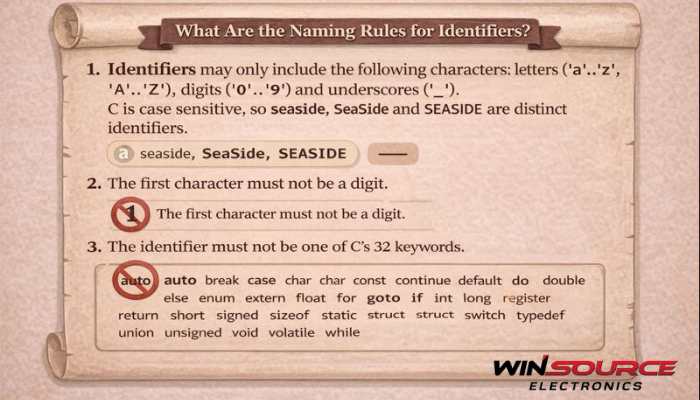
1. Allowed Characters in Identifiers
In general, an identifier may include:
- Letters(A–Z, a–z)
- Digits(0–9)
- Underscores(_)
However:
- An identifier must not start with a digit
- Spaces and special characters (such as @, #, %, &) are not allowed
Valid examples:
- counter
- total_sum
- data3
Invalid examples:
- 3data(starts with a digit)
- total-sum(contains a hyphen)
- user name(contains a space)
2. Reserved Words Cannot Be Used
Identifiers cannot use reserved keywords defined by the programming language.
For example:
- In C / Java: int, while, return
- In Python: class, def, lambda
These words have predefined meanings and cannot be reused as identifiers.
3. Case Sensitivity Rules
Most modern programming languages are case-sensitive, meaning:
- Value
- value
- VALUE
are treated as three different identifiers.
Because of this, consistent capitalization is important to avoid confusion and errors.
4. Length and Readability
While many languages allow long identifiers, good practice recommends:
- Using clear and descriptive names
- Avoiding unnecessary abbreviations
- Keeping names readable and meaningful
Example:
- Better: temperatureSensorValue
- Worse: tsv
Readable identifiers improve code maintenance and reduce misunderstanding.
5. Common Naming Conventions (Recommended Practices)
Although not strict rules, these conventions are widely used:
- camelCase: userName, totalCount
- snake_case: user_name, total_count
- PascalCase: UserName, CustomerOrder
- UPPER_CASE(constants): MAX_SIZE, TIMEOUT_MS
The choice usually depends on:
- Programming language
- Team standards
- Project type
Engineering Insight
Following proper identifier naming rules is not just about avoiding syntax errors—it directly affects code clarity, maintainability, and collaboration efficiency.
Well-named identifiers help both developers and non-technical stakeholders better understand what the code is doing.
Conclusion
The basic naming rules for identifiers can be summarized as follows:
- Use letters, digits, and underscores only
- Do not start identifiers with digits
- Do not use language reserved keywords
- Respect case sensitivity
- Prefer clear, descriptive, and consistent naming
Understanding and following these rules helps ensure clean, readable, and error-free code across different programming environments.

COMMENTS