* Question
What should I consider when choosing a resistor?
* Answer
When choosing a resistor, engineers should consider more than just the resistance value. The right resistor affects circuit accuracy, stability, heat performance, long-term reliability, and overall product cost.
The first factor is resistance value. It determines how much the resistor limits current or divides voltage in the circuit. The selected value should match the circuit design requirements and the available standard resistor series, such as E12, E24, E96, or E192.
The second factor is tolerance. Tolerance shows how close the actual resistance is to the rated value. For general circuits, ±5% or ±1% may be enough. For precision circuits, such as measurement equipment, sensor interfaces, voltage references, and feedback networks, tighter tolerance values such as ±0.1% or ±0.01% may be required.
Power rating is also critical. A resistor converts electrical energy into heat. If the power dissipation exceeds its rated capacity, the resistor may overheat, drift, or fail. Engineers should calculate the actual power using formulas such as P = I²R or P = V²/R, and leave enough derating margin for long-term reliability.
Another important parameter is the temperature coefficient of resistance, usually expressed in ppm/°C. It indicates how much the resistance changes with temperature. A lower TCR is preferred in precision, automotive, industrial, and high-temperature applications.
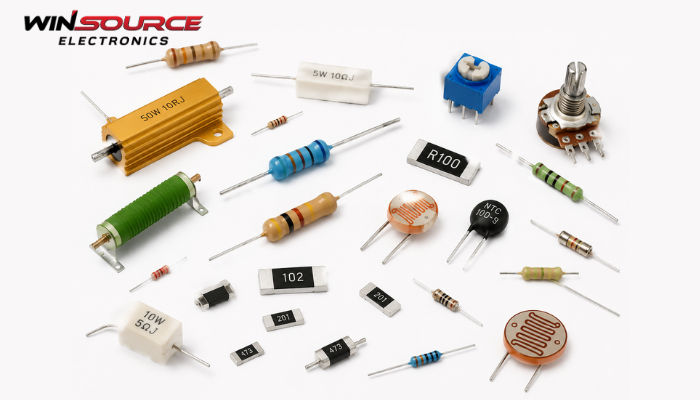
The resistor type should also match the application. Carbon film resistors are suitable for low-cost general circuits. Metal film resistors offer better accuracy and stability. Wirewound resistors handle higher power but may have inductance. Thick film and thin film chip resistors are widely used in surface-mount designs, with thin film types offering better precision and stability.
Engineers should also consider package size and mounting method. Common SMD sizes include 0402, 0603, 0805, 1206, and larger power packages. Smaller resistors save PCB space but usually have lower power ratings and may be more sensitive to thermal stress.
Voltage rating is another factor that should not be ignored. Even if the power rating is sufficient, the resistor must also withstand the maximum voltage applied across it. This is especially important in high-voltage dividers, power supplies, automotive electronics, and industrial control systems.
For high-frequency or fast-switching circuits, parasitic inductance and capacitance matter. Some resistor types may affect signal integrity, pulse response, or RF performance. In these cases, low-inductance resistors or dedicated RF resistors may be more suitable.
Reliability and environment should also be evaluated. Humidity, temperature cycling, vibration, sulfur exposure, overload pulses, and long operating hours can all affect resistor performance. For harsh environments, engineers may choose anti-sulfur resistors, automotive-grade resistors, high-reliability resistors, or pulse-withstanding resistors.
Finally, availability and cost are practical considerations. A resistor may meet the technical requirements, but it should also be available in stable supply, suitable packaging, and acceptable price for production.
In summary, choosing a resistor requires consideration of resistance value, tolerance, power rating, TCR, resistor type, package size, voltage rating, frequency behavior, environmental reliability, cost, and supply availability. A well-selected resistor helps improve circuit stability, reduce failure risk, and ensure long-term product performance.