* Question
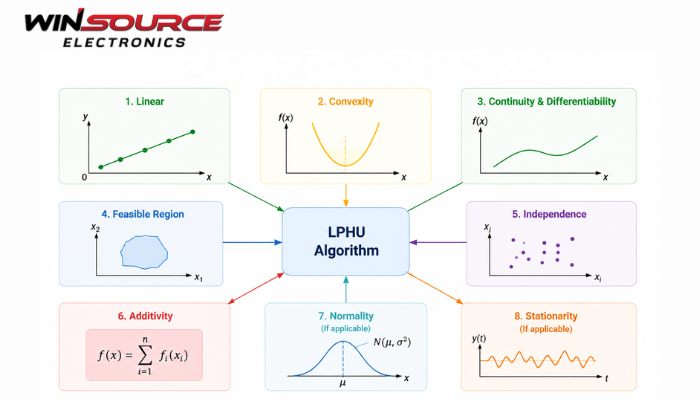
What assumptions are made by the LPHU algorithm?
* Answer
The LPHU (Likely Local Peak / Harmonic Unfolding) algorithm is typically used in signal processing for peak detection and harmonic analysis. Its operation relies on several underlying assumptions:
- Local Peak Existence:
- The algorithm assumes that significant signal features appear as local peaks within the sampled data.
- Noise or minor fluctuations are treated as non-relevant, and a threshold may be applied to distinguish true peaks.
- Harmonic Relationships:
- Harmonics in the signal are assumed to be integer multiples of a fundamental frequency.
- The algorithm uses this assumption to “unfold” overlapping harmonics and correctly identify their amplitudes and positions.
- Quasi-Stationarity of Signal:
- The signal is assumed to be locally stationary over the analysis window, meaning its frequency content does not change drastically within the sampled segment.
- This ensures reliable peak detection and harmonic mapping.
- Noise Characteristics:
- Noise is assumed to be additive and relatively low compared to signal peaks, allowing the algorithm to distinguish true peaks from random fluctuations.
- Sampling Adequacy:
- The data must be sampled at a rate high enough to capture relevant peaks without aliasing.
- Undersampling may lead to missed peaks or misidentified harmonics.
Summary:
The LPHU algorithm operates under the assumptions that the signal contains distinguishable local peaks, harmonics follow integer multiples of a fundamental, and the signal is locally stationary with manageable noise. These assumptions allow it to effectively detect and unfold peaks for further spectral or feature analysis.