*Image from the internet; all rights belong to the original author, for reference only.
What Does SK Hynix’s Early HBM4E Sample Delivery Mean?
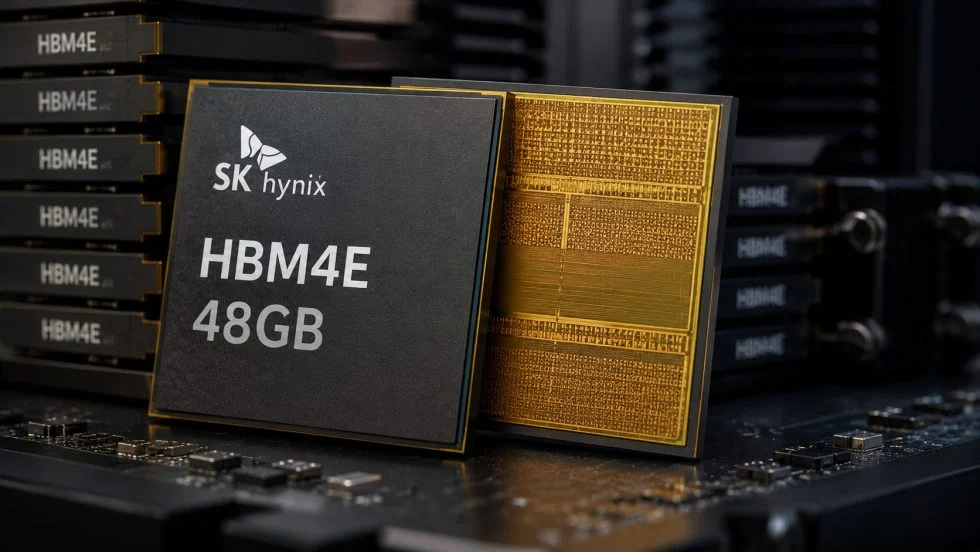
On June 18, SK Hynix announced that it has delivered 12-layer HBM4E engineering samples to key customers and has entered the customer qualification phase. This progress comes earlier than market expectations.
Against the backdrop of continuously increasing AI computing demand, this development is not simply a product milestone. It reflects a broader signal: the validation and alignment of critical components in the AI supply chain are shifting earlier in the cycle.
Q1: What does the early HBM4E sample delivery indicate?
From a supply chain perspective, the most important change is timing.
The involvement of key AI accelerator customers, including leading GPU platform players such as NVIDIA, is moving further upstream into the design phase. As a result, HBM is gradually shifting from a traditional memory component to a system-level co-designed architecture element.
This leads to several structural changes:
- Supplier selection is moving earlier in the lifecycle
- Product validation cycles are becoming shorter
- Design-stage alignment is becoming more significant
Overall, the supply chain is entering an earlier-stage locking phase.
Q2: Why has HBM become a critical node in the AI supply chain?
HBM is no longer a standalone memory component in AI systems. It has become part of the foundational architecture of AI computing platforms.
Its supply chain characteristics include:
- High supplier concentration
- Long capacity expansion cycles
- High manufacturing and packaging complexity
- Limited substitution options
Within this structure, HBM functions more like a system-level constraint resource rather than a standard electronic component.
Q3: What does 12-layer stacking and capacity improvement imply?
HBM4E adopts a 12-layer stacking architecture and increases per-stack capacity to up to 48GB, while also achieving:
- Up to 16Gbps per pin data rate
- Approximately 20% improvement in energy efficiency
At the system level, these changes result in:
- Higher memory bandwidth per GPU
- Increased data throughput for AI training and inference workloads
- Improved power efficiency per unit of computing performance
Overall, the coupling between compute capability and memory bandwidth continues to strengthen.
Q4: How does HBM evolution impact the broader electronics supply chain?
HBM generation upgrades do not remain isolated within memory components. They propagate through the system architecture.
The main impact areas include:
- AI computing platforms (GPUs and accelerator systems)
- High-speed interconnect and signal integrity components
- Advanced packaging and substrate structures (e.g., interposers and related technologies)
As HBM bandwidth increases, system-level design increasingly requires tighter coordination among multiple component categories.
Q5: What does the competition between Samsung and SK Hynix indicate?
Both companies are currently in the sampling and customer qualification phase for HBM4E. The focus of competition is shifting.
Rather than early-stage performance leadership, the competition is increasingly centered on:
- Speed of customer qualification
- Manufacturing scalability and consistency
- Long-term supply stability
At the same time, customers are playing a more dominant role in the supply chain, with supplier involvement moving further into the design stage.
Q6: What are the implications for procurement and supply chain strategy?
From an operational perspective, three major shifts can be observed:
1. Earlier decision cycles for critical components
Supplier selection is increasingly based on medium- to long-term capacity planning and customer alignment, rather than short-term pricing.
2. Long-term capacity commitments becoming standard
Due to tight coupling between HBM, GPU compute chips, and advanced packaging capacity, procurement is shifting from quarterly adjustments to multi-year capacity agreements.
3. Changes in financial and supply structures
To secure priority supply, some key customers are adopting stricter prepayment terms and Take-or-Pay agreements.
Overall, supply chain management is shifting its focus from cost optimization toward supply assurance.
Associated Supply Chain Impact Areas
HBM generation upgrades typically generate cascading effects across the system. The main transmission paths include:
- AI computing platforms (GPUs and accelerator modules)
- High-bandwidth memory products (HBM3E / HBM4 / HBM4E)
- High-speed interconnect and advanced packaging components (such as interposers and substrate-related structures)
These segments are increasingly interconnected at a system level rather than evolving independently.
Conclusion
The early shipment of HBM4E samples reflects more than a product milestone. It indicates a structural shift in the AI supply chain.
The key takeaway can be summarized as follows:
Critical components in AI computing systems are being locked into the supply chain at increasingly earlier stages.
© 2026 Win Source Electronics. All rights reserved. This content is protected by copyright and may not be reproduced, distributed, transmitted, cached or otherwise used, except with the prior written permission of Win Source Electronics.