
* Question
What Is Photocurrent in Semiconductor Devices?
* Answer
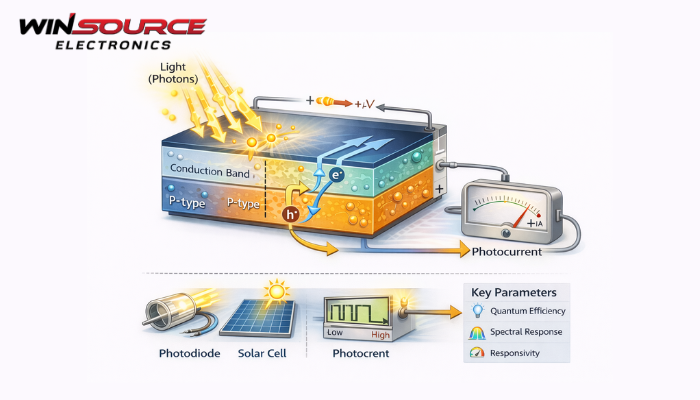
Photocurrent is the electric current generated in a material or electronic device when it is exposed to light. This phenomenon occurs because incoming photons transfer energy to electrons in a semiconductor, creating mobile charge carriers that can move through the device and produce an electrical current.
Photocurrent is a fundamental principle behind many optoelectronic devices, including photodiodes, solar cells, phototransistors, and optical sensors.
1. Basic Principle of Photocurrent Generation
Photocurrent originates from the photoelectric effect in semiconductors. When light strikes a semiconductor material, photons with sufficient energy can excite electrons from the valence band into the conduction band.
This process generates:
- Free electrons
- Holes (positive charge carriers)
These charge carriers can then move under the influence of an internal or external electric field, producing a measurable electric current.
The process can be summarized as:
- Incident photons hit the semiconductor surface
- Photon energy excites electrons
- Electron–hole pairs are generated
- Charge carriers move through the device
- Electrical current is produced
This current is referred to as photocurrent.
2. Photocurrent in Photodiodes
In a photodiode, photocurrent is generated when light enters the p–n junction region.
Under illumination:
- Photons create electron–hole pairs within the depletion region
- The built-in electric field separates these carriers
- Electrons move toward the n-type region
- Holes move toward the p-type region
This movement of charge carriers forms the photocurrent, which is proportional to the intensity of the incident light.
Because of this property, photodiodes are widely used in:
- Optical communication receivers
- Light detection systems
- Imaging sensors
3. Relationship Between Photocurrent and Light Intensity
Photocurrent is generally proportional to the intensity of incident light over a certain operating range.
This relationship can be expressed conceptually as:
Photocurrent ∝ Incident light power
As the number of photons striking the semiconductor increases, more electron–hole pairs are generated, resulting in a higher current.
However, at very high illumination levels, the device may experience saturation effects, which limit further current increase.
4. Factors Affecting Photocurrent
Several factors influence the magnitude of photocurrent in semiconductor devices:
Light wavelength – Photons must have sufficient energy to excite electrons across the bandgap.
Material properties – Different semiconductor materials (such as silicon, GaAs, or InGaAs) respond to different wavelength ranges.
Device structure – Junction design and depletion region width affect carrier collection efficiency.
Quantum efficiency – Determines how effectively photons generate charge carriers.
Optimizing these factors is essential in the design of high-sensitivity optical detectors.
5. Applications of Photocurrent
Photocurrent is widely used in many modern electronic and optoelectronic technologies.
Typical applications include:
- Solar cellsfor converting sunlight into electrical energy
- Optical communication receivers
- Digital cameras and image sensors
- Light intensity meters
- Automatic lighting control systems
In these systems, photocurrent serves as the electrical signal that represents incoming optical information.
Conclusion
Photocurrent is the electric current generated when light interacts with a semiconductor material and produces mobile charge carriers. Through the creation and movement of electron–hole pairs, optical energy is converted into electrical signals. This process forms the foundation of many important devices, including photodiodes, solar cells, and optical sensors, making photocurrent a key concept in modern optoelectronics.

COMMENTS