* Question
What is Photoelectric Property?
* Answer
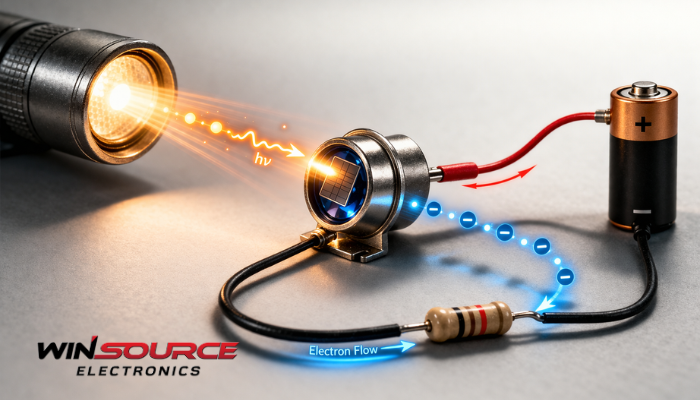
Photoelectric property refers to the ability of a material to emit electrons when exposed to light or other electromagnetic radiation. This phenomenon is known as the photoelectric effect, and it plays a fundamental role in the interaction between light and matter. The photoelectric property is most commonly observed in metals, where the absorption of photons (light particles) causes the ejection of electrons from the material’s surface.
The key principles of photoelectric property include:
- The Photoelectric Effect:
The photoelectric effect occurs when light, typically ultraviolet (UV) or visible light, strikes a material and causes the emission of electrons from the material’s surface. The energy from the photons is transferred to the electrons, allowing them to overcome the work function (the energy required to release the electron from the material). If the energy of the photons is greater than or equal to the work function, electrons are emitted, creating a current. - Material Dependence:
Not all materials exhibit photoelectric properties in the same way. Metals like copper, aluminum, and goldare good conductors and typically exhibit strong photoelectric effects. On the other hand, insulating materials and semiconductors may require higher energy light or specific conditions to exhibit similar behavior. - Threshold Frequency:
The photoelectric effect is only observed when the frequency of the incident light is above a certain threshold frequency, which corresponds to the energy needed to release electrons. Below this threshold, no electrons are emitted, regardless of the light’s intensity. - Applications of Photoelectric Property:
The photoelectric property is widely used in various applications, including:
- Photovoltaic cells (solar panels): These devices use the photoelectric effect to convert sunlight into electrical energy. Photons from sunlight strike the solar cell material, causing the emission of electrons, which generates electricity.
- Photoelectric sensors: These sensors use the photoelectric effect to detect the presence or absence of objects by measuring changes in light intensity.
- Electron microscopes: In these devices, the photoelectric effect is used to create images at the atomic level.
- Light meters and cameras: These devices often rely on the photoelectric property to measure light intensity.
- Einstein’s Contribution:
The photoelectric effect was first explained by Albert Einsteinin 1905, who won the Nobel Prize in Physics for his work on this phenomenon. His explanation helped establish the concept of quantized energy levels and laid the foundation for the development of quantum mechanics.
Insight:
The photoelectric property is a critical concept in both physics and practical applications. It bridges the gap between light and electricity and is at the core of technologies like solar power and electronic sensors. Understanding how materials interact with light through the photoelectric effect opens the door to numerous innovations in energy generation, detection systems, and material science.