* Question
What Is a Mirror-Type Karman Vortex Airflow Sensor?
* Answer
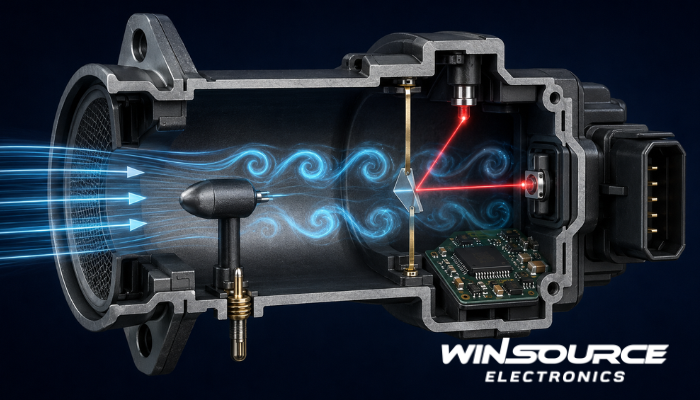
A mirror-type Karman vortex airflow sensor is an optical airflow meter commonly used in automotive engine management systems. It measures intake air volume by detecting the vortices created when air passes around a specially shaped obstruction called a vortex generator or bluff body.
As air flows past the vortex generator, alternating vortices form downstream in a pattern known as a Karman vortex street. The frequency at which these vortices are produced increases with airflow velocity. By measuring this frequency, the sensor can determine the volume of air entering the engine.
How Does It Work?
The sensor typically consists of:
- A vortex generator
- A light-emitting diode (LED)
- A phototransistor
- A lightweight mirror
- A tension band
- A thick-film signal-conditioning circuit
- An intake air temperature sensor
Pressure fluctuations caused by the vortices make the tension-band-supported mirror oscillate. The LED projects a beam of light onto the mirror, which reflects the light toward the phototransistor. As the mirror moves, the amount or position of reflected light reaching the phototransistor changes periodically.
The phototransistor converts these optical variations into electrical pulses. After signal conditioning, the sensor sends a frequency-based output to the engine control unit (ECU). A higher pulse frequency generally indicates a higher intake airflow rate.
The ECU uses this airflow data, together with inputs such as intake air temperature, engine speed, and manifold pressure, to calculate engine load, fuel-injection duration, and ignition timing.
Applications
Mirror-type Karman vortex airflow sensors are mainly found in certain electronic fuel-injection systems, particularly in some older Japanese vehicle platforms. They support functions such as:
- Air–fuel ratio control
- Engine-load calculation
- Ignition-timing adjustment
- Turbocharger management
- Emissions control
Design and Replacement Considerations
When sourcing a replacement sensor, verify the connector and pin configuration, supply voltage, airflow range, output-frequency characteristics, housing dimensions, and intake air temperature sensor specifications. Two sensors with similar housings may not be electrically or functionally interchangeable.
Common problems include contamination inside the airflow passage, damaged tension bands, restricted mirror movement, degraded optical components, wiring faults, and intake air leaks. Because the mirror mechanism is delicate and factory-calibrated, it should not be touched or cleaned with aggressive solvents. Diagnosis should include checking the power supply, ground circuit, intake sealing, temperature-sensor resistance, and output waveform with an oscilloscope or frequency-capable multimeter.