* Question
What Is the Pyroelectric Effect?
* Answer
The pyroelectric effect is a phenomenon in which certain materials generate an electrical charge or voltage when their temperature changes. This occurs because temperature variations affect the internal polarization of the material, creating a measurable electrical signal.
The pyroelectric effect enables materials to convert thermal energy into electrical signals, making them useful in applications such as infrared sensing, motion detection, thermal measurement, and low-power sensing systems.
Unlike conventional temperature sensors that measure absolute temperature, pyroelectric devices mainly respond to changes in temperature. This unique characteristic makes them especially suitable for detecting moving heat sources and variations in infrared radiation.
How Does the Pyroelectric Effect Work?
Pyroelectric materials have a naturally polarized crystal structure. Under stable temperature conditions, the internal electric charges remain balanced.
When the temperature changes, the arrangement of atoms and electric dipoles inside the material changes as well. This affects the material’s spontaneous polarization and creates surface charges, producing a temporary voltage signal.
The basic process can be summarized as:
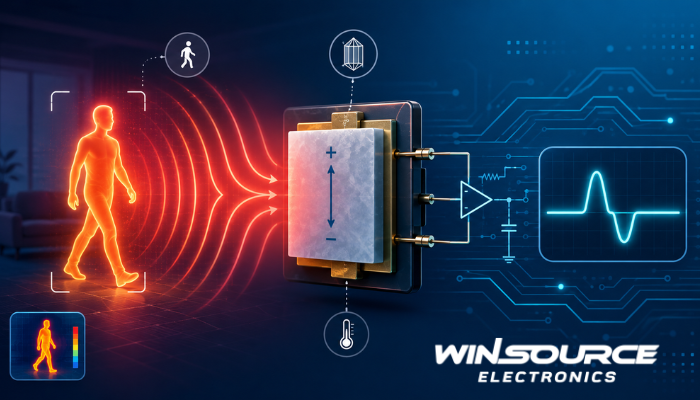
Temperature change → Polarization change → Electrical charge generation → Signal detection
The generated electrical signal depends mainly on the rate of temperature change, rather than the absolute temperature itself. This is why pyroelectric sensors are effective for detecting moving objects or changing infrared radiation but are not typically used for measuring constant temperatures.
What Materials Exhibit the Pyroelectric Effect?
Several materials have pyroelectric properties due to their special crystal structures. Common pyroelectric materials include:
- Lithium tantalate (LiTaO₃)
- Lithium niobate (LiNbO₃)
- Lead zirconate titanate (PZT)
- Polyvinylidene fluoride (PVDF)
- Triglycine sulfate (TGS)
The performance of a pyroelectric material depends on factors such as:
- Pyroelectric coefficient
- Sensitivity
- Temperature stability
- Mechanical properties
- Manufacturing compatibility
Different materials are selected depending on the requirements of the application, including detection range, response speed, and environmental conditions.
What Are Pyroelectric Sensors Used For?
Pyroelectric sensors are widely used because they can detect thermal changes without physical contact with the target object.
Infrared Motion Detection
One of the most common applications is the passive infrared (PIR) sensor.
PIR sensors use pyroelectric elements to detect changes in infrared radiation caused by moving objects. When a person or object moves within the detection area, the change in infrared energy generates an electrical signal that can trigger a control system.
Common applications include:
- Automatic lighting systems
- Security alarms
- Smart home devices
- Occupancy detection systems
Thermal Measurement and Infrared Detection
Pyroelectric materials can absorb infrared radiation and convert it into electrical signals. This makes them suitable for:
- Industrial temperature monitoring
- Non-contact measurement systems
- Thermal detection equipment
- Equipment inspection applications
Low-Power and IoT Applications
Because pyroelectric sensors can operate with low power consumption, they are also being explored for applications such as:
- Smart sensors
- Wireless monitoring systems
- IoT devices
What Is the Difference Between the Pyroelectric Effect and the Piezoelectric Effect?
The pyroelectric effect and piezoelectric effect are related because both involve the generation of electrical charges from changes in material properties. However, they are triggered by different conditions.
Feature | Pyroelectric Effect | Piezoelectric Effect |
Trigger | Temperature change | Mechanical stress or pressure |
Electrical response | Charge generated by thermal variation | Charge generated by mechanical deformation |
Common applications | Infrared sensors, thermal detectors | Vibration sensors, actuators, ultrasonic devices |
Some materials, such as PZT, can exhibit both pyroelectric and piezoelectric properties depending on their structure and operating conditions.
What Are the Advantages of Pyroelectric Sensors?
Pyroelectric sensors offer several advantages for modern electronic systems:
- Non-contact detection:They can detect infrared radiation without direct contact with the target.
- Low power consumption:They are suitable for battery-powered and IoT applications.
- Compact design:Their small size allows easy integration into electronic devices.
- Fast response to temperature changes:They can quickly detect variations in infrared energy.
These characteristics make pyroelectric sensors valuable in applications requiring efficient and reliable thermal detection.
What Are the Limitations of Pyroelectric Sensors?
Although pyroelectric sensors have many advantages, they also have some limitations:
- They detect temperature changes rather than absolute temperature.
- Environmental temperature fluctuations may affect performance.
- The output signal is usually small and requires amplification.
- Accurate measurement may require calibration and signal processing.
For applications requiring precise temperature measurement, engineers should consider additional factors such as sensor design, signal conditioning, and environmental compensation.
Why Is the Pyroelectric Effect Important?
The pyroelectric effect provides an effective method for converting thermal changes into electrical signals. Its ability to support non-contact detection, low-power operation, and compact sensor designs makes it an important technology in modern electronics.
With increasing demand for smart home devices, industrial automation, IoT systems, and advanced sensing solutions, pyroelectric materials continue to play an important role in thermal detection and infrared sensing applications.