
* Question
What is the role of the parallel RC network at both ends of the thyristor?
* Answer
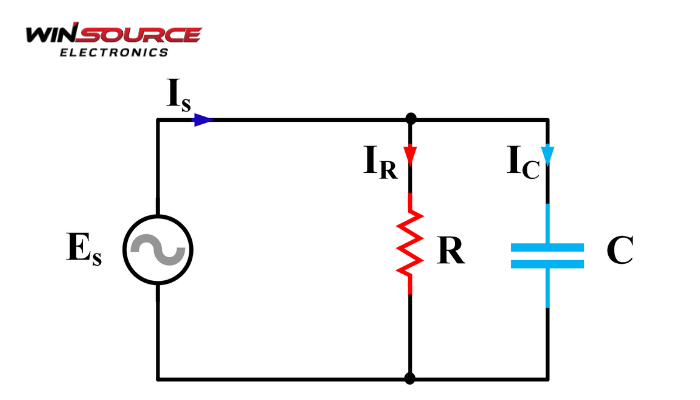
A parallel RC network, commonly known as an RC snubber, is often connected across the anode and cathode of a thyristor (SCR).
Its primary role is to protect the thyristor from false triggering, excessive voltage stress, and switching transients, thereby improving circuit reliability and operational stability.
This RC network is widely used in AC power control, motor drives, rectifiers, inverters, and industrial power electronics.
1. Suppressing Excessive dv/dt (Rate of Voltage Rise)
Why dv/dt Is a Problem
Thyristors can unintentionally turn on if the voltage across them rises too quickly.
This happens because internal junction capacitances generate a displacement current that may trigger conduction.
How the RC Network Helps
- The capacitor (C)slows down the rate of voltage rise across the thyristor.
- The resistor (R)limits the charging current of the capacitor.
Together, they reduce dv/dt, preventing false or unintended triggering.
2. Absorbing Switching Transients and Voltage Spikes
In inductive loads (motors, transformers, solenoids), rapid current interruption causes high-voltage spikes due to stored magnetic energy.
The parallel RC network:
- Absorbs transient energy
- Clamps peak voltage
- Reduces stress on the thyristor junction
This protection is especially critical in devices such as TYN612 or C106 SCRs, which have defined maximum repetitive peak off-state voltages.
3. Limiting Turn-Off Overvoltage and Ringing
When a thyristor turns off, parasitic inductance in wiring can cause oscillation and ringing.
The RC network:
- Provides a damping path
- Suppresses oscillations
- Stabilizes voltage transitions
This helps maintain predictable commutation behavior in phase-controlled rectifiers and AC regulators.
4. Improving EMC and Reducing EMI
Fast voltage transitions are a major source of electromagnetic interference (EMI).
By smoothing voltage edges, the RC snubber:
- Reduces radiated and conducted EMI
- Improves compliance with EMC standards
- Minimizes interference with nearby control electronics
This is particularly important in industrial environments and power supplies.
5. Design Considerations for the RC Network
Capacitor Selection
- Typically polypropylene or polyester film capacitors
- Rated for high voltage and low ESR
Resistor Selection
- Non-inductive, high-power resistors
- Chosen to balance damping and power loss
Typical Values
- Capacitance: 0.01 µF to 0.1 µF
- Resistance: 10 Ω to 100 Ω
The exact values depend on load characteristics, supply voltage, and thyristor specifications.
Engineering Insight
The RC network does not improve thyristor performance directly—it protects the operating conditions under which the thyristor functions safely.
Modern power semiconductors often specify maximum dv/dt ratings, and proper snubber design ensures these limits are never exceeded in real-world applications.
In some advanced designs, RC snubbers may be replaced or supplemented by RCD snubbers, MOVs, or TVS diodes, depending on energy levels and switching behavior.
Conclusion
The parallel RC network connected across a thyristor plays a critical role in:
- Suppressing excessive dv/dt
- Preventing false triggering
- Absorbing voltage spikes
- Reducing switching oscillations
- Improving EMI performance
By stabilizing voltage transitions and protecting against transients, the RC snubber ensures reliable and long-term operation of thyristor-based power circuits.

COMMENTS