
* Question
What Is Sensitivity Temperature Drift?
* Answer
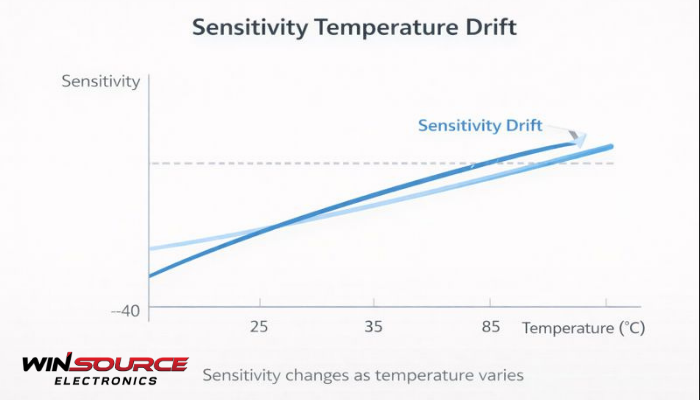
Sensitivity temperature drift refers to the change in a device’s sensitivity as the operating temperature varies.
In simple terms, it describes how much a sensor or electronic component’s output response changes with temperature, even when the input signal remains the same.
This parameter is especially important in sensors, measurement circuits, and precision analog systems.
1. What “Sensitivity” Means in This Context
Sensitivity is the ratio between the output signal and the input stimulus.
Examples:
- A pressure sensor: output voltage per unit pressure
- A temperature sensor: voltage per degree
- A current sensor: output per ampere
If temperature changes cause this ratio to shift, the device no longer responds consistently to the same input.
2. What Causes Sensitivity Temperature Drift
Sensitivity temperature drift occurs mainly due to:
- Temperature-dependent material properties
- Changes in semiconductor parameters
- Variations in internal amplifier gain
- Mechanical stress caused by thermal expansion
As temperature rises or falls, these factors alter how efficiently the device converts input signals into output signals.
3. How Sensitivity Temperature Drift Is Specified
Manufacturers usually express sensitivity temperature drift as:
- %/°C
- ppm/°C
Example
If a sensor has a sensitivity temperature drift of 0.05%/°C, it means:
- For every 1°C temperature change, the sensitivity changes by 0.05%
Over a wide temperature range, this drift can lead to noticeable measurement errors.
4. Why Sensitivity Temperature Drift Matters
Sensitivity temperature drift affects:
- Measurement accuracy
- Repeatability
- Long-term system stability
In applications such as:
- Industrial sensing
- Automotive electronics
- Medical devices
- Precision instrumentation
Even small sensitivity changes can accumulate into significant system-level errors if not compensated.
5. How Sensitivity Temperature Drift Is Managed
Common approaches include:
- Using temperature-compensated sensors
- Applying software-based calibration
- Designing circuits with low-drift components
- Operating devices within controlled temperature ranges
Modern systems often combine hardware stability with digital compensation algorithms to minimize drift effects.
Engineering Insight
Sensitivity temperature drift does not usually cause sudden failure.
Instead, it introduces gradual accuracy deviation, which can be harder to detect but more damaging in precision systems. Understanding this parameter helps users choose the right components and design more reliable measurement solutions.
Conclusion
Sensitivity temperature drift describes how a device’s sensitivity changes as temperature varies.
It is a key parameter for evaluating accuracy and stability in sensors and precision electronics, and it must be considered when designing systems that operate across wide temperature ranges.

COMMENTS