* Question
What is the working principle of a timer/counter?
* Answer
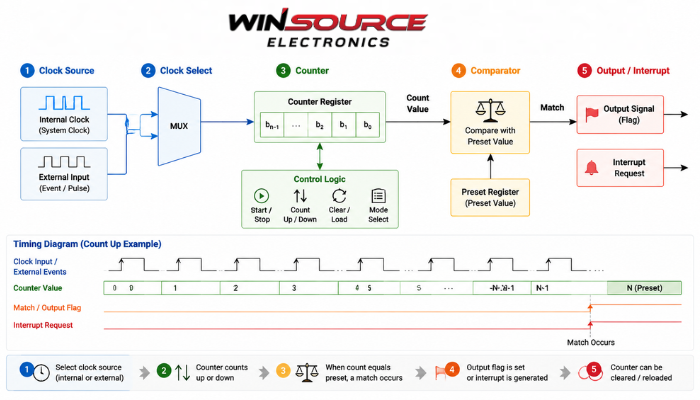
A timer/counter is a digital or analog device used in electronic circuits to measure time intervals or count events. Its working principle relies on generating precise pulses and using these pulses to either keep track of elapsed time or tally occurrences of specific signals.
- Timer Mode:In timer mode, the device measures the passage of time. A stable clock source provides periodic pulses, which are counted by the timer. Once the count reaches a pre-set value, the timer generates an output signal, often used to trigger events or generate delays. The accuracy depends on the stability of the clock source.
- Counter Mode:In counter mode, the device counts external events or pulses instead of clock cycles. Each pulse from an input signal increments (or decrements) the counter. When the count reaches a specified threshold, the device can trigger an output, indicating that a set number of events have occurred.
- Configurable Operation:Many timer/counter modules allow configurable operation modes, including up-counting, down-counting, pulse-width modulation (PWM), or event timing. This flexibility makes them useful in applications ranging from simple time delays to complex signal processing.
- Applications:Timers and counters are widely used in microcontrollers, digital watches, event counters, frequency measurement, and motor control. By providing accurate timekeeping or event counting, they form the backbone of many electronic control systems.
In essence, the timer/counter functions by translating sequential pulses—either from an internal clock or external signal—into meaningful time or event measurements that can drive further operations in a circuit.