
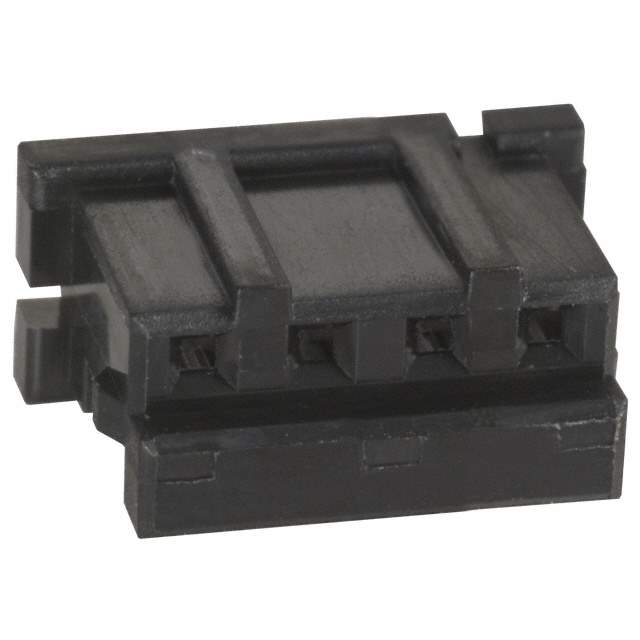
2 mm-pitch, four-contact crimp socket; current depends on wire gauge and certification.
Quick Engineering Summary
| Field | Value |
|---|---|
| Manufacturer | Hirose Electric Co Ltd |
| Category | Rectangular Connectors |
Is DF3-4S-2C ready for a new harness?
It is a plausible harness choice, but its lifecycle status is unverified. Ask Hirose to confirm that status before committing a new design; the catalog's Unknown field is not evidence of discontinuation. The part is marked compliant with EU RoHS.
The ordering code selects four contacts, a socket, 2 mm pitch and crimp termination. That makes it a wire-side housing, not a board receptacle. The catalog calls it a receptacle, but Hirose places this exact entry in its crimping-socket table. Use the maker's classification when selecting mating hardware.
Which DF3-4S-2C electrical limit governs the harness?
Wire gauge changes the series current rating: 3 A with AWG 22 to 24, 2 A with AWG 26 and 1 A with AWG 28. These are ceilings, not target currents. The separate UL/CSA rating is 1 A with AWG 24 to 28 wire and 30 V AC; the series product voltage rating for crimping is 250 V AC. Do not use that product rating to claim UL/CSA operation above its stated voltage.
The 30 mΩ maximum contact resistance is specified at a 100 mA test current. Ohm's law gives 0.1 A × 0.03 Ω = 0.003 V at that test condition. The corresponding resistive loss is 0.1 A squared × 0.03 Ω = 0.0003 W per contact at the same condition. Neither calculation establishes contact loss at the rated currents.
What does DF3-4S-2C connect to?
This free-hanging crimp socket belongs on discrete wire, mating to an appropriate DF3-series pin header or in-line arrangement. Its four contacts occupy one row at 2 mm pitch. The socket table gives a 10 mm A dimension and a 6 mm B dimension for the four-contact entry, useful for an initial space check but not for releasing an enclosure or mating interface.
Contacts are selected separately by wire size and finish. Hirose lists distinct socket contacts for AWG 22 and AWG 24 to 28, along with designated crimp tools. Choose the contact and tool together; an otherwise correct housing will not rescue a poor crimp.
What must close the DF3-4S-2C assembly decision?
Get Hirose's part-specific engineering drawing before fixing the mating layout or harness fixture. The series document explicitly directs readers to request that drawing for current, accurate design information. It provides a single-contact insertion and extraction test, but not a mating-force limit for the assembled four-contact connector. It also does not state a crimp-height target or wire pull-out limit for the completed termination. Those gaps matter more to assembly qualification than another reading of the series current table.
View the Win-Source product page for DF3-4S-2C.
Key Takeaways for Engineers & Buyers
- Match the wire gauge to the selected socket contact before releasing the harness BOM.
- Compare the UL/CSA voltage rating with the circuit requirement before claiming certified operation.
- Obtain the part-specific engineering drawing before fixing the assembly tooling.
How the figures on this page were worked out
| Result | Formula | Datasheet inputs | Value |
|---|---|---|---|
| Maximum contact voltage drop at the resistance-test current | V = I × R | I = 0.1 A (Page 2, contact-resistance test condition: 100 mA); R = 0.03 Ω (Page 2, contact resistance: 30 mΩ maximum at 100 mA) | 0.003 V |
| Maximum resistive loss per contact at the resistance-test current | P = I² × R | I = 0.1 A (Page 2, contact-resistance test condition: 100 mA); R = 0.03 Ω (Page 2, contact resistance: 30 mΩ maximum at 100 mA) | 0.0003 W |