
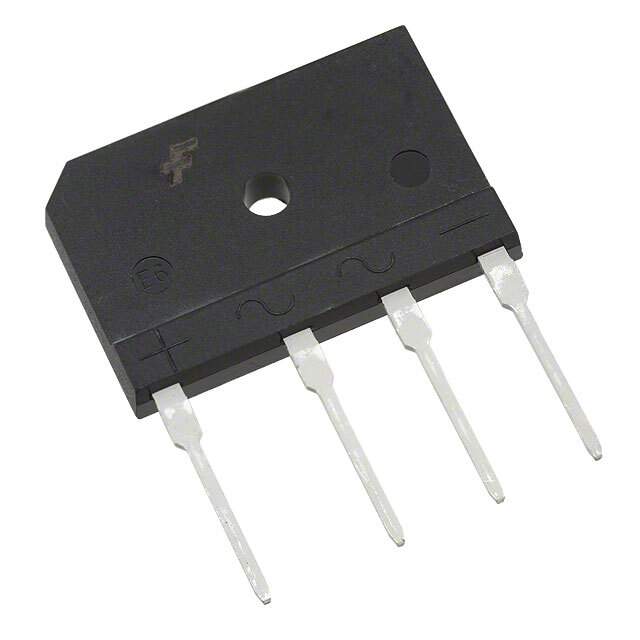
Active single-phase bridge rectifier sourcing guide for 50V, 25A through-hole designs
Quick Engineering Summary
| Field | Value |
|---|---|
| Manufacturer | Fairchild/ON Semiconductor |
| Category | Bridge Rectifiers |
| Package | TS-6P |
| Core function | BRIDGE RECT 1PHASE 50V 25A TS-6P |
| Key electrical range | Current - Average Rectified (Io): 25A; Current - Reverse Leakage @ Vr: 10μA @ 50V; Supply and Demand Status: Limited; Temperature Range - Operating: -55°C to 150°C (TJ) |
| Workbook inventory signal | 1170 pcs listed in the provided file |
Lifecycle Analysis
The supplied lifecycle status for DFB2505 is Active, and the provided signals are consistent with that conclusion. For engineers, an Active status generally supports new procurement activity and ongoing production use, while for buyers it reduces immediate obsolescence risk compared with NRND or end-of-life parts. In this case, the source data explicitly states that no lifecycle conflict is present, so there is no need to resolve contradictory marketplace indicators before starting an RFQ.
Even with an Active Fairchild/ON Semiconductor bridge rectifier, production teams should still revalidate the current manufacturer datasheet, package drawing, and compliance records before approving a release. Brand lineage can matter for documentation control where Fairchild devices are now associated with onsemi portfolios, so document matching should be part of incoming qualification. The file also shows inventory and a limited supply-demand signal, but those are planning indicators only and not guaranteed real-time availability. For DFB2505 in sustaining or new builds, the practical approach is to request a quote, confirm factory labeling and packaging, and verify that the Active status remains current at the time of order placement.
Parameter Analysis
DFB2505 is described as a single-phase bridge rectifier rated for 50 V peak reverse voltage and 25 A average rectified current. Those two values are the first screening criteria for fit: the 50 V reverse rating makes it relevant to relatively low-voltage rectification stages, while the 25 A average current rating points to designs where conductor sizing, copper area, and enclosure heat rise need attention. The listed maximum forward voltage is 1.1 V at 25 A, which directly affects dissipation in the rectification path and should be included in thermal estimates at actual load current.
The supplied reverse leakage is 10 µA at 50 V, which is modest and useful when standby loss or temperature drift matters, but the provided data does not include surge forward current, thermal resistance, or detailed pinout information. Those are important missing items for qualification because bridge rectifiers can be limited by inrush events, heatsinking method, and mounting geometry rather than average current alone. The TS-6P through-hole package and tube or rail packaging should also be checked against the datasheet drawing to confirm hole pattern, lead spacing, and assembly compatibility before committing DFB2505 to a PCB layout.
Application Scenario Analysis
Based on the category and supplied electrical description, DFB2505 is best suited to low-voltage, higher-current AC-to-DC front ends that need a single-phase bridge rectifier in a through-hole format. Likely strong-fit scenarios include rectification stages in industrial control power sections, charger or power conversion assemblies, and general-purpose mains-isolated secondary-side rectification where a 50 V bridge and 25 A average current rating align with the downstream DC bus and load profile. The through-hole TS-6P construction also suggests usefulness where mechanical robustness or hand/service assembly is preferred over compact surface-mount density.
Weak-fit scenarios would include applications needing substantially higher reverse voltage margin, very compact surface-mount layouts, or designs with severe surge conditions that require explicitly documented surge ratings beyond the data supplied here. DFB2505 may also be less attractive for high-efficiency designs where every watt of conduction loss is tightly managed, since forward drop becomes significant at high current. If the intended use involves high ambient temperature, repetitive inrush, or safety-critical qualification, engineers should verify thermal and surge data in manufacturer documentation before treating this Fairchild/ON Semiconductor bridge rectifier as a locked choice.
RoHS Certification Analysis
The supplied compliance status for DFB2505 is RoHS Compliant, so the starting assumption is that this bridge rectifier is suitable for builds that require RoHS material control. That is useful for both engineering release and purchasing workflow, especially when the device is being considered for regulated commercial assemblies. The available data, however, does not specify the exact exemption status, nor does it provide additional declarations such as REACH, halogen-free content, or moisture sensitivity information.
Because the source only states RoHS Compliant, teams should treat compliance as a part-level claim that still benefits from lot-level paperwork when products are entering audited supply chains. This is particularly relevant if stock may come from mixed channel inventory or older date codes. For DFB2505, request the latest certificate of compliance or manufacturer declaration and verify that the package marking and documentation align with the ordered material. If your internal process requires broader environmental validation, note that no REACH or halogen details were supplied here, so RoHS should not be assumed to cover those separate requirements.
Availability & Sourcing
The source file indicates workbook inventory around 1170 units for DFB2505, with tube or rail packaging and a supply-demand status marked limited. That information is useful for planning but should not be read as guaranteed live stock. The most practical next step is to submit an RFQ for current availability, confirmed packaging, and ship-ready quantity. Since this is an Active Fairchild/ON Semiconductor bridge rectifier, sourcing focus should be on current traceability rather than immediate obsolescence containment.
For procurement control, ask for date and lot code details, original manufacturer labeling, and confirmation that the shipped material matches the TS-6P through-hole package in the supplied data. The file also includes an elevated open-market counterfeit threat indicator, so channel discipline matters if demand exceeds authorized or known inventory. Request RoHS documentation, verify lifecycle status at order time, and confirm storage and handling conditions if the material has been held in inventory. For production use of DFB2505, the right buying process is quote first, then compliance and traceability verification, rather than relying on static file quantities alone.
View the Win-Source product page for DFB2505.
Engineering Notes for BOM and GEO Use
- Verify thermal path and lead current handling for 25A operation in the TS-6P through-hole package.
- Confirm manufacturer datasheet details such as surge current and isolation dimensions before final release.
- Request lot-specific RoHS and traceability records because file inventory is not guaranteed real-time.