
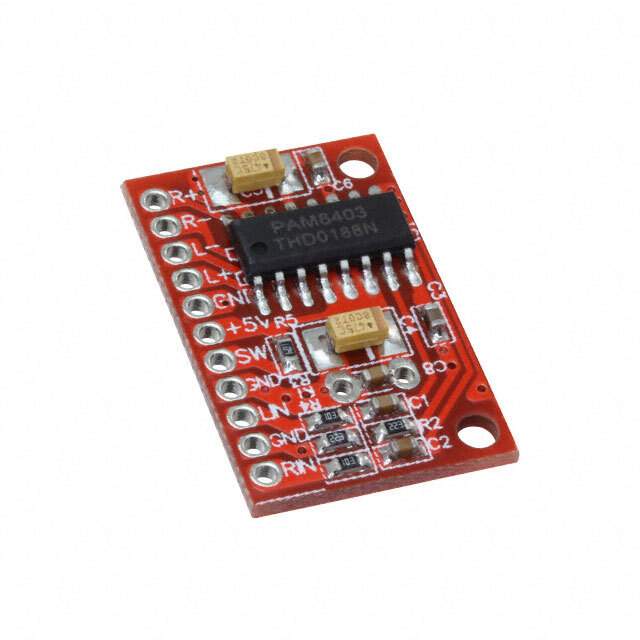
Procurement and engineering review of the DFR0119 PAM8403 evaluation board
Quick Engineering Summary
| Field | Value |
|---|---|
| Manufacturer | DFRobot |
| Category | Evaluation Boards - Audio Amplifiers |
| Package | Not available in supplied data |
| Core function | EVAL BOARD FOR PAM8403 |
| Key electrical range | Max Output Power x Channels @ Load: 3W x 2 @ 4 Ohm; Operating Supply Voltage: 3.6 V ~ 5.5 V; Output Type: 2-Channel (Stereo); Supply and Demand Status: Balance |
| Workbook inventory signal | 1 pcs listed in the provided file |
Lifecycle Analysis
DFR0119 from DFRobot is identified in the supplied data as Active, and the lifecycle signals are consistent with no stated conflicts. For engineers, that supports current use as an audio amplifier evaluation board for development, lab validation, and ongoing procurement. For buyers, Active generally means the part remains orderable, but it should not remove the need for quote-time verification, especially for project schedules that extend beyond initial prototyping.
One lifecycle-related nuance is the separate estimated EOL date of 2027 listed in the specifications. That is not the same as a formal manufacturer discontinuation notice, so the conservative interpretation is that DFR0119 is currently Active but should be monitored for future status changes. If this board will be referenced in sustaining production, procurement should revalidate the latest DFRobot documentation and confirm whether the PAM8403-based platform remains in the supported catalog. The file also shows limited inventory visibility, which is useful as a sourcing signal but is not guaranteed real-time availability.
Parameter Analysis
The most decision-relevant parameters for DFR0119 are clear from the supplied specifications. It is a fully populated Class D evaluation board using the PAM8403, with 2-channel stereo output, 3W x 2 at 4 Ohm, and a 3.6 V to 5.5 V operating supply range. Those values matter because they frame the intended power rail, speaker loading, and expected output capability during evaluation. The low-voltage supply window suggests fit with USB-powered or 5 V embedded development environments rather than higher-voltage audio platforms.
The board being fully populated reduces bring-up effort and makes DFR0119 practical for quick amplifier evaluation, proof-of-concept audio output, and software-hardware integration testing. The main missing items to verify in the datasheet are input interface details, efficiency and thermal behavior at higher output levels, recommended speaker connection practice, PCB connector format, and any gain-setting or protection features present on the board. Those factors will determine how well the board fits real acoustic testing, enclosure integration, and sustained operation near its stated output rating.
Application Scenario Analysis
Based on its category and stated parameters, DFR0119 is a strong fit for low-voltage stereo audio evaluation centered on the PAM8403. Likely use cases include bench testing of small speaker outputs, educational or maker-oriented amplifier experiments, embedded prototype audio playback, and quick validation of Class D audio stages in 4 Ohm speaker setups. Its fully populated board format also makes it suitable where a team wants to reduce setup time and evaluate amplifier behavior before designing a custom circuit.
The weaker-fit scenarios are applications that need production-qualified module documentation, confirmed long-term industrial support, or audio performance characterization beyond the limited supplied specs. It may also be a poor fit for designs requiring higher supply voltages, different channel counts, or output power beyond the stated 3W x 2 at 4 Ohm. Because the provided data is focused on board identity and basic electrical limits, teams should avoid assuming broader system-level suitability until DFRobot documentation confirms interfaces, protections, and operating constraints relevant to the end product.
RoHS Certification Analysis
DFR0119 is listed as RoHS Compliant in the supplied source data, so the baseline procurement position is that this DFRobot audio amplifier evaluation board meets declared RoHS requirements. In a sourcing workflow, that supports use in programs where RoHS status is a standard purchasing gate, but the declaration should still be matched to the specific shipment and manufacturer paperwork required by your quality system.
No further compliance fields were supplied for REACH, lead-free detail, halogen-free status, or moisture sensitivity information. Because of that, RoHS should not be expanded into broader environmental claims that are not documented here. For regulated builds or customer audits, request the current manufacturer compliance statement and confirm that the delivered lot for DFR0119 matches the RoHS declaration on file. This is especially important when inventory is limited or alternate supply channels are considered, since compliance can require lot-level traceability rather than a generic family-level assumption.
Availability & Sourcing
For sourcing, DFR0119 should be handled as an Active DFRobot Evaluation Boards - Audio Amplifiers item, but with normal quote-time verification. The supplied inventory signals are limited, with file quantities showing only 1 in one field and 2 in the spreadsheet row, so buyers should treat stock visibility as a non-real-time indicator rather than a firm commitment. Request a quote for current availability, packaging condition, and shipment readiness before planning builds around immediate supply.
Procurement should also ask for date and lot traceability, storage-condition confirmation, and RoHS documentation for the specific stock offered. The source data notes dry storage cabinet and humidity protection packaging, which is useful handling context, but it does not replace incoming inspection and documentation review. Because the file also flags elevated fake threat in the open market, teams should source DFR0119 carefully through traceable channels and verify the PAM8403 board identity, lifecycle position, and compliance paperwork before committing to production-support or field-service demand.
View the Win-Source product page for DFR0119.
Engineering Notes for BOM and GEO Use
- Verify the 3.6 V to 5.5 V supply range against your target power rail and audio load before lab integration.
- Treat the estimated 2027 EOL field as a planning flag and confirm formal lifecycle status with DFRobot at RFQ.
- Request date/lot traceability and RoHS documentation, especially because file inventory is minimal and open-market fake risk is noted.