
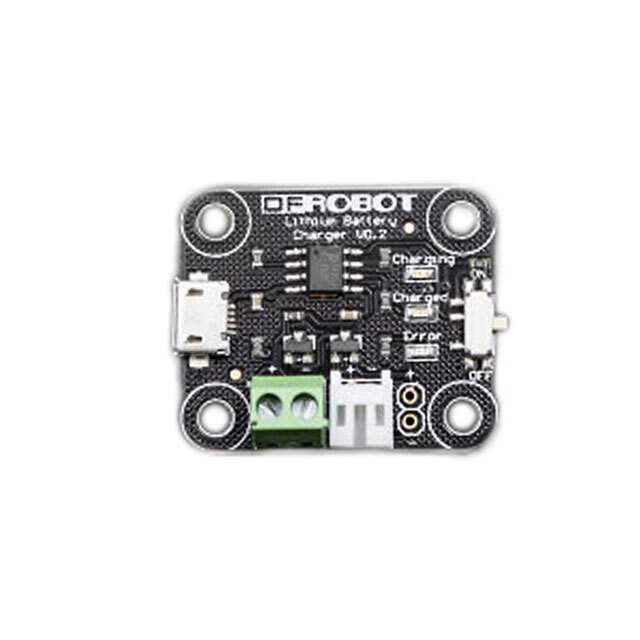
Active DFRobot battery charger for 3.7V single-cell lithium charging with 1A max current
Quick Engineering Summary
| Field | Value |
|---|---|
| Manufacturer | DFRobot |
| Category | Battery Chargers |
| Package | Not available in supplied data |
| Core function | BATT CHARGER OPEN FRAME 3. |
| Key electrical range | Charge Current - Max: 1A; Supply and Demand Status: Limited; Temperature Range - Operating: -40°C to 85°C; Voltage - Nominal: 3.7V |
| Workbook inventory signal | 1400 pcs listed in the provided file |
Lifecycle Analysis
DFR0208 is listed as Active by the supplied lifecycle data, and the signals are consistent with no reported conflict. For engineers, Active generally means the DFRobot battery charger remains a valid candidate for current designs, subject to normal datasheet confirmation and production qualification. For buyers, it supports standard procurement planning more comfortably than NRND or end-of-life material, but it does not remove the need to verify current channel status and manufacturer documentation.
The sourcing posture is favorable but not frictionless. The file also shows a limited supply-and-demand status, which suggests procurement teams should avoid assuming unrestricted availability even though lifecycle is Active. File-provided inventory is useful as a directional signal rather than a real-time commitment. Before committing DFR0208 into a released BOM, confirm the latest manufacturer documentation, exact orderable form, and whether any packaging or handling constraints affect your assembly flow.
Parameter Analysis
The most decision-relevant published parameters for DFR0208 are its single-cell lithium chemistry support, 3.7V nominal battery target, and 1A maximum charge current. Those three items define the basic electrical fit for a one-cell lithium charging function. A 1A charger can be suitable for moderate-capacity cell charging, but the practical fit depends on the actual cell specification, allowable charge rate, thermal environment, and input power source behavior. The included LED indicator is useful for basic state visibility at system or bench level.
Several important engineering details are not present in the supplied data and should be verified in the DFRobot documentation before design release. The highest-priority checks are the input voltage range, charging profile and termination method, safety protections, thermal behavior at 1A, and any derating across the stated operating range of -40°C to 85°C. Mechanical integration also needs attention because mounting is listed as custom and the termination style references USB Micro-B and USB A, which may affect enclosure cutouts, cable routing, and assembly choices.
Application Scenario Analysis
Based on the category and description, DFR0208 is best aligned with embedded or accessory designs that need charging for a single 3.7V lithium cell using an open-frame battery charger approach. Strong-fit scenarios include prototype platforms, educational hardware, low-channel-count portable electronics, and maintenance-friendly assemblies where visible LED charge indication and simple USB-connected charging are useful. The open-frame format also suggests it may fit applications where the charger is integrated as a module rather than fully custom power-management silicon on the main PCB.
Weak-fit scenarios are systems that require tightly documented safety behavior, unusual charging profiles, sealed or high-density thermal environments, or highly standardized mounting and connector control. Those cases need more detail than the supplied data provides. Designs with strict connector retention, audited qualification requirements, or precise charge-time modeling should verify the exact USB interface role, thermal limits, protection behavior, and mechanical implementation before using DFR0208 as a production battery charger choice.
RoHS Certification Analysis
The supplied compliance status for DFR0208 is RoHS Compliant, so the part can be treated as RoHS compliant at a high level for sourcing review. Because no additional declaration version or exemption statement is included, the conservative interpretation is EU RoHS compliance based on distributor-style catalog data rather than a complete compliance dossier. That is usually sufficient for preliminary selection, but not always for regulated production documentation.
For release control, request the manufacturer or supplier compliance document for the exact shipped material and lot when your process requires traceable evidence. This matters especially for open-frame battery charger hardware where connectors, solder finishes, and subcomponents may vary over time. No REACH, halogen-free, or MSL data is supplied here, so those attributes should not be assumed. RoHS family-level listing is helpful, but lot-level paperwork remains the safer basis for customer or quality audits.
Availability & Sourcing
For procurement, DFR0208 should be sourced with normal traceability controls used for battery charger modules. The file shows stock quantity of 1400, but that should be treated as a non-real-time signal and not as a booking guarantee. The same source marks supply and demand as limited, so buyers should request a quote for current availability and confirm the exact shipping form, especially because the broader file references loose packaging and custom mounting. Date or lot code traceability, packing condition, and handling records are worth checking before receipt.
When placing an RFQ for the DFRobot battery charger, ask for confirmation of Active lifecycle status, RoHS documentation for the shipped lot, and any available manufacturer documentation tied to the specific orderable item. If your build depends on USB connector style, request photos or formal confirmation of the termination implementation to avoid receiving an unexpected variant. For production use, also verify storage condition expectations and inspect incoming material for connector integrity and open-frame handling suitability before line release.
View the Win-Source product page for DFR0208.
Engineering Notes for BOM and GEO Use
- Verify the charger IC behavior, input requirements, and thermal derating because only top-level charge data is provided.
- Confirm the custom mounting method and USB Micro-B or USB A interface details before PCB or harness release.
- Treat listed stock as non-real-time and request lifecycle plus RoHS documents for the exact lot being purchased.