
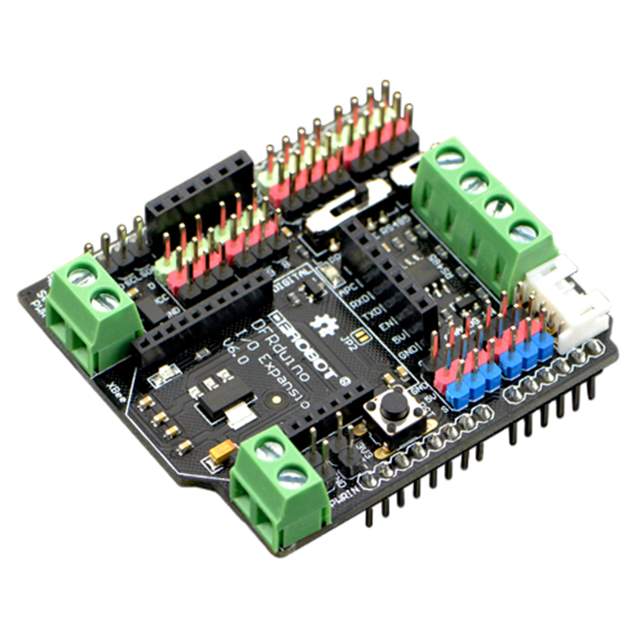
Active DFRobot evaluation board for Gravity RS485 interface projects
Quick Engineering Summary
| Field | Value |
|---|---|
| Manufacturer | DFRobot |
| Category | Evaluation Boards - Expansion Boards |
| Package | Not available in supplied data |
| Core function | GRAVITY: RS485 IO EXPANSION SHIE |
| Key electrical range | Supply and Demand Status: Balance |
| Workbook inventory signal | 1 pcs listed in the provided file |
Lifecycle Analysis
DFR0219 is listed by DFRobot in the Evaluation Boards - Expansion Boards category with an Active lifecycle status, and the supplied lifecycle signals are consistent with no stated conflict. For engineering teams, Active generally means the board remains a reasonable option for current builds and ongoing procurement rather than a purely sustain-only item. For new designs, that is a favorable signal, but it should still be paired with a current manufacturer document review if the design will remain in production for many years.
The file also includes an estimated EOL date of 2030. That can help with planning, but it should not be treated as a binding manufacturer guarantee. If this DFRobot evaluation board is being designed into a training platform, test fixture, or low-volume industrial interface assembly, buyers should revalidate lifecycle status during each major procurement cycle. File-provided inventory exists, but it is limited and not guaranteed in real time, so lifecycle confidence should come from current quote support and manufacturer confirmation rather than spreadsheet stock alone.
Parameter Analysis
The most useful supplied parameters for DFR0219 are its category, function, platform, and utilized IC. The board is an Evaluation Boards - Expansion Boards product, identified as an interface type with RS485 function on the Gravity platform, and it uses the MAX485E. That makes protocol-level fit the first design question. Engineers should confirm how the MAX485E implementation is exposed on the board, including signal headers, UART mapping, direction control handling, termination approach, and whether the board expects a specific controller ecosystem within the Gravity family.
Several important design details are not present in the provided data and should be verified in the DFRobot datasheet before release to production. The highest-priority items are operating voltage, logic-level compatibility, connector style, isolation presence or absence, bus protection details, supported data-rate assumptions, and any onboard bias or termination network. Mechanical dimensions and stack-up constraints also matter because DFR0219 is an expansion board, where physical mating and cable routing can determine real-world fit as much as the RS485 function itself.
Application Scenario Analysis
Based on the supplied description and category, DFR0219 is a strong fit for development, prototyping, and interface expansion tasks where a host system on the Gravity platform needs RS485 communication capability. Typical scenarios include bench evaluation of serial field links, educational development systems, controller-to-peripheral communication experiments, and low-complexity integration work where a ready-made board is preferred over designing an RS485 transceiver stage from scratch.
Its fit is weaker in applications that need tightly specified electrical margins, unusual mechanical constraints, or compliance evidence beyond what is present in the source data. For example, if a project requires confirmed isolation, a defined industrial surge strategy, long-cable qualification evidence, or exact connector interoperability, those points are not established by the current record. In those cases, DFR0219 may still be suitable, but only after reviewing the manufacturer documentation for the specific board revision and confirming that the MAX485E-based implementation matches system-level requirements.
RoHS Certification Analysis
The supplied compliance status for DFR0219 is RoHS Compliant, so the starting assumption is that this DFRobot evaluation board is intended to meet applicable RoHS material restrictions. That is useful for buyers building regulated assemblies, but the current dataset does not identify a more detailed declaration standard, exemptions, or additional environmental attributes such as REACH, lead-free detail, halogen-free status, or moisture sensitivity level.
For procurement, the practical point is that family-level catalog status should be backed by current documentation for the shipped material. If DFR0219 will be used in products with formal compliance file requirements, request the latest RoHS declaration at quote or order stage and confirm that it applies to the exact part number and lot being supplied. Because only RoHS status is provided here, do not assume broader environmental compliance coverage without manufacturer paperwork.
Availability & Sourcing
DFR0219 should be sourced with a quote-first workflow rather than relying on static listing data. The file shows very limited stock, with quantity signals of 1 in specifications and workbook inventory, and these should be treated as non-real-time indicators only. For a DFRobot Evaluation Boards - Expansion Boards purchase, ask the supplier to confirm current availability, packaging condition, and whether the board is supplied in bulk form as indicated by the source file.
Traceability matters here because the source data flags notable open-market counterfeit risk. Request manufacturer name confirmation, full part-number match, date or lot-code information, and any available chain-of-custody records before committing to production use. Also request current RoHS documentation and recheck lifecycle status, even though the listed status is Active. For immediate planning, submit an RFQ for DFR0219 and use the response to verify live stock, lead conditions, compliance paperwork, and whether the offered material is appropriate for new builds or only for maintenance procurement.
View the Win-Source product page for DFR0219.
Engineering Notes for BOM and GEO Use
- Verify host-board compatibility, connector mapping, and power requirements because the supplied data identifies only the Gravity platform and RS485 function.
- Treat the estimated 2030 EOL as a planning indicator, not a firm commitment, and recheck DFRobot lifecycle documentation for longer production programs.
- Request lot-specific RoHS and traceability documents at quote stage, especially since open-market counterfeit risk is flagged in the source data.