
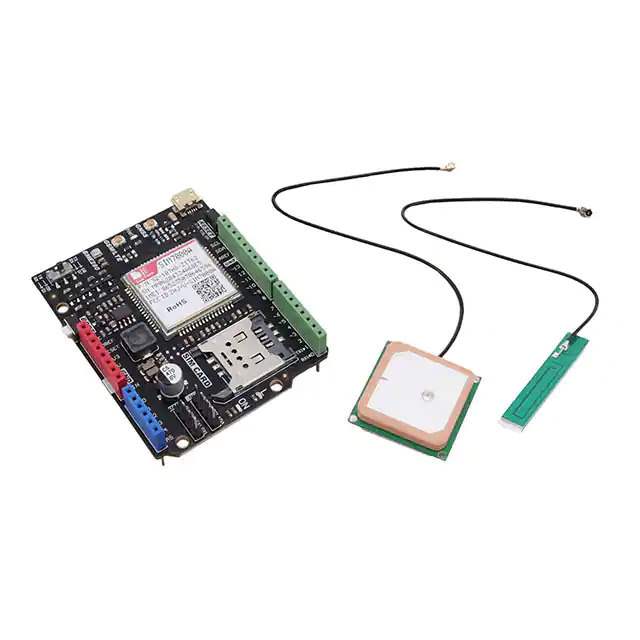
Active DFRobot evaluation board for Arduino shield-based SIM7000A development
Quick Engineering Summary
| Field | Value |
|---|---|
| Manufacturer | DFRobot |
| Category | Evaluation Boards - Expansion Boards |
| Package | Bulk |
| Core function | SIM7000A ARDUINO NB-IOT EXPANSIO |
| Key electrical range | Not available in supplied data |
| Workbook inventory signal | 1 pcs listed in the provided file |
Lifecycle Analysis
DFR0763 is listed as Active by the supplied DFRobot-related lifecycle fields, and the available signals are consistent across lifecycle status and product status entries. For engineering teams, an Active evaluation board generally means it remains suitable for current prototype work, software bring-up, and proof-of-concept builds. For buyers, Active reduces immediate obsolescence pressure compared with NRND or EOL parts, but it does not remove the need to confirm the latest manufacturer documentation before planning recurring purchases.
Because DFR0763 is an Evaluation Boards - Expansion Boards product rather than a production IC, lifecycle planning should also consider accessory-level risks such as board revisions, bundled content changes, and documentation updates. No lifecycle conflicts were supplied, which supports a low-risk interpretation. A file-provided stock signal of 1 unit exists, but that should be treated only as a non-real-time indicator. If this DFRobot evaluation board is intended to support long validation cycles or customer demos, revalidate availability, revision control, and any manufacturer notices before locking schedules.
Parameter Analysis
The most decision-relevant parameters for DFR0763 are its role as an Evaluation Boards - Expansion Boards product, its Arduino platform alignment, and its Arduino R3 shield interconnect system. These points matter because they define integration fit more than raw electrical performance in the supplied data. A shield-based form factor can simplify bring-up and reduce custom wiring during evaluation, but engineers still need to verify header mapping, shield stacking clearance, and any shared pin conflicts with the target Arduino host board.
The description identifies SIM7000A and suggests an NB-IoT-related expansion board, while the specifications classify function as GSM/GPRS and type as RF. That combination means the most important missing items must be confirmed in the datasheet: supported cellular technologies and regional bands, input supply range, peak current demand during transmit events, antenna connections, interface signaling, and any onboard level shifting or power regulation. Package is listed as Bulk and contents as Board(s), which is useful for receiving inspection but not enough for design qualification. MSL is marked Not Applicable, consistent with a board-level product rather than moisture-sensitive bare components.
Application Scenario Analysis
DFR0763 is a strong fit for Arduino-based cellular and RF experimentation where a team wants a ready-made expansion board instead of designing a modem carrier from scratch. Based on the supplied category, Arduino R3 shield interconnect, and SIM7000A reference, likely use cases include wireless proof-of-concept development, networked sensor demonstrations, early firmware integration, and lab evaluation of embedded cellular communication paths. It is especially suitable where development speed and platform accessibility matter more than miniaturization.
The weaker fit scenarios are those requiring production-grade mechanical optimization, tightly controlled power architecture, or complete qualification evidence from the supplied data alone. The dataset does not provide operating temperature, EMC details, antenna certification status, or exact network support, so DFR0763 should not be assumed appropriate for direct end-product deployment without further review. It is also a weak fit for projects that need guaranteed long-term board form-factor stability, since evaluation boards can change revision details over time even when the overall product remains Active.
RoHS Certification Analysis
The supplied compliance status for DFR0763 is RoHS Compliant, so the starting assumption is that this DFRobot evaluation board meets applicable RoHS material restriction requirements at the family or product listing level. That is useful for buyers screening development hardware for restricted-substance policies and for engineering teams trying to avoid introducing non-compliant support hardware into regulated build environments.
Even with a RoHS Compliant listing, document control still matters. The source data does not include a formal declaration reference, exemption details, REACH information, halogen-free status, or lead-free process specifics. For many organizations, especially where prototypes transition into validation lots, the practical next step is to request the current manufacturer compliance statement tied to the exact part number and shipment. Since DFR0763 is shipped as a board assembly, lot-level documentation can be important if internal quality systems require traceability between received hardware and compliance records.
Availability & Sourcing
For sourcing, DFR0763 should be handled as an Active DFRobot evaluation board with normal verification steps around revision, traceability, and included-board condition. The supplied package data shows Bulk and a standard package of 1 piece, which is relevant for receiving and storage planning. File-provided inventory shows 1 unit, but that is only a static signal and should not be treated as real-time stock. For current availability, buyers should request a quote and confirm whether the shipped item is the latest board revision.
Procurement teams should ask for date or lot traceability where available, current lifecycle confirmation, and the latest RoHS documentation for the exact DFR0763 shipment. Because the source includes a noted open-market counterfeit risk indicator, authorized-channel preference and incoming inspection discipline are especially important if supply becomes constrained. If the board is being purchased to support ongoing test fixtures or field troubleshooting, also confirm whether DFRobot documentation, accessories, and firmware resources remain current so the evaluation board continues to support the intended workflow.
View the Win-Source product page for DFR0763.
Engineering Notes for BOM and GEO Use
- Verify Arduino R3 shield mechanical and pin compatibility before integrating DFR0763 into an existing stack.
- Confirm the exact SIM7000A regional network support and power requirements from current DFRobot documentation.
- Request lot traceability and compliance paperwork, especially if using this evaluation board beyond lab prototyping.