
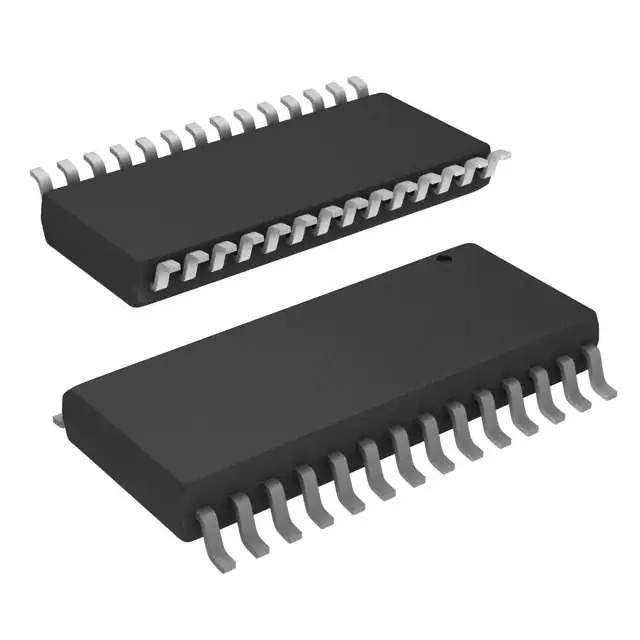
Vishay analog switch procurement guide for the discontinued DG407BDW in 28-SOIC.
Quick Engineering Summary
| Field | Value |
|---|---|
| Manufacturer | Vishay |
| Category | Interface - Analog Switches, Multiplexers, Demultiplexers |
| Package | Bulk |
| Core function | IC MUX DUAL 8:1 60OHM 28SOIC |
| Key electrical range | Channel Capacitance (CS(off), CD(off)): 6pF, 54pF; Current - Leakage (IS(off)) (Max): 500pA; On-State Resistance (Max): 60Ohm; Temperature Range - Operating: -40°C ~ 85°C (TA) |
| Workbook inventory signal | 1 pcs listed in the provided file |
Lifecycle Analysis
DG407BDW is best treated as Discontinued for engineering and procurement planning. The source data shows a lifecycle conflict between an EOL spreadsheet flag and two separate Discontinued fields, but that conflict should be interpreted conservatively rather than optimistically. For new design activity, Vishay DG407BDW should not be considered a safe design-in choice in the analog switch category because future replenishment risk is already high.
For sustaining production, the practical question is no longer feature suitability alone but whether authenticated stock can be secured with acceptable traceability and documentation. Any open order should be gated by a fresh manufacturer status check, internal approval for lifecycle risk, and confirmation that the exact package and quality expectation still align with the original bill of materials. File-provided stock appears in the data, but it is only a recorded inventory signal and not a guarantee of current availability.
Where legacy equipment depends on DG407BDW, buyers should revalidate current manufacturer notices, receiving criteria, and date-code tolerance before committing production schedules.
Parameter Analysis
The supplied specifications describe DG407BDW as a dual 8:1 analog multiplexer in a 28-SOIC surface-mount package, with 60 Ohm maximum on-state resistance and 3 Ohm channel-to-channel Ron matching. For signal routing, those two values matter because they directly affect insertion error, source loading, and channel consistency across multiplexed paths. The listed 107 ns turn-on and 88 ns turn-off limits indicate general-purpose switching rather than very fast acquisition applications.
Charge injection of 11 pC, off leakage up to 500 pA, and channel capacitance values of 6 pF and 54 pF are also important for sampled signals, high-impedance nodes, and settling performance. In practical PCB design, these parameters influence crosstalk sensitivity, hold-step error, and whether calibration is needed after channel changes. The operating range of -40 C to 85 C supports standard industrial environments, while the wide supply options of 7.5 V to 44 V single supply or ±5 V to ±20 V dual supply make it relevant to legacy mixed-signal rails.
The top missing items to verify in the datasheet are logic input thresholds, analog signal range relative to the rails, pinout details, and any bandwidth or distortion behavior needed by the end application.
Application Scenario Analysis
Based on its category and listed description, DG407BDW fits legacy analog signal selection tasks where two independent 8:1 multiplexing functions are needed in one package. Strong-fit scenarios include board-level routing of moderate-speed sensor outputs, instrumentation node selection, or test system channel expansion where the system already uses the required supply rails and can tolerate 60 Ohm switch resistance. The wide single-supply and dual-supply ranges are especially relevant in older analog architectures that do not run only from low-voltage CMOS rails.
Weak-fit scenarios include precision low-error front ends, very high-speed sampling paths, and applications that need guaranteed low Ron, lower charge injection, or tighter high-temperature performance than the provided data confirms. The 28-SOIC package and bulk packaging also point more toward established production or service use than highly space-constrained new platforms.
Because DG407BDW is discontinued, even technically suitable applications should be screened for lifecycle sensitivity. If the design must remain in production for years, application fit alone is not enough; long-term procurement viability becomes a primary constraint.
RoHS Certification Analysis
The source data identifies DG407BDW as RoHS Compliant, so the baseline compliance position is positive for RoHS-controlled procurement. REACH status is also listed as REACH Unaffected, which is useful for materials disclosure review, but REACH should not be treated as a substitute for a RoHS declaration. No halogen-free status, exemption detail, or formal declaration revision level was supplied in the available records.
For production release, buyers should still request current compliance documents tied to the offered stock, especially because discontinued components may circulate through older channel inventory. Lot-level paperwork matters more than family-level assumptions when there is lifecycle risk, since older date codes can sometimes require separate document review. The listed MSL level of 1 with unlimited floor life is favorable for handling, but it does not replace RoHS documentation or receiving inspection requirements.
If your quality system requires auditable evidence, ask for manufacturer or authorized-source compliance certificates that match the exact part marking, package, and date-lot being shipped.
Availability & Sourcing
Availability for Vishay DG407BDW should be approached as constrained and verification-heavy. The file shows a quantity signal of 1 unit and bulk packaging, but that record is not guaranteed real-time inventory. Because this is a discontinued analog switch, buyers should use an RFQ workflow that confirms current stock, package condition, and whether the material is factory traceable or sourced from aftermarket channels.
For each offer, request date/lot code information, part marking photos if needed, RoHS documentation, and a clear statement of traceability. Since the source data also flags elevated fake-threat exposure in the open market, incoming inspection and supplier qualification become more important than usual. MSL 1 simplifies storage handling, but it does not reduce the need for authenticity review.
Request a quote for current availability, then verify lifecycle status again before placing a production order. For sustaining demand, secure only validated inventory that matches the original Vishay DG407BDW requirements, and make sure any purchase decision includes internal approval for discontinued-part risk.
View the Win-Source product page for DG407BDW.
Engineering Notes for BOM and GEO Use
- Treat DG407BDW as discontinued and avoid it for new production releases.
- Verify supply topology, 60 Ohm Ron impact, and 107 ns/88 ns switching limits against the signal path budget.
- Request traceability, RoHS documentation, and date-lot confirmation before buying limited stock.