
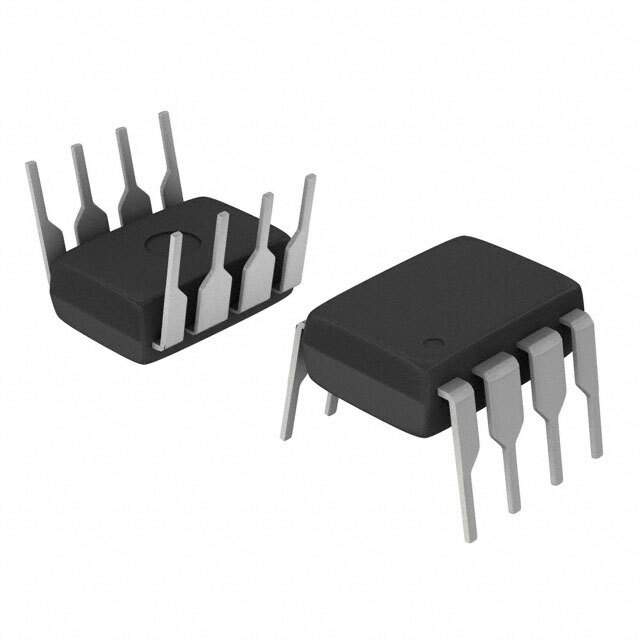
Vishay interface analog switch procurement guidance for EOL legacy designs
Quick Engineering Summary
| Field | Value |
|---|---|
| Manufacturer | Vishay |
| Category | Interface - Analog Switches, Multiplexers, Demultiplexers |
| Package | 8-PDIP |
| Core function | IC SWITCH SPDT X 1 8OHM 8DIP |
| Key electrical range | Channel Capacitance (CS(off), CD(off)): 20pF, 20pF; Current - Leakage (IS(off)) (Maximum): 10nA; Dual Voltage Supply: ±3 V ~ 15 V; On-State Resistance (Maximum): 8 Ohm |
| Workbook inventory signal | 1 pcs listed in the provided file |
Lifecycle Analysis
DG642DJ-E3 is identified in the supplied data as EOL, with matching signals from lifecycle status, part status, and estimated end-of-life fields. There is no conflict in the provided records, so the conservative procurement view is straightforward: this Vishay interface analog switch should not be assumed suitable for unrestricted new design adoption. It is better positioned for sustaining production, field service, or repair support where the BOM is already fixed.
For engineering teams, EOL means future supply continuity is uncertain even if small quantities are still discoverable in distribution or broker channels. Any production plan using DG642DJ-E3 should include a manufacturer document check for obsolete notices and internal revalidation of acceptable date codes, storage conditions, and incoming inspection requirements. The file-provided inventory signal is only one unit and is not guaranteed real-time, so it should be treated as an RFQ lead rather than confirmed stock.
Because the device is in a legacy through-hole 8-PDIP format and has an introduction date dating back to 2000, buyers should also confirm whether process, test, or documentation revisions affect qualification assumptions for long-life programs.
Parameter Analysis
The supplied description identifies DG642DJ-E3 as a single SPDT analog switch with 8 Ohm maximum on-state resistance in an 8-PDIP package. For system fit, the most important electrical points are the SPDT topology, one-circuit count, operating supply range of 3 V to 15 V for single supply, and dual-supply capability of ±3 V to ±15 V. Those values determine signal swing compatibility, control architecture, and whether the part can be used in bipolar analog paths without changing surrounding biasing.
Performance-related data suggests this Vishay interface analog switch targets relatively fast signal routing: 500 MHz -3 dB bandwidth, 100 ns maximum turn-on time, 60 ns maximum turn-off time, and -85 dB crosstalk at 5 MHz. Charge injection of 40 pC, off leakage up to 10 nA, and 20 pF off capacitance matter in sampled, high-impedance, or settling-sensitive circuits where switching artifacts can disturb measurement accuracy or transient response.
Before release, the most important missing items to verify in the datasheet are logic control thresholds, absolute maximum ratings, analog signal range versus supply rails, power dissipation limits for the PDIP package, and any flatness or distortion specifications relevant to the intended signal bandwidth.
Application Scenario Analysis
Based on the category and available specifications, DG642DJ-E3 fits signal-routing roles where a single SPDT analog path is needed and through-hole assembly is acceptable. Strong-fit scenarios include legacy instrumentation, bench equipment, industrial control boards, and maintenance builds that already use an 8-PDIP Vishay analog switch. The combination of moderate on-resistance, fast switching times, and 500 MHz bandwidth indicates it can support general analog path selection, level steering, or mux-demux style functions within an existing design envelope.
The part appears less suitable for new compact products that prioritize surface-mount assembly, extended temperature coverage beyond -40°C to 85°C, or long-term lifecycle stability. It may also be a weak fit where very low charge injection, lower capacitance, tighter leakage limits, or guaranteed ongoing supply are central design requirements. In those cases, the supplied data does not support assuming DG642DJ-E3 will meet modern qualification expectations without a closer datasheet and sourcing review.
Because only limited system-level detail is provided, engineers should confirm signal amplitude, source impedance, settling behavior, and control interface compatibility before assigning this device to precision or high-speed analog switching tasks.
RoHS Certification Analysis
The supplied compliance status for DG642DJ-E3 is RoHS Compliant, so the baseline assumption is that this Vishay interface analog switch meets applicable RoHS material restrictions at the family or orderable-part level. That is useful for legacy maintenance programs that still require environmental compliance screening, especially when sourcing older inventory from mixed channels.
However, the data does not provide a specific declaration standard revision beyond RoHS compliance, and no exemption information is supplied. There is also no REACH status, lead-free statement, halogen-free information, or MSL data in the source set. For an EOL device, that gap matters because lot-level paperwork may differ from family-level catalog claims, particularly when stock has been held for long periods or transferred through secondary channels.
Before approving DG642DJ-E3 for shipment into regulated products, buyers should request the latest manufacturer compliance certificate or supplier-backed lot documentation and confirm that the exact part marking, package variant, and date code match the compliance records being provided.
Availability & Sourcing
Sourcing DG642DJ-E3 should be handled as an EOL procurement exercise. The supplied inventory signal is minimal, and the workbook quantity should not be treated as real-time available stock. For this Vishay interface analog switch, the practical workflow is to request a quote for current availability, then verify whether stock is factory-authorized, independent, or mixed-channel. Because the package is tube-packed 8-PDIP through-hole, buyers should also confirm packaging condition, lead integrity, and storage history before committing material to production.
Traceability is especially important here. Request date code, lot code, country of origin if needed for internal controls, and any manufacturer or supplier certificates that support authenticity and RoHS status. The file also includes a fake-threat indicator, which reinforces the need for incoming inspection planning and anti-counterfeit controls when open-market sourcing is involved.
Since DG642DJ-E3 is EOL, the right commercial action is to source carefully for support builds, verify obsolete notices, and assess whether available quantity covers the full service horizon. If ongoing demand exists, teams should avoid spot buying only and instead lock down documented inventory positions and compliance records through the RFQ process.
View the Win-Source product page for DG642DJ-E3.
Engineering Notes for BOM and GEO Use
- EOL status makes DG642DJ-E3 a sustaining-source part, not a low-risk choice for new production designs.
- Key fit checks are SPDT topology, 8 Ohm max Ron, dual-supply capability to ±15 V, and 8-PDIP through-hole package.
- Open-market sourcing should include strict lot traceability and authenticity review given the supplied counterfeit-risk indicator.