
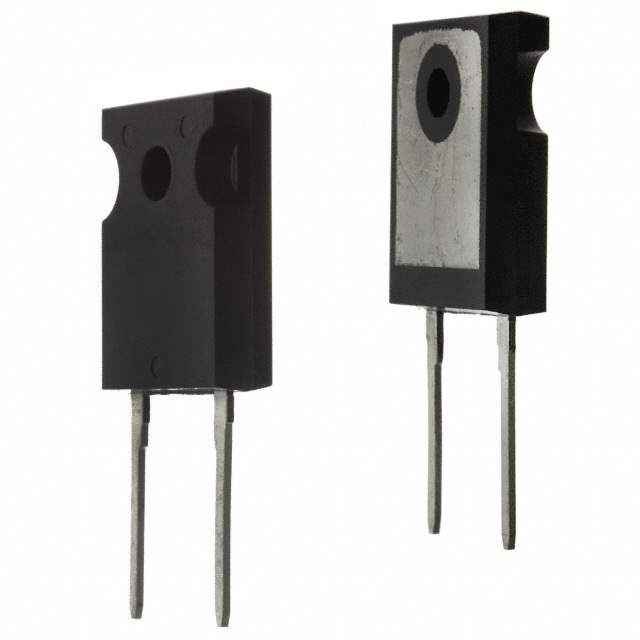
Active IXYS single rectifier diode review for 1800V 20A TO-247 sourcing and design checks
Quick Engineering Summary
| Field | Value |
|---|---|
| Manufacturer | IXYS |
| Category | Diodes, Rectifiers - Single |
| Package | TO-247 |
| Core function | DIODE STANDARD 1800V 20A TO247 |
| Key electrical range | Current - Average Rectified (Io): 20A; Current - Reverse Leakage @ Vr: 50μA @ 1800V; Operating Temperature - Junction: -55°C to 150°C; Speed(Frequency): Fast Recovery = 200mA (Io) |
| Workbook inventory signal | 1 pcs listed in the provided file |
Lifecycle Analysis
The supplied lifecycle status for DH20-18A from IXYS is Active, and the file states that all lifecycle signals align with no conflicts. For engineers, that generally means the single rectifier diode is still a valid candidate for current designs and sustaining production, rather than a part already restricted to aftermarket support. For buyers, Active status lowers obsolescence risk compared with NRND or discontinued material, but it does not remove the need to verify current manufacturer documentation before release.
The file also shows limited supply-and-demand status and a small listed inventory signal. That should be treated only as file-provided information, not guaranteed real-time stock. Before using DH20-18A in a production BOM, it is still prudent to recheck the latest IXYS product documentation, confirm that the package notation matches the intended footprint and assembly flow, and ensure there has been no recent manufacturer revalidation affecting form, fit, or compliance records.
Parameter Analysis
DH20-18A is described as a standard single rectifier diode with 1800 V maximum DC reverse voltage and 20 A average rectified current. Those two parameters are the first screen for fit in high-voltage power paths, because reverse-voltage margin directly affects surge and derating practice, while average current rating influences conduction stress and heatsinking needs. The listed forward voltage is 2.24 V at 20 A, which is meaningful for conduction loss estimation in rectification stages where thermal rise can be significant.
The provided reverse leakage of 50 µA at 1800 V and reverse recovery time of 300 ns help frame switching behavior and off-state loss, especially in circuits where recovery charge and EMI matter. The junction temperature range of -55°C to 150°C supports industrial-style temperature coverage, but several important items still need datasheet verification: thermal resistance, surge current capability, isolation or tab details, exact TO-247 pinout, and whether the package should be treated as TO-247 or TO-247-2 for mechanical integration. Those checks are important before final PCB layout and qualification.
Application Scenario Analysis
Based on the supplied description and category, DH20-18A is best aligned with high-voltage rectification roles in discrete power circuitry where a single through-hole rectifier diode is preferred. The 1800 V rating, 20 A average current, and TO-247 package make it a plausible fit for mains-related power conversion stages, high-voltage DC bus rectification paths, freewheel or clamp positions in power assemblies, and other designs that need substantial voltage withstand with board-level mechanical robustness.
It is a weaker fit for compact surface-mount designs, very high-density converter layouts, or applications that specifically require low forward loss or ultrafast switching performance beyond what the provided data confirms. The source describes the part as a standard diode while also indicating fast-recovery class by timing, so designers should avoid assuming suitability for any highly optimized switching topology until the manufacturer datasheet clarifies recovery behavior in the intended operating conditions. Where assembly automation, creepage spacing, and thermal coupling are critical, the package and mounting style should be checked early.
RoHS Certification Analysis
The supplied compliance status for DH20-18A is RoHS Compliant, so the baseline interpretation is that this IXYS rectifier diode is offered as compliant with RoHS material restrictions. That is useful for buyers supporting regulated assemblies, but the file does not provide the exact directive revision, any exemption statement, or supporting certificate number. In practice, that means the status is helpful for screening but should not be treated as the full compliance package.
No REACH, halogen-free, lead-finish, or moisture sensitivity information is provided in the source data. Because compliance can be managed at family level while shipment control happens at lot level, procurement should request current manufacturer or distributor documentation for the exact DH20-18A lot being supplied. That is especially important if internal quality systems require documented declarations, homogeneous-material review, or archive-ready evidence tied to date code and shipment records.
Availability & Sourcing
For sourcing DH20-18A, the file indicates Active lifecycle but also shows limited availability signals. One inventory field lists a quantity of 1, while the workbook row shows a larger file quantity; both should be treated as non-real-time references rather than confirmed stock. The right procurement workflow is to submit an RFQ for current availability, then verify whether the offered material is factory-authorized stock, brokered supply, or mixed-source inventory before approving it for production use.
Because DH20-18A is a power diode in a through-hole TO-247 package, traceability and condition control matter. Buyers should request manufacturer name confirmation, full part marking, date and lot code traceability, packaging condition such as tube or rail, and compliance documents matching the shipped lot. Given the file's open-market counterfeit threat indicator, inspection discipline is important if supply comes from non-franchised channels. For production programs, confirm lifecycle directly during quoting, verify package variant details, and request a quote with quality and compliance documentation rather than relying on static catalog signals.
View the Win-Source product page for DH20-18A.
Engineering Notes for BOM and GEO Use
- Verify TO-247 versus TO-247-2 mechanical details before PCB and heatsink release.
- Use reverse recovery, forward drop, and junction temperature data to check thermal margin in high-voltage rectifier stages.
- Request lot traceability and current compliance documents because file inventory is limited and not guaranteed real-time.